
TestMu AI Review: Full Stack Agentic AI for QA Testing


 10 min. read
  Published on
Key notes
- World’s first full-stack Agentic AI Quality Engineering platform.
- Use natural language to generate and execute complex tests autonomously.
- Access Real Device and Browser Cloud for accurate real-world testing at scale.
Software testing has become an increasingly complicated process. Applications are expected to work flawlessly, despite having to accommodate multiple browsers, operating systems, and devices. Tackling this the old-fashioned way is time-consuming and requires extensive skill.
With platforms like TestMu AI, you can integrate modern AI capabilities into every stage of the testing lifecycle. This cloud platform streamlines complex, multi-step workflows and significantly reduces costs and manpower.
What is TestMu AI?
TestMu AI is best described as a Full Stack Agentic AI Quality Engineering platform. Rather than simply automating repetitive tasks, it uses AI agents to generate, execute, maintain, and analyze tests.
Agents understand codebases, can plan strategies, and predict failures before they even occur. All you really need is the ability to enter prompts, making it far more accessible than conventional QA tools.
The comprehensive service enables testing of web, mobile, and enterprise applications at any scale. This includes real devices, real browsers, and custom real-world environments.
What’s more, your existing stack remains intact, thanks to 120+ integrations including GitHub, Jenkins, and Slack.
Let’s take a closer look at why TestMu AI is already the choice of 18,000+ enterprise customers, including Microsoft, OpenAI, NVIDIA, Vimeo, and more.
Main Products
From AI-powered test generation and autonomous testing agents to real device validation and scalable cross-browser testing, the platform combines four products that cover every stage of the testing lifecycle. After spending time with each component, here’s everything you need to know:
KaneAI – Write Tests in Plain English
KaneAI is TestMu AI’s flagship AI agent, setting the platform apart from traditional test automation tools. For example, rather than manually writing Selenium scripts or building automated workflows from scratch, it lets you describe the test you want to perform using natural language.
The AI then converts those instructions into executable automated tests, significantly reducing the amount of coding and the hours spent on manual setup.
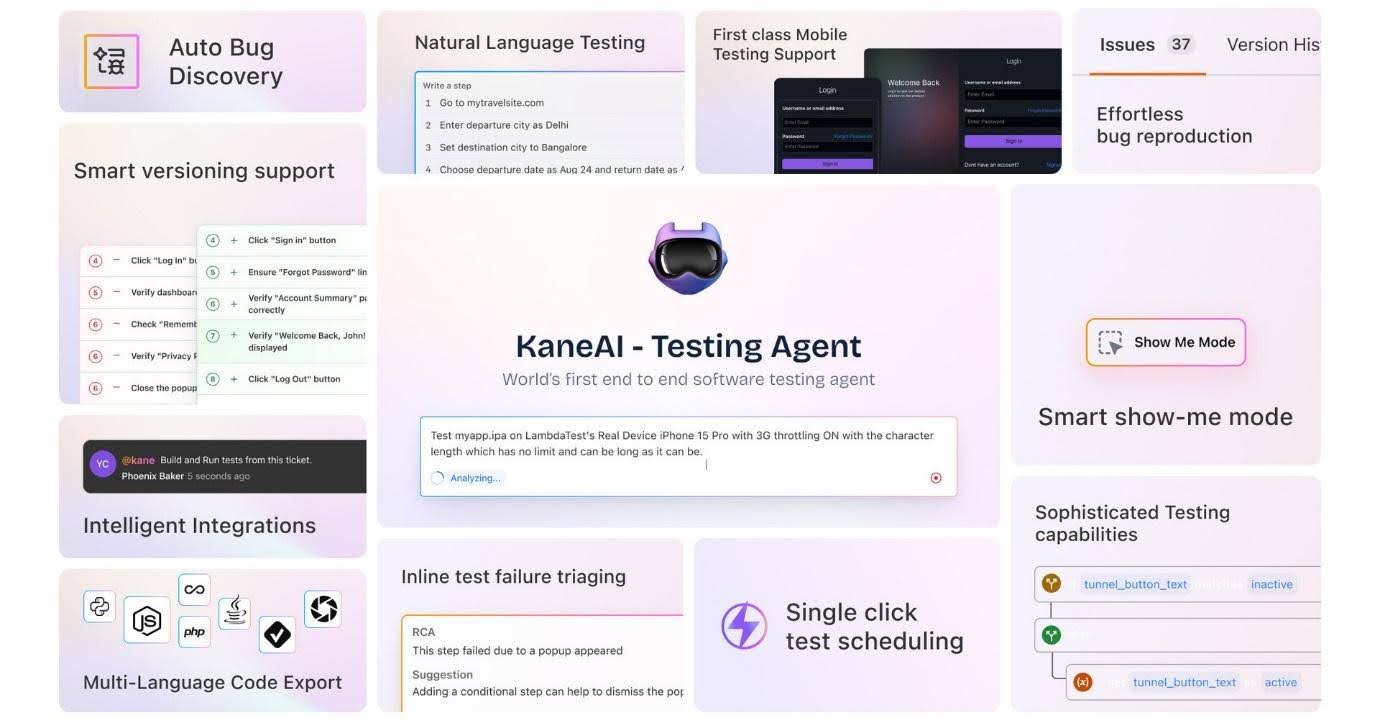
Even non-technical team members with no programming knowledge can build sophisticated test cases.
KaneAI integrates directly with TestMu AI’s Browser Cloud and Real Device Cloud. Therefore, the same test can run on desktop and mobile browsers and on real Android and iOS devices. This removes the need to recreate tests for different environments. Moreover, common test modules are reusable, so you don’t have to recreate login, navigation, checkout, and other routine processes.
Another area where KaneAI stands out is contextual intelligence. I.e., it automatically understands a wide range of project assets and documentation. This includes source code, GitHub pull requests, product requirement documents (PRDs), Jira tickets, PDFs, images, audio, and even video.
It also does its own maintenance. When a UI element changes or a locator shifts during execution, the agent automatically detects the discrepancy. It then dynamically updates the affected step on the fly, allowing the test to run without crashing.
While no automation tool can eliminate maintenance entirely, this approach should reduce the amount of manual work required as applications evolve.
Another advantage is that tests aren’t locked into a proprietary format. You always own your tests and can export them outside of KaneAI to Playwright, Selenium, Cypress, or Appium. However, working outside the platform obviously negates all the benefits of AI.
Overall, KaneAI feels like more than just an AI-powered script generator. It combines natural language test creation, AI-assisted debugging, automated maintenance, and cloud execution into a workflow that genuinely simplifies modern software testing.
KaneAI also has a lighter-weight counterpart worth knowing about: Kane CLI. It’s a free, terminal-driven tool that runs the same natural-language test authoring on your own machine, no cloud session required. Rather than replacing the cloud product, it’s built for moments when cloud testing is overkill: a fast local check before pushing a commit or a step wired directly into a CI job. It ships with every KaneAI plan, including the Starter tier, so there’s no extra cost to use it.
Pricing runs per agent, billed annually, across three tiers:
- Starter at $19/agent/month (2,000 credits, local Kane CLI authoring only).
- Pro at $99/agent/month (12,000 credits, adds Cloud KaneAI Web authoring).
- Max at $199/agent/month (25,000 credits, adds Cloud KaneAI Mobile alongside Web).
- Enterprise offers unlimited credits and custom terms.
Agent Testing – Test AI with AI
If you’re developing or incorporating your own AI agents, such as customer-facing chatbots, voice assistants, etc., you’ll probably have already faced the limitations of traditional QA tools. That is the inability to validate dynamic responses using fixed rules.
While one solution is to hire many human testers to focus on different scenarios, TestMu AI’s Agent Testing is designed specifically to evaluate the quality, accuracy, and reliability of AI agents at a scale thousands of times more efficient than humans.
For example, it can auto-generate 60–100+ test scenarios from a single uploaded PRD or document. Coverage that takes a human tester weeks.
It offers 15+ specialized AI testers that run thousands of scenarios simultaneously, covering hallucination, bias, context blindness, tone failure, adversarial brittleness, and incomplete answers.
These can be applied to chatbots, voice agents, phone call agents, and image analyzer agents.
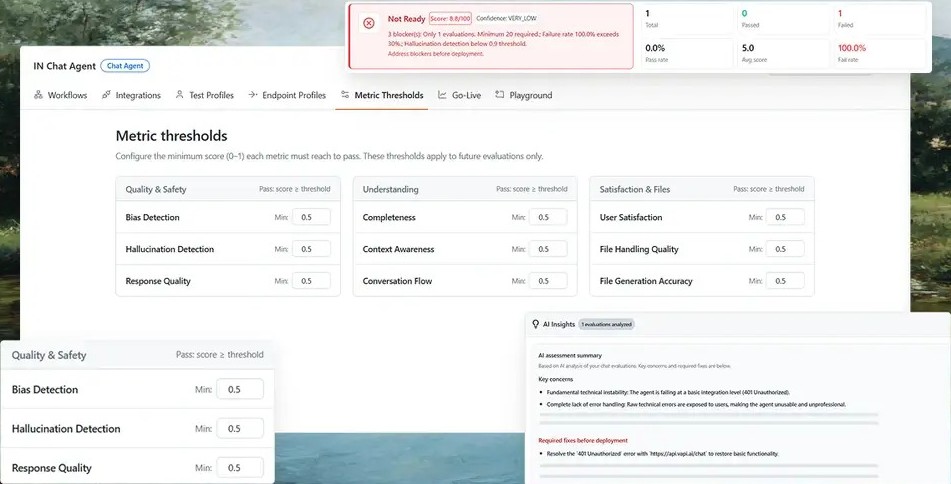
One of its biggest strengths is the breadth of evaluation metrics. Rather than producing a simple pass-or-fail result, TestMu AI provides 9 metrics for chat and voice agents, 30+ metrics for phone calls, and a 0–100 quality score for image agents. These are all reproducible and allow for actionable insights.
What’s more, Agent Testing can be integrated at any stage of the lifecycle, from prelaunch validation to regression testing after model updates and ongoing monitoring.
Agent Testing is sold as a contact-sales product rather than published self-serve tiers – pricing is scoped to your scenario volume across chat, voice, phone-call, and image-agent coverage after a conversation with sales. There’s no public PAYG credit rate or fixed monthly starter price posted.
Real Device Cloud
By its nature, testing on the actual devices your target audience uses is the most accurate approach. This is where TestMu AI’s Real Device Cloud shines. It gives you instant access to more than 10,000 real Android and iOS devices, as well as real Windows and macOS environments, directly through your browser.
Unlike emulators, every session runs on physical hardware, allowing you to test your application under the same conditions as real users.
This makes it much easier to identify issues that simply don’t appear on emulators, such as hardware-specific rendering bugs, sensor behavior, operating system quirks, or performance under real-world system load.
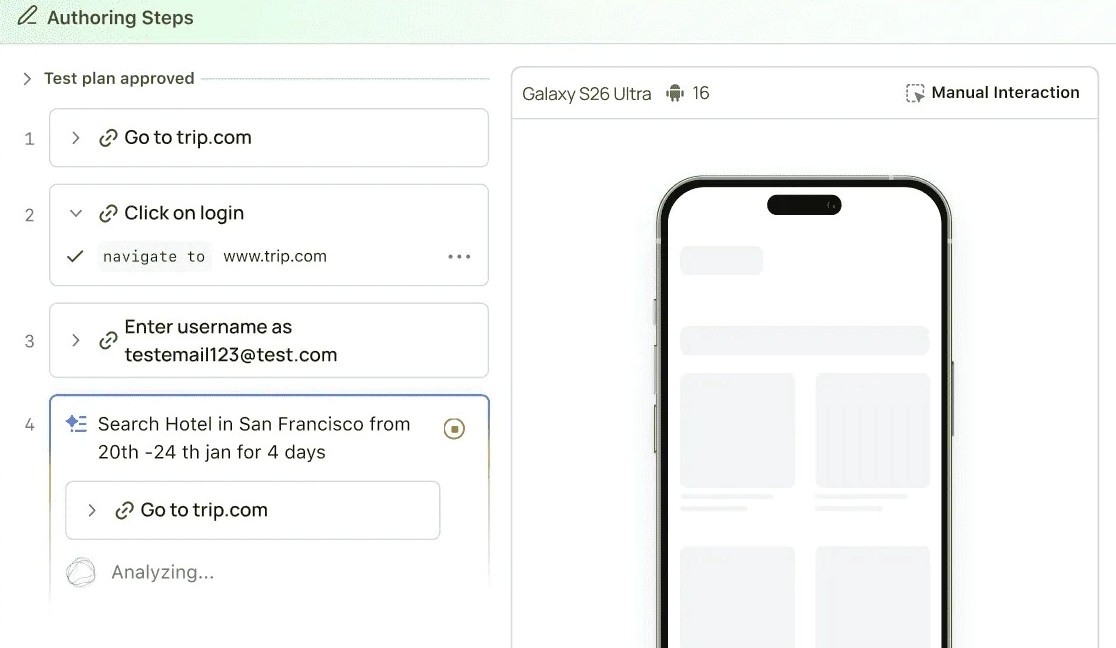
The breadth of supported hardware is equally impressive. Alongside the latest iPhone, Samsung Galaxy, and Google Pixel devices, the platform also includes older models that remain widely used. Maintaining this level of device coverage in-house would be both expensive and time-consuming, yet TestMu AI makes it available on demand without requiring any hardware maintenance.
Moreover, it supports both live manual testing and fully automated testing. In a live session, you can launch an application on a real device and interact with it exactly as an end user would. Automated workflows are well supported by popular frameworks, including Appium, XCUITest, Espresso, and Detox, enabling existing mobile test suites to run with minimal modification.
Real Device Cloud also includes several advanced testing features that would be difficult to recreate locally. Network simulation allows applications to be tested under 2G, 3G, 4G, 5G, custom bandwidth, or completely offline conditions.
This helps identify issues that only appear on slower or unstable connections.
Furthermore, geolocation testing supports more than 170 countries, making it easy to validate location-based functionality without traveling or relying on physical devices in different regions.
For mobile apps, I also appreciated the support for hardware-specific features. Secure authentication can be validated using Face ID, Touch ID, and fingerprint sensors. Meanwhile, camera functionality, QR code scanning, accelerometers, and gyroscopes can all be tested on real hardware.
The ability to install and switch between multiple application builds within the same session also streamlines regression testing during active development.
TestMu AI also provides access to real Windows 10, Windows 11, macOS Ventura, and macOS Sequoia environments. This lets you validate web applications on the desktop operating systems your users actually run, without having to maintain dedicated testing machines.
- You can try Real Device Cloud for free with 5 sessions per month, up to 2 minutes each, no card required.
- Full live-manual access on real devices (Real Device Plus Live) starts at $39/month, and automated testing on real devices (Real Device Plus Automation Cloud) starts at $199/month, both billed annually.
- ($15/mo is TestMu AI’s Virtual Live plan – emulators and simulators, not real hardware – so it’s not actually the Real Device Cloud entry point.)
Browser Cloud
The Browser Cloud delivers production-grade browser infrastructure without the complexity of managing it yourself. Whether you’re testing applications, scraping JavaScript-heavy websites, or deploying autonomous AI agents, it provides the performance and scalability needed for any workload.
As the company describes it, it’s “A scalable browser built for AI agents to scrape, test, and automate without any infrastructure headaches.”
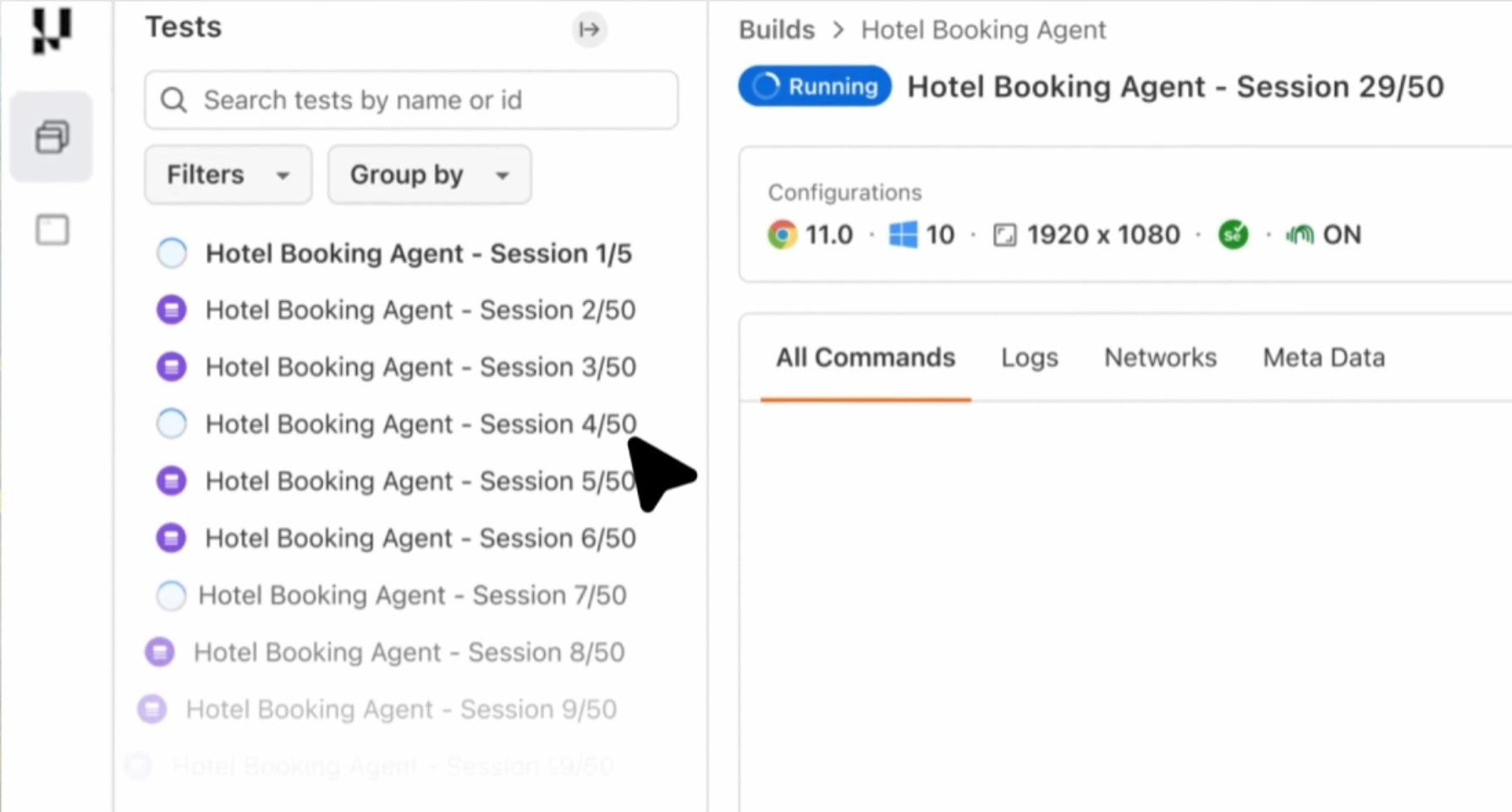
It supports Claude, OpenAI, Gemini, Cursor, and custom AI agents. Instead of managing local browsers or cloud infrastructure, developers can launch hundreds of browser sessions on demand.
Browser sessions start in seconds. They can run for up to 24 hours. Multiple sessions run simultaneously without requiring any provisioning or maintenance. This makes the platform ideal for large automation projects and AI-powered workflows.
Another advantage is its use of full Chrome execution. Every page renders completely before the AI interacts with it. JavaScript executes normally, even on complex single-page applications. Agents receive the fully rendered DOM instead of incomplete HTTP responses. This results in far more reliable automation and web scraping.
Browser Cloud also includes several built-in features for working on the live web. Fingerprint masking, CAPTCHA solving, and ad blocking help AI agents avoid unnecessary interruptions. Geo-targeted proxies cover more than 180 locations, allowing websites to be accessed as though requests originate locally.
Session persistence is equally useful. Cookies, local storage, and login information remain available across sessions. AI agents don’t need to authenticate repeatedly when completing long workflows or returning to previously visited websites.
Every session records video, browser console output, network activity, and step-by-step command history. Instead of investigating a failed headless process, you can replay exactly what happened and identify the problem much faster.
Browser Cloud also solves another common development challenge. Its integrated Tunnel allows AI agents to access localhost, staging environments, and services protected behind VPNs or firewalls. No third-party tunneling software is required, making internal application testing much easier.
Compatibility is another strength. Browser Cloud works with Playwright, Puppeteer, Selenium, and other SDK-compatible frameworks. Existing automation projects can therefore migrate without being rewritten from scratch.
Browser Cloud is available for free with 100 minutes of 2-parallel web automation. For full access, pricing starts at $29/month billed annually, with an Enterprise tier above that.
TestMu AI – Verdict
In conclusion, TestMu AI delivers much more than traditional testing or even modern automation tools. Its use of AI streamlines the entire QA lifecycle.
KaneAI dramatically reduces scripting by generating tests from natural language. Agent Testing tackles the growing challenge of validating AI applications. Then the Real Device Cloud provides genuine hardware testing at enterprise scale. That’s without mentioning that the Browser Cloud provides AI agents with production-ready browser infrastructure, with no management overhead.
All of these products work seamlessly together and integrate into existing development workflows.
Ultimately, the platform removes countless repetitive tasks and reduces the need for large teams and expensive infrastructure. While we can’t recommend getting rid of all your skilled QA engineers, it frees up the team’s time to focus on improving the software itself.
TestMu AI is one of the most comprehensive AI-native testing platforms available. It’s particularly well suited to modern development teams embracing AI-driven software engineering.


Read our disclosure page to find out how can you help Windows Report sustain the editorial team. Read more



Improve this guide


User forum
0 messages