
New Gemini Agent Unveiled at Gemini at Work 2026, Expect It to Take Over Your Workload
The agent can run your work, create AI agents, and keep working while you’re away


 3 min. read
  Published on
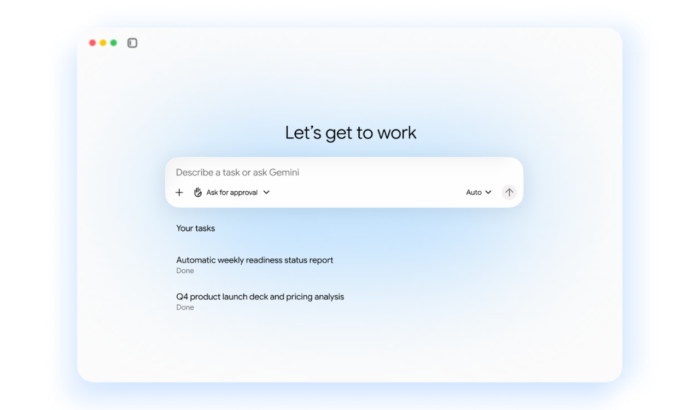
At the Gemini at Work 2026 keynote, Google took Gemini to a completely different level with its new Gemini agent. The company wants this AI to do the work, not simply talk about it. If you use Gemini for work, you must be aware of how quickly Google has been expanding its AI capabilities. Speaking of which, the new Gemini agent is designed to act more like an actual coworker.
Gemini can take an objective and handle the entire workflow
For the uninitiated, you give Gemini an objective instead of a long list of instructions. It can plan the work, choose skills and tools, connect with your systems, and return a finished result. Notably, Gemini can work across the web, Android, iOS, Windows, and Mac.
It also connects with Google Workspace, Microsoft 365, Slack, command-line environments, and third-party applications. The agent also keeps working in the cloud after you close your laptop. Google says longer tasks can continue for hours or days without needing another briefing.
Gemini can create sub-agents and remember how you work
One of the interesting details shared by Google is multi-agent orchestration. Gemini can create temporary sub-agents with their own identities for different parts of complicated jobs. These agents can work simultaneously or sequentially. Gemini can also create persistent coworker agents with dedicated identities, storage, and roles.
Google is also giving Gemini four types of memory. These include session, semantic, procedural, and episodic memory. The idea is to let Gemini learn your workflows over time. Another big change involves model selection. Gemini can reportedly choose between Google’s models and Claude models from Anthropic. Google says this can improve results while keeping costs lower.
Google is pushing Gemini deeper into Workspace and enterprise data
Gemini now works directly inside Gmail, Drive, Docs, Slides, Sheets, Chat, and Calendar. It can handle tasks across these apps without forcing users to repeatedly explain the same project. Google is also adding dedicated data skills. Gemini can generate PySpark code, train models, troubleshoot pipelines, and create operational reports from plain-language requests.
For businesses, Gemini can connect with tools including Microsoft Office, Teams, Slack, Git, Jira, Salesforce, ServiceNow, BigQuery, Databricks, Postgres, and Snowflake. The company is also introducing industry-specific Gemini capabilities. Financial Services and Legal are getting specialized tools first, while Government, Healthcare, and Retail are coming later.
Security and cost controls are getting serious attention
Google knows autonomous agents can’t simply be allowed to roam around company systems. Gemini agents will therefore get individual identities, permissions, audit trails, and policy controls. Agent Sandbox provides an isolated environment, while Agent Gateway acts as an AI network firewall.
Google is also adding Smart Routing and real-time spending limits. Companies can set project-level AI spending caps, with Gemini pausing work when those limits are reached. The scale is already massive. Google says nearly 80% of Google Cloud customers use its AI products. Nearly 90% of Fortune 100 companies use Gemini Enterprise.
The company is also highlighting major deployments worldwide. SOMPO has built more than 10,000 custom agents, while Tata Steel deployed more than 300 specialized agents. Google is clearly betting that the next phase of Gemini will not be about better answers. It will be about handing AI an objective and letting it actually get the job done.

Read our disclosure page to find out how can you help Windows Report sustain the editorial team. Read more



Improve this guide




User forum
0 messages