
Microsoft Maia 300 AI Chip Promises 40% Better Efficiency as Azure Plans Multi-Gigawatt Expansion


 3 min. read
  Published on
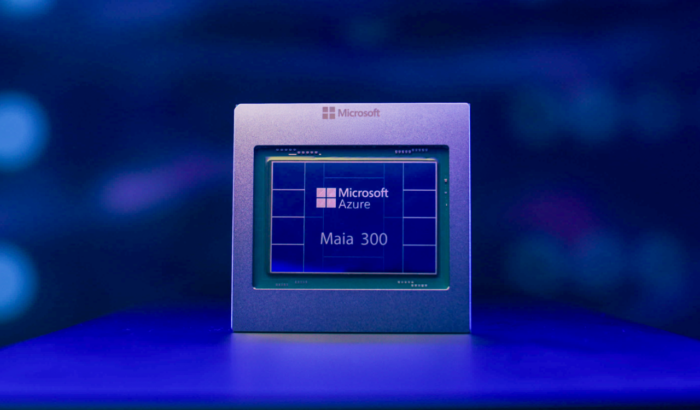
At the start of this year, Microsoft entered the race of custom AI chip with the launch of its Maia 200. Now, Microsoft is looking to scale its custom Azure Maia AI chips to multi-gigawatt deployments starting in 2027. The company says its upcoming Maia 300 AI chip could deliver 40% more AI tokens per megawatt than leading GPU-based systems, as it looks to reduce the cost of running AI services at scale.
Today’s announcement also confirms that Maia 200 is already running production workloads. Microsoft is now using its custom silicon to support products such as Copilot while preparing its next-generation hardware for more demanding AI tasks.
Microsoft Maia 300 Targets AI Inference at Scale
As Microsoft notes, Maia 300 is designed for long-context reasoning, responsive conversations, and multi-step AI agents. These workloads are becoming increasingly important as businesses move beyond chatbots toward AI systems that can complete tasks with less human intervention.
The accelerator uses eight HBM4 memory stacks, delivering 18TB/s of peak memory bandwidth within a 950-watt power envelope. Its chiplet design separates compute, memory-controller, and input/output functions, while compute chiplets use TSMC’s N2P manufacturing process.
Microsoft is also focusing on reducing unnecessary data movement between processors and memory. Its software-defined dataflow architecture and AI-assisted kernel optimization aim to improve hardware utilization, helping the company serve more requests without proportionally increasing power consumption.
Maia 200 is already supporting Microsoft’s AI services
While Maia 300 remains scheduled for production deployment in 2027, Maia 200 is already serving Microsoft workloads across the United States, Europe, and Australia. Microsoft claims the existing accelerator delivers up to 1.7 times more tokens per watt for built-in AI capabilities in Teams, Copilot, and Cowork experiences compared with leading GPU infrastructure.
The company plans to expand Maia 200’s role further. GitHub Copilot and Microsoft Foundry are expected to follow by the end of 2026, alongside additional workloads involving Microsoft’s MAI models and other leading AI model families. A full Maia 300 rack will contain 96 accelerators within a 167-kilowatt power envelope. Microsoft says this configuration provides 27.6TB of HBM capacity and 1.7 petabytes per second of aggregate HBM bandwidth.
NVIDIA faces more competition from custom AI chips
Microsoft’s announcement means another tech giant has joined the trend of custom AI chip among major cloud providers. Developing its own silicon gives the company greater control over hardware design, software integration, and the economics of operating AI services. That said, Microsoft has not hinted that custom Maia chips will replace third-party GPUs entirely. Its claims will also need to be assessed against real-world workloads, since performance and efficiency can vary between models and applications. Microsoft plans to share further details at Ignite 2026 in San Francisco next month. For more information, head to this official deep dive on Maia 300.

Read our disclosure page to find out how can you help Windows Report sustain the editorial team. Read more



Improve this guide

User forum
0 messages