
Microsoft Rejects Claims That Python Errors Undermine Quantum Research


 3 min. read
  Published on
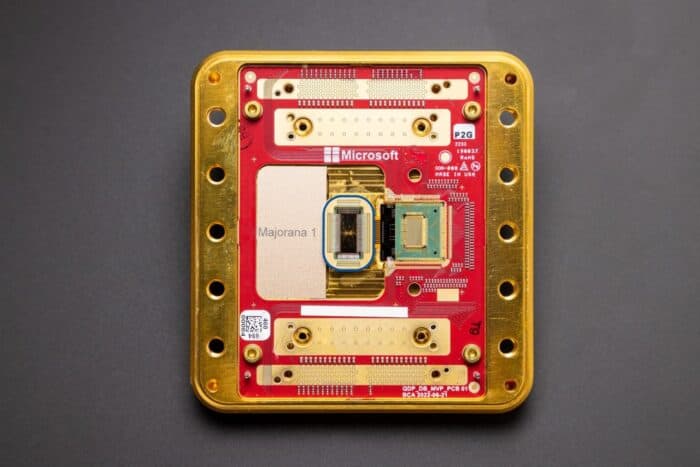
Microsoft’s ambitious plan to build a commercial quantum supercomputer by 2029 is facing renewed scientific scrutiny after a new peer-reviewed critique challenged the company’s earlier Majorana-based quantum computing claims. Microsoft recently introduced its Majorana 2 quantum chip, describing it as a major step toward scalable quantum computing.
The debate centers on Microsoft’s 2025 research, which laid the foundation for its Majorana quantum program. A critique published in Nature argues that the company’s data analysis may have contained fundamental software errors that affected how experimental results were interpreted.
The company continues to pursue an approach based on topological qubits, which rely on elusive Majorana zero modes that, in theory, could prove significantly more resistant to errors than conventional superconducting qubits.
Critique claims Python errors influenced the analysis
According to the report, Microsoft’s custom Python data-processing pipeline contained programming mistakes that may have affected how electrical conductance data was analyzed.
The paper argues that the software mishandled certain data arrays and selectively highlighted measurements supporting Microsoft’s claimed topological gap while excluding contradictory or noisy results. These issues could have produced a false positive rather than evidence of a genuine quantum breakthrough.
Among the alleged problems, the critique points to:
- Python code that reportedly processed array indexes instead of physical measurement values.
- Plotting scripts that displayed only selected regions of the experimental data.
- Omitted data that allegedly showed behavior inconsistent with a topological quantum state.
- Software logic that critics say reduced the visibility of contradictory measurements.
These issues could undermine Microsoft’s conclusions and leave insufficient evidence for the existence of the topological gap required for its Majorana-based qubits.
Microsoft rejects the conclusions
Microsoft strongly disputes the criticism and says the alleged coding issues do not invalidate its experimental results.
The company published a formal rebuttal alongside the critique in Nature, maintaining that the software served as a practical tuning tool rather than the basis for its scientific conclusions. Microsoft also argues that the critique does not provide an alternative explanation capable of accounting for all of the observed data.
Dr. Chetan Nayak, who leads Microsoft’s quantum hardware efforts, said the company continues to stand behind both its published research and its roadmap toward scalable quantum computing.
According to Nayak, Microsoft is already operating quantum hardware based on these qubits and remains confident in its long-term strategy despite the criticism.
DARPA milestone supports Microsoft’s roadmap
Microsoft also points to its recent progress under the U.S. Defense Advanced Research Projects Agency’s Quantum Benchmarking Initiative.
The company says DARPA advanced Microsoft into the program’s final phase after evaluating both public and proprietary evidence related to its technology. Microsoft argues that this independent assessment reinforces confidence in its overall approach, even as debate within the scientific community continues.
For now, the disagreement highlights the challenges of validating one of the most ambitious approaches in quantum computing. While critics question whether Microsoft’s experiments truly demonstrate the required physics, Microsoft insists its technology continues to advance toward its goal of delivering a scalable quantum computer by 2029.
In other Microsoft news, the company is also reportedly working on a new datacenter project in Texas.
Via Neowin

Read our disclosure page to find out how can you help Windows Report sustain the editorial team. Read more



Improve this guide


User forum
0 messages