
MSI Afterburner Adds Power Guard Support for RTX 50 and RX 9000 GPUs


 2 min. read
  Published on
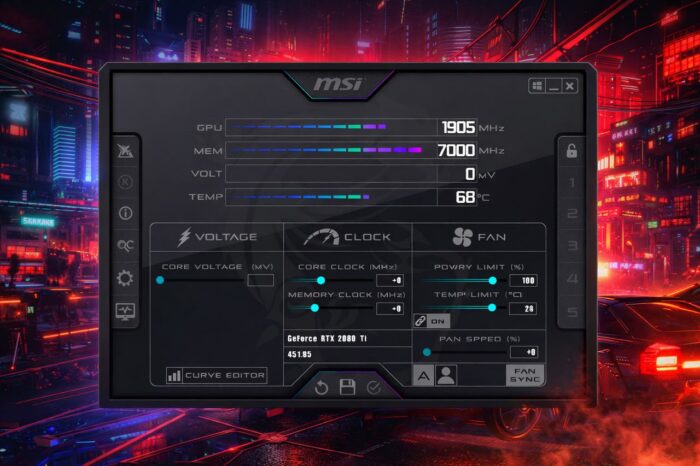
ASUS recently introduced its Level Sense feature aimed at protecting graphics cards, and now other vendors are moving in the same direction with their own hardware-level safety measures.
As VideoCardz reports, MSI has announced a new lineup of power supplies at CES 2026 that focus heavily on GPU protection. While the units are not yet available, MSI confirmed they will introduce two new safety technologies called GPU Safeguard and GPU Safeguard+.
MSI Afterburner will work with the new GPU Safeguard protection
The GPU Safeguard features continuously monitor the 12V-2×6 power connector for abnormal behavior. If the system detects an issue, the power supply can trigger an audible buzzer warning and, if the condition persists, force a system shutdown to prevent hardware damage.
MSI designed these power supplies around modern 16-pin 12V-2×6 connectors, ensuring compatibility with next-generation graphics cards such as NVIDIA GeForce RTX 50 and AMD Radeon RX 9000.
On the software side, MSI is aligning these protections with its popular tuning tool. MSI Afterburner, maintained by developer Unwinder, has received updates to fully support GeForce RTX 50-series GPUs, particularly MSI models.
These updates improve monitoring and control paths for newer power designs and sensors, while also preparing Afterburner for tighter integration with hardware-level GPU safety mechanisms.
Power Guard avoids shutdowns by lowering GPU power limits
While effective, a forced shutdown can still result in potential data loss if the user is not present. To address this, an upcoming Afterburner update introduces a new software layer called Power Guard, exposed through GPU Safeguard+.
Instead of cutting power entirely, Power Guard applies a predefined emergency profile that reduces GPU power limits to stabilize the system. On NVIDIA GPUs, the default emergency limit is set to 75 percent power, easing electrical and thermal stress while keeping the system running.
MSI notes that this default limit may still prove too high in certain scenarios, and additional configuration options may be introduced in future updates.
Meanwhile, elsewhere in the hardware space, more users continue to report No-POST issues on Ryzen 9000 processors paired with ASRock motherboards. ASRock has officially acknowledged the problem and says it is actively working toward a solution.

Read our disclosure page to find out how can you help Windows Report sustain the editorial team. Read more



Improve this guide


User forum
0 messages