
AMD Radeon RX 9060 XT Smashes GPU Frequency Record, Hits 4.769 GHz


 2 min. read
  Published on
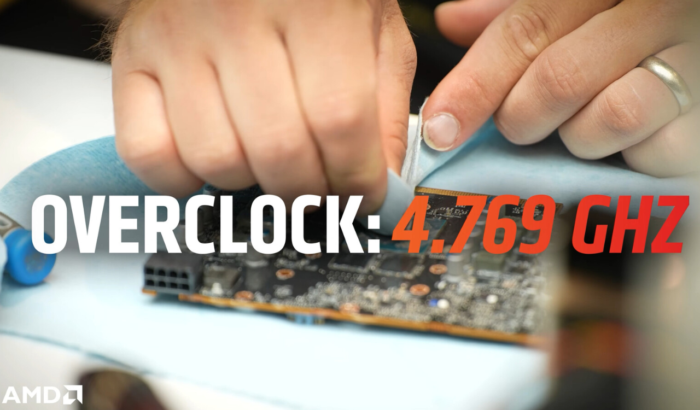
If you’ve ever wondered how far you can push AMD’s Radeon RX 9060 XT GPU, the company’s latest extreme overclocking test has given us the answers. In a test conducted internally, the said GPU reached a peak clock speed of 4.769 GHz, setting a world record.
Radeon RX 9060 XT pushes towards record overclock under extreme cooling
The overclocking session was conducted internally at AMD alongside veteran overclockers Bill “Sampson” Alverson and Splave. The video doesn’t focus on the technical aspects, but rather on the moment the frequency counter spikes to 4.769 GHz.
For those unaware, the AMD Radeon RX 9060 XT usually operates a little above 2.5 GHz under normal workloads. However, AMD’s listing suggests that the GPU can be boosted to a clock speed of around 3.13 GHz. In other words, the record 4.8 GHz clock speed sits roughly 90% above the normal 2.5 GHz operating range. Additionally, it is more than 50% beyond the official boost specification.
As with most extreme overclocking tests, you have to keep multiple things in mind. Just to be clear, the video does not detail the test platform, BIOS configuration, driver stack, or specific voltage tuning. There’s also no continuous telemetry readout showing board power draw or long-term stability behavior.
A brief snapshot suggests the GPU was running at around 4.0 GHz at approximately -20°C. This suggests that the test was done with the help of sub-ambient cooling methods. Usually, these record-attempt overclockers take the help of liquid nitrogen to unlock this kind of headroom.
Previous milestones for discrete GPUs have generally been reported to be around the 4.0 GHz mark, with integrated graphics like Intel’s Arrow Lake reportedly touching roughly 4.25 GHz. If AMD’s 4.769 GHz overclocking result is validated under comparable criteria, it would mark a giant leap in reported GPU frequency.
That said, without benchmark scores or sustained workload metrics, it remains unclear whether the peak was momentary or practically impactful. Speaking of the Radeon RX 9000 series, let’s not forget that these GPUs are seeing a downward trend in their pricing due to weakened demand.
Article feature image source: AMD

Read our disclosure page to find out how can you help Windows Report sustain the editorial team. Read more



Improve this guide



User forum
0 messages