
Microsoft Teams to Use AI to Detect Phishing and Impersonation


 2 min. read
 Published on

Microsoft Teams is getting AI-powered phishing detection in November 2026 to help users identify scams, impersonation attempts, and social engineering attacks.
According to Microsoft 365 Message Center advisory MC1519866, the new protection will analyze conversation context to detect suspicious behavior, even when attackers don’t include malicious links or attachments.
Microsoft plans to begin rolling out the feature in early November, with worldwide general availability expected between early and mid-December 2026.
Microsoft Teams will use AI to detect phishing and impersonation attacks
The new security feature will use context-aware AI to identify deceptive behavior in Teams conversations.
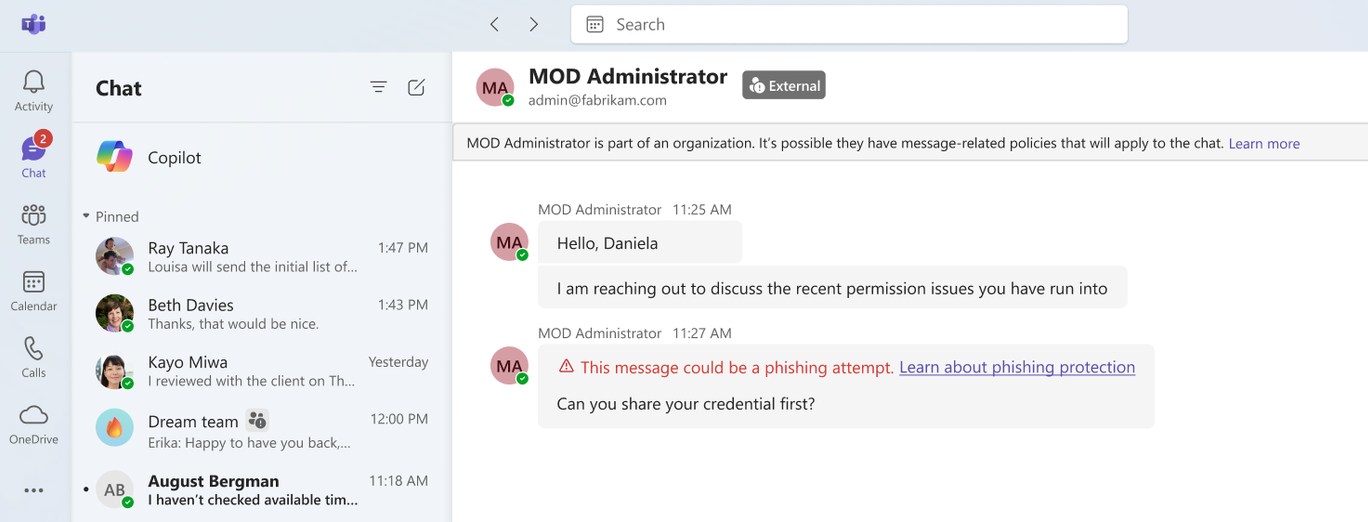
Unlike traditional phishing detection, which often focuses on malicious URLs and attachments, the new system will also examine conversation patterns to identify potential threats.
Microsoft says the protection will target several types of attacks:
- Phishing scams: Messages that attempt to trick users into sharing sensitive information.
- Social engineering: Conversations designed to manipulate users into taking unsafe actions.
- Impersonation attacks: Scammers pretending to be colleagues, executives, or other trusted individuals.
- Link-free phishing: Suspicious conversations that contain no malicious attachments or URLs.
Initially, the feature will focus on external first-contact chats, where users receive messages from people outside their organizations.
Microsoft previously announced impersonation protection for Teams, reflecting its broader effort to address security threats within workplace conversations.
The protection will activate automatically
Microsoft says IT administrators won’t need to change any settings or configure additional policies to enable the new phishing detection capabilities.
The company also states that it won’t retain customer message content for AI training or other secondary purposes.
The feature will roll out automatically, starting in November, before reaching general availability in December 2026.
In other Teams developments, Microsoft has announced a new efficiency mode that improves performance by 20% and plans to remove Copilot Studio from Teams in 2027.
Via BleepingComputer

Read our disclosure page to find out how can you help Windows Report sustain the editorial team. Read more


Improve this guide


User forum
0 messages