
Intel Reveals Clearwater Forest Xeon 6+ Chips With Up to 288 E-Cores


 4 min. read
  Published on
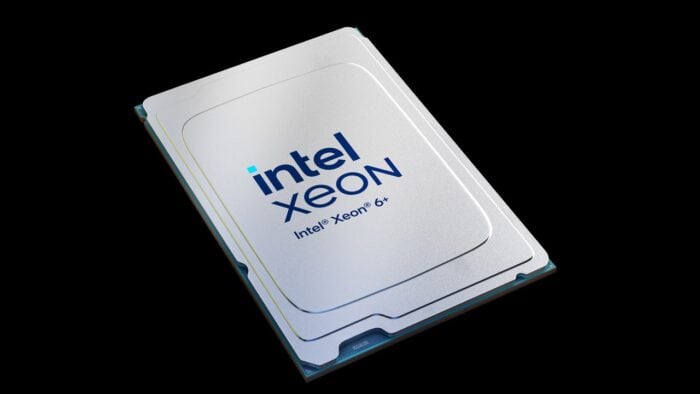
Intel used Computex 2026 to outline a major shift in its data center strategy as the company prepares for an AI-heavy future. Alongside the new OpenVINO Physical AI Platform, Intel introduced next-generation Xeon 6+ processors, new networking hardware, and energy telemetry tools designed for modern AI infrastructure.
The company says data centers are rapidly moving away from traditional CPU-only workloads toward mixed environments that combine CPUs, accelerators, and AI inference systems. Intel expects AI and traditional workloads to reach a near 50-50 split within the next five years.
Intel says AI inference will drive future data center growth
Intel believes AI inference workloads will become one of the largest growth areas in enterprise and cloud infrastructure. Because of that, the company says future data centers need stronger performance per watt, improved per-core performance, higher core density per rack, greater memory bandwidth, and better support for accelerator-connected training and inference.
Intel argues that traditional server designs are no longer enough for AI-focused deployments. The company wants to position Xeon 6+ as a platform optimized for dense and efficient AI-era workloads.
Clearwater Forest launches with up to 288 E-cores
One of the biggest announcements was Clearwater Forest, Intel’s upcoming Xeon 6+ server platform built on the Intel 18A process node.
The chips use new Darkmont E-cores and focus heavily on core density and power efficiency.
Intel says the top Clearwater Forest SKU features up to 288 E-cores. Each compute tile contains 24 E-cores, while the largest configuration combines 12 compute tiles in total.
The company also highlighted major improvements in cache and memory support.
Xeon 6+ specifications
| Feature | Xeon 6+ Clearwater Forest |
|---|---|
| Architecture | Darkmont E-cores |
| Process node | Intel 18A |
| Maximum cores | 288 |
| Memory support | 12-channel DDR5 |
| Maximum memory speed | 8000 MT/s |
| Last-level cache | Up to 576MB |
Intel says the platform includes up to 576MB of enhanced low-latency last-level cache. The processors also support 12-channel DDR5 memory running at speeds up to 8000 MT/s.
That level of server memory bandwidth suggests Intel has made major improvements to its integrated memory controller design.
Intel compares Xeon 6+ against AMD EPYC
Intel directly compared its flagship Xeon 6990E+ processor against AMD’s EPYC 9965.
According to Intel, the new Xeon chip delivers up to 30% higher average performance per thread. The company also claims up to 30% better performance per watt during workloads operating at roughly 40% CPU utilization.
Intel also compared the platform against its own previous-generation Xeon 6780E processor.
Intel claims Xeon 6+ delivers up to 55% better efficiency and as much as 126% higher overall performance on average compared to the earlier generation.
Application Energy Telemetry targets power efficiency
Intel also introduced a new feature called Application Energy Telemetry, or AET.
AET provides low-overhead CPU-level energy usage tracking directly from the processor silicon. Intel says this allows data center operators to measure energy usage across workloads such as applications and virtual machines without relying heavily on operating system or runtime-level tracking.
One major advantage is workload tracking across moving threads. Even when threads shift between cores, AET can continue monitoring energy usage accurately.
Intel says the feature should help cloud operators optimize workload scheduling and improve power efficiency inside large server environments.
AET support begins with Linux kernel 7.0 and newer.
Intel announces new 200Gbps Ethernet controller
Intel also announced the E835 Ethernet controller and adapter for server-grade networking environments.
The controller supports speeds up to 200Gbps, which equals roughly 25GB/s of throughput.
The announcement fits Intel’s broader AI infrastructure message, where networking bandwidth becomes increasingly important for accelerator-heavy deployments and distributed inference systems.
New Xeon 6300 chips target SMB servers
In addition to high-end AI-focused hardware, Intel also launched new Xeon 6300 processors for small and medium business entry servers.
The new chips support up to 12 cores, which represents a 50% increase over previous 8-core entry-level Xeon platforms.
Intel appears to be updating both the high-performance AI segment and the lower-cost SMB market at the same time.
Intel teases Diamond Rapids for 2027
Intel briefly teased its next-generation Diamond Rapids platform during the presentation.
The company did not share detailed specifications yet, but Diamond Rapids is expected to launch in 2027 as Intel’s next major server architecture after Clearwater Forest.
Intel pushes deeper into AI infrastructure
The overall message from Intel at Computex 2026 was clear. The company wants to stay competitive as the data center market shifts toward AI inference, accelerators, and power-efficient high-density infrastructure.
Clearwater Forest focuses heavily on E-core scaling, memory bandwidth, and efficiency rather than raw traditional CPU performance alone.
In other Intel news, the company recently claimed its upcoming Arc G3 handheld devices can outperform the ASUS ROG Xbox Ally X by up to 42% in gaming performance.

Read our disclosure page to find out how can you help Windows Report sustain the editorial team. Read more



Improve this guide




User forum
0 messages