
Microsoft Expands Azure AI Infrastructure With AMD Helios and EPYC Processors


 2 min. read
  Published on
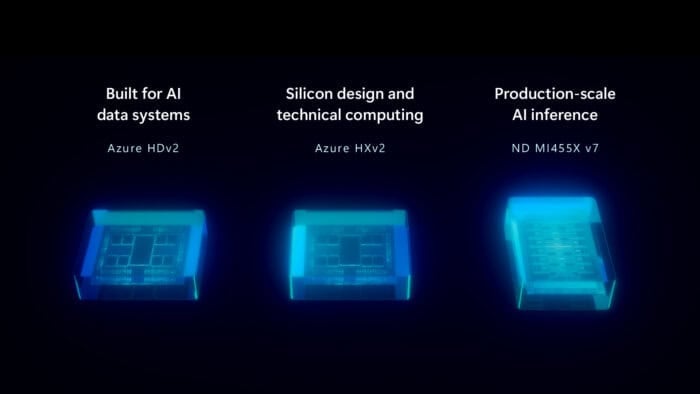
Microsoft is doubling down on its AI ambitions with another major Azure infrastructure expansion. This time, the company is teaming up with AMD to bring its latest AI platform and next-generation EPYC processors to Azure, introducing three new virtual machine families designed for everything from AI inference to semiconductor design and scientific computing.
The announcement comes as AI workloads continue to become larger and more demanding, pushing cloud providers to offer specialized infrastructure instead of relying on one-size-fits-all hardware. Microsoft’s latest Azure additions aim to tackle that challenge by giving businesses dedicated compute options depending on the type of AI workload they’re running.
Microsoft introduces three new Azure VM families powered by AMD
The expansion is built around AMD’s newest Helios AI platform alongside its 6th Gen EPYC processors, with Microsoft announcing three upcoming Azure virtual machine offerings.
Leading the lineup is Azure HDv2, a VM family built for AI data systems and agent-based workloads. Microsoft says these instances feature nearly 500 physical AMD EPYC CPU cores, 4TB of RAM, 32TB of local NVMe storage, and 400Gb Azure Boost networking, making them suitable for large-scale data preparation, reinforcement learning, AI search, and agent orchestration.
The second addition is Azure HXv2, which targets customers developing the next generation of AI chips. Designed for electronic design automation (EDA), RTL simulation, engineering analysis, and scientific computing, HXv2 packs 176 sixth-generation EPYC CPU cores, clock speeds exceeding 5GHz, significantly larger cache per core, up to 4TB of memory, and 800Gb InfiniBand networking for large distributed HPC workloads.
New AI infrastructure also targets large-scale inference
Microsoft also unveiled ND MI455X v7, a new Azure offering powered by AMD’s Helios rack-scale AI platform. Unlike the CPU-focused HDv2 and HXv2 families, this platform is optimized for production AI inference, including reasoning models, enterprise search, and agentic AI applications. Microsoft says the goal is to deliver higher performance while giving customers more flexibility when selecting infrastructure for different AI workloads.
The company further emphasized that customer choice remains central to Azure’s AI strategy. Rather than relying on a single hardware architecture, Azure continues to combine AMD technologies with Microsoft’s own custom silicon and systems to improve performance, efficiency, and operating costs across a wide range of cloud AI deployments.

Read our disclosure page to find out how can you help Windows Report sustain the editorial team. Read more



Improve this guide

User forum
0 messages