
NVIDIA Officially Enters the Windows PC CPU Market With RTX Spark


 4 min. read
  Published on
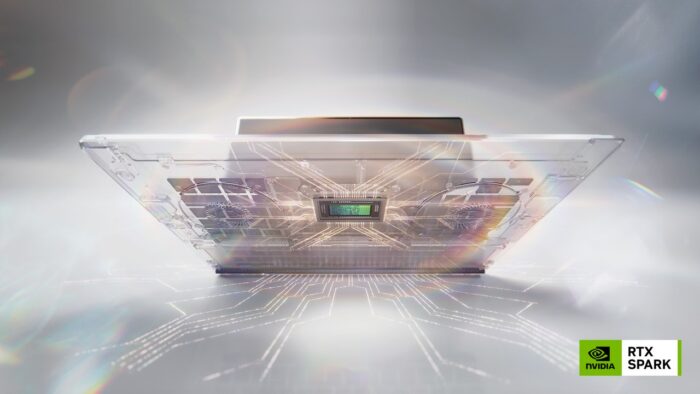
NVIDIA has officially announced RTX Spark, a new Windows PC platform built around a Grace Blackwell superchip.
The announcement confirms earlier rumors that NVIDIA was preparing a consumer PC processor, following leaks around the N1 and N1X chips. Instead of launching under those names, NVIDIA is branding the platform as RTX Spark.
NVIDIA RTX Spark targets AI, creators, and gaming
RTX Spark was announced with Microsoft at GTC Taipei and is designed for slim Windows laptops and compact desktop PCs.
NVIDIA says the platform targets AI agents, content creation, and gaming. The first systems are expected to arrive this fall from major PC makers.
A full NVIDIA PC chip
RTX Spark combines a Blackwell RTX GPU with a 20-core Grace CPU custom-built with MediaTek.
The CPU and GPU connect through NVLink-C2C, giving the chip up to 600GB/s of GPU-to-CPU bandwidth. NVIDIA says this is around five times the bandwidth of PCIe Gen5.
The top configuration supports up to 128GB of LPDDR5X unified memory.
RTX Spark brings Blackwell graphics to Arm PCs
The flagship RTX Spark configuration includes 6,144 CUDA cores, fifth-generation Tensor Cores, and FP4 AI acceleration.
NVIDIA lists up to 1 petaFLOP of FP4 AI performance. The company also says RTX Spark can run 120-billion-parameter language models locally and support up to 1 million tokens of context.
For creators, NVIDIA says the platform can handle 90GB 3D scenes, 12K 4:2:2 video editing, and 4K AI video generation.
Gaming is part of the pitch
RTX Spark also supports RTX ray tracing, DLSS, Reflex, and G-SYNC.
NVIDIA claims RTX Spark PCs can play AAA games at 1440p and over 100FPS with ray tracing, DLSS, and Reflex enabled. The company also said graphics performance can come close to a GeForce RTX 5070 Laptop GPU, depending on the application.
Windows on Arm remains the biggest question
RTX Spark uses Arm architecture, which means traditional x86 Windows apps may need Microsoft’s Prism emulator.
Native Arm apps should offer better performance and efficiency. NVIDIA says Adobe is reworking Photoshop and Premiere for RTX Spark, while apps such as Blender, DaVinci Resolve, Maxon Cinema4D, Redshift, Topaz Photo, CapCut, Cubase, Bitwig Studio, and Affinity by Canva are also part of the native software push.
NVIDIA and Microsoft are also working on a Windows platform for local AI agents. NVIDIA calls its runtime OpenShell, while Microsoft is adding security and containment features so agents can run under user control.
First RTX Spark laptops are coming from major OEMs
We already saw Surface Laptop Ultra with RTX Spark announced, but additional devices will come in 14-inch to 16-inch designs. Some models will be as thin as 14mm and weigh around three pounds.
Confirmed partners include ASUS, Dell, HP, Lenovo, Microsoft Surface, MSI, ASUS, and later Acer and GIGABYTE.
Confirmed systems include the ASUS ProArt P14 and P16, Dell XPS 16, HP OmniBook X14 and Ultra 16, Lenovo Yoga Pro 9N, Microsoft Surface Laptop Ultra, and MSI Prestige N16 Flip AI.
Interestingly, NVIDIA did not mention the leaked Lenovo Yoga Pro 7 with N1X branding.
Premium first, cheaper models later
The first RTX Spark systems will likely target premium price points. NVIDIA has not confirmed pricing yet.
The company says RTX Spark will grow into a wider family of chips covering more price ranges. Lower-end configurations may start with as little as 16GB of memory.
Several details remain unclear, including Linux driver plans, exact real-world performance, pricing, and whether NVIDIA has plans for gaming handhelds.
Still, RTX Spark marks a major shift for NVIDIA. The company is no longer just selling GPUs for Windows PCs. It is now building the full chip inside them.

Read our disclosure page to find out how can you help Windows Report sustain the editorial team. Read more



Improve this guide


User forum
0 messages