
PlayStation 6 May Not Fall Far Behind Xbox Project Helix in Performance


 3 min. read
  Published on
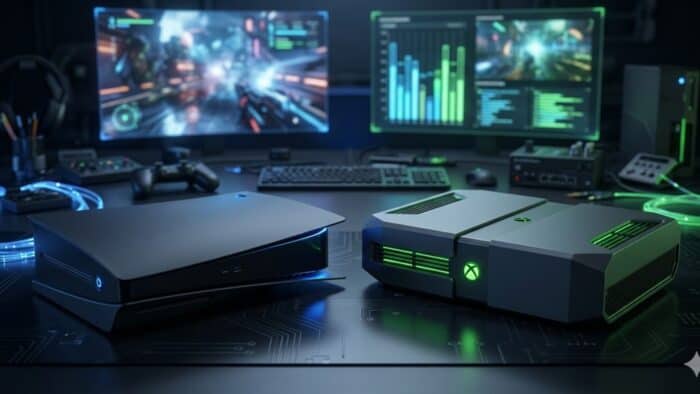
The next console generation is slowly coming into focus, and the ongoing debate over hardware power is already starting. Leaked specifications suggest Microsoft’s upcoming Xbox Project Helix will outperform Sony’s PlayStation 6 on paper. But when it comes to actual gameplay, tech analysts agree that the advantage probably will not change how you experience the games.
Microsoft takes the lead in raw numbers
According to hardware experts at Digital Foundry and known AMD leaker Kepler_L2, it is widely believed that the hardware gap between consoles is closing; the opposite appears true for the next generation. The technical difference between the Xbox Project Helix and the PlayStation 6 is shaping up to be larger than the gap between the PlayStation 5 and the Xbox Series X.
The Helix’s APU, reportedly code-named Magnus, features about 25 percent higher teraflops and texture rates. It also pushes 33 percent higher front-end bandwidth, geometry rates, and pixel rates, alongside significantly more memory bandwidth.
This represents a larger hardware gap than the current one between the PlayStation 5 and the Xbox Series X. On a spreadsheet, Microsoft clearly has the heavier hitter.
Why that power advantage might not translate to your screen
While those percentages sound impressive, they are unlikely to translate into massive differences in how games actually play. Analysts agree that the raw power advantage is not enough to create a scenario where a game runs at a smooth 60 frames per second on Xbox but is locked at an unplayable 30 frames per second on PlayStation. Both consoles will also be fully capable of handling demanding lighting features like path tracing.
What this really means is that the Xbox Project Helix will likely run games at slightly higher internal resolutions or use marginally better graphical settings. Future titles will rely heavily on advanced upscaling technologies like Sony’s PSSR and AMD’s FSR Diamond. Because of this, that small bump in native resolution will be almost invisible to the average player sitting on their couch.
A bigger chip means a bigger price tag at launch
Power comes at a cost. The Xbox Magnus chip is reportedly over 400 square millimeters and utilizes a dual-die design. This makes it a very large and expensive component for a home console. In contrast, the PlayStation 6 is expected to use a smaller, monolithic die similar in size to the PS5 Pro. That approach is naturally cheaper to manufacture.
Microsoft might find itself in a tough spot if the Helix costs significantly more to build. A higher retail price could limit the console’s mass-market appeal, especially when its performance edge over the cheaper PlayStation 6 is barely noticeable on a standard television.
Both systems are currently targeting a 2027 release, so manufacturing costs and pricing strategies will be major factors to watch as the launch window approaches.


Read our disclosure page to find out how can you help Windows Report sustain the editorial team. Read more



Improve this guide




User forum
0 messages