
Anthropic's New Claude Opus 4.7 Model Edges Past GPT-5.4 in Agentic Coding Benchmarks
The new model is generally available


 2 min. read
  Published on

Anthropic‘s latest AI model, Claude Opus 4.7, is now generally available, and it comes with improved advanced reasoning, coding, and multimodal performance across professional workloads. The update arrives as an incremental upgrade over Opus 4.6 that stands out in complex software engineering tasks. Early feedback suggests that Opus 4.7 can now handle long, multi-step coding workflows with less supervision.
Claude Opus 4.7 boosts coding, vision, and instruction accuracy
The model is more precise in following instructions, which means it may behave more literally compared to earlier versions, sometimes changing how prompts need to be structured. Additionally, Opus 4.7 now supports higher-resolution image inputs, allowing it to process more detailed visuals such as dense screenshots, diagrams, and interface layouts. This makes it more useful for tasks involving design interpretation, document analysis, and visual debugging.
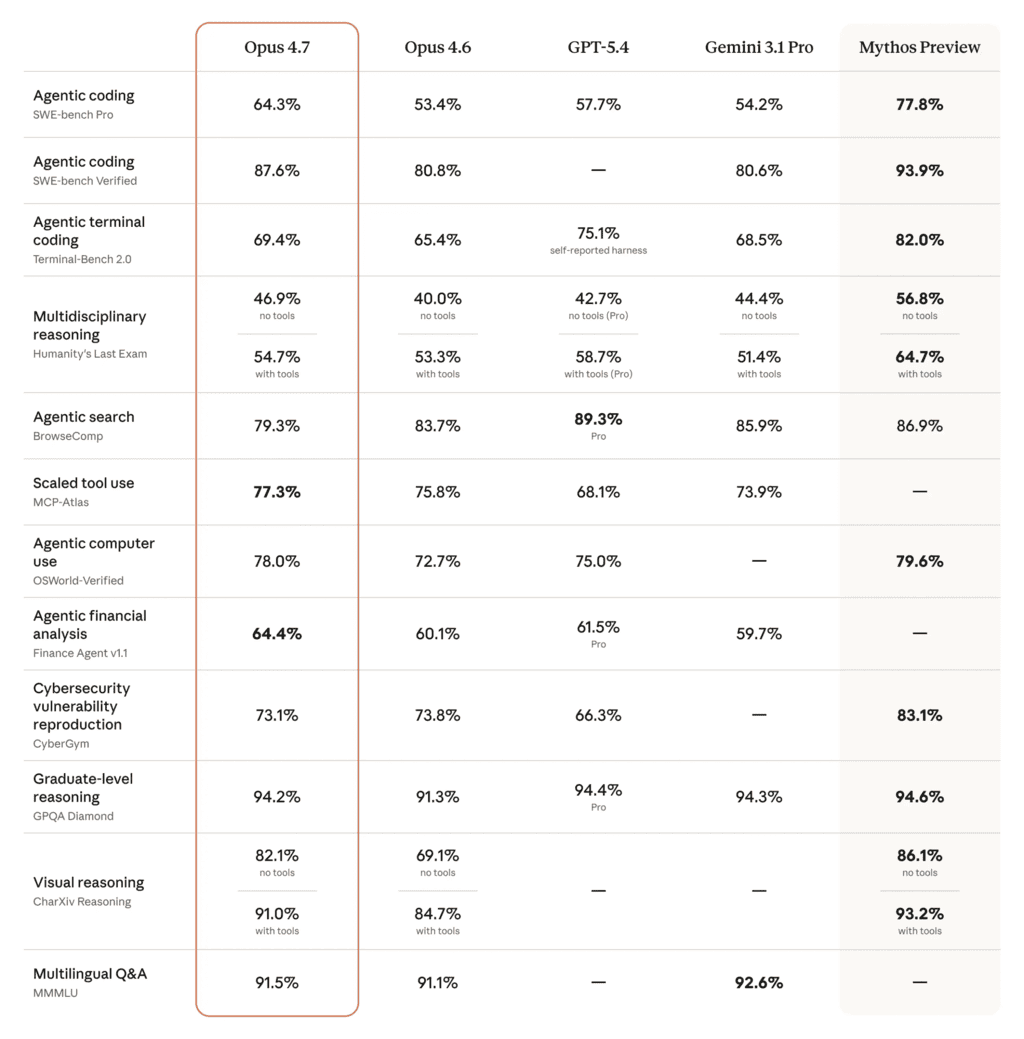
In real-world use cases, the model shows stronger performance in finance-related workflows, structured analysis, and professional document generation. It also improves multi-session memory handling through file-based context retention, helping it continues tasks with less repeated input from users. One thing to note here is that Claude Opus 4.7 beats OpenAI’s GPT-4 in agentic coding benchmarks. Here’s how the latest model stands against its rivals:
Safety, cyber controls, and broader rollout changes
Alongside improvements, Anthropic has also detailed safety and cybersecurity controls. Opus 4.7 includes updated safeguards that detect and block high-risk cyber-related requests, especially in areas linked to offensive security use cases. The company says this is part of its broader testing strategy ahead of more capable future models.
A new Cyber Verification Program has also been introduced for professionals working in legitimate security roles, such as vulnerability research and red-teaming, giving controlled access under defined conditions.
The model is now available across Claude products, API access, and major cloud platforms including Amazon Bedrock, Google Cloud Vertex AI, and Microsoft Foundry. Pricing remains unchanged from Opus 4.6, keeping it at $5 per million input tokens and $25 per million output tokens.
Moving on, Anthropic is also rolling out additional platform features alongside Opus 4.7, including a new “xhigh” effort level that sits between high and max performance modes. This gives developers more room when balancing speed and reasoning depth in complex tasks. Moreover, in Claude Code, a new “ultrareview” feature allows automated code review sessions that scan for bugs and structural issues.

Read our disclosure page to find out how can you help Windows Report sustain the editorial team. Read more



Improve this guide



User forum
0 messages