
How to Tell If a Text Was Written by AI: Practical Signals That Matter


 5 min. read
  Published on
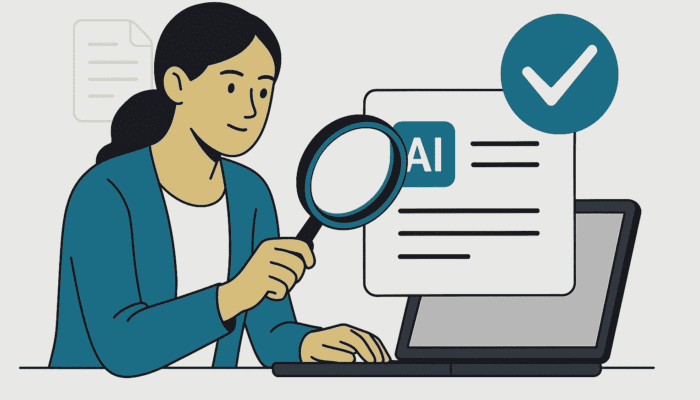
How can you tell if the paragraph in front of you was penned by a person burning the midnight oil or by a language model quietly spinning words in the cloud? The question is no longer academic. Educators, editors, and peer reviewers now face coursework, articles, and even grant proposals that may contain AI-generated passages slipped in without disclosure. Spotting them early protects assessment integrity and helps everyone credit the right author.
The good news is that machine text still leaves fingerprints – little patterns that appear when you read closely or run a few diagnostics. They are subtle rather than glaring, which is why intuition alone is not enough. Most successful reviewers mix careful human reading with a short checklist of practical signals. Do that often and you start noticing suspicious regularities almost by reflex, the same way seasoned copy editors sense a buried typo before they consciously see it.
One quick tactic is to run a snippet through an online detector when you need to detect ChatGPT text, but tools alone never close the case. They give you probabilities, not verdicts. A high confidence score should push you to look harder; a low score is not a free pass. Ultimately, you have to combine machine feedback with your own observations about structure, diction, and narrative flow.
The Pulse of Sentence Variety
Human writers bounce between spurts of energy and pauses for thought. That rhythm shows up on the page as a mix of short, punchy lines and longer, winding ones. AI, in contrast, tends to march to a steadier drumbeat. Because large language models generate each next word by maximizing probability, they often produce sentences of similar length and moderate complexity. If you paste an essay into a word-length analyzer and the histogram forms a tidy cluster instead of a jagged skyline, keep your eyebrows raised.
Burstiness vs. Flatline
Try reading a suspected text out loud. Do you find yourself inhaling at predictable intervals, almost like reciting metronomic poetry? That can be a sign of uniform sentence length. Equally telling is the lack of genuine stumbles – humans occasionally misuse a semicolon, double back to reframe an idea, or drop in a one-word exclamation for emphasis. Those irregularities create “burstiness,” a quality researchers still struggle to model faithfully. AI can fake the odd, abrupt phrase if asked, but the surprises rarely feel organic; they read like staged spontaneity.
Vocabulary Tells on Itself
Even well-prompted AI loves safe, middle-register vocabulary. It will happily produce “important,” “significant,” or “crucial” in back-to-back sentences where a human might risk “game-changing,” “earth-shaking,” or a sly metaphor. Look for semantic lawns mowed to a uniform height – few weeds, no wildflowers. That sameness is especially noticeable in adjectives and adverbs. Over several paragraphs, the prose begins to feel like an airport lounge: spotless, functional, but curiously scent-free.
Predictable Adjectives and Function Words
Psycholinguists track something called the type-token ratio, the number of unique words divided by total words. Strikingly low ratios can hint at AI authorship because the model keeps recycling high-probability terms. Another metric, burstiness of rare words, matters too. Humans often clump technical jargon in a single paragraph, then switch to plain English; AI disperses jargon evenly, smoothing peaks and valleys in a way no hurried graduate student ever would.
Logic Flow and Idea Handoffs
Machines excel at sentence-to-sentence coherence, but they still falter at big-picture architecture. Read an op-ed allegedly written by a student. Does every paragraph end with a miniature conclusion that hands off perfectly to the next like a relay baton? That flawless sequencing can actually be suspicious. Humans occasionally jump, digress, or foreshadow clumsily. These imperfections create texture.
Transitions That Feel Too Smooth
Check transitional phrases. A model often leans on “additionally,” “moreover,” and “consequently” in rigid cycles. A seasoned human may throw in a casual “on top of that” or a sudden rhetorical question. Over-polished flow becomes conspicuous when the topic is complex. Paradoxically, the harder the subject, the more likely a genuine writer is to show seams – hesitations, asides, even mild contradictions later reconciled. AI rarely grants itself that luxury.
Metadata and Revision Clues
Sometimes the giveaway hides outside the prose. Look at file metadata, version history, or learning-management timestamps. A forty-page report appearing in one upload, with no earlier drafts tracked, strains credulity. Humans revise, save, and resave. AI can generate near-final output in seconds; the digital footprint reflects that speed.
Time-Stamped Miracles and Instant Drafts
If a student’s cloud document logs only a single two-minute editing session for a 2,500-word essay, alarms should ring. Similarly, examine the comment history. Genuine authors often leave themselves bracketed notes like [check source] or [rewrite intro]; AI-generated drafts exported straight from a chat window arrive squeaky clean. Of course, savvy users may fake revision trails, but verifying consistency between claimed drafting time and observable metadata still catches many careless submissions.
Putting Signals Together Responsibly
None of these clues is ironclad. A disciplined writer can produce even sentence lengths, and a distracted one might rely too heavily on “moreover.” That is why probability scores from commercial detectors must sit alongside human judgment. Here, a single mention is due: Smodin, among the most widely used detectors in classrooms today, emphasizes that its probability meter is a starting point, not a finish line. Treat every flag as an invitation to ask follow-up questions, request earlier drafts, or hold a short oral check-in about the work.
False positives carry real costs: accusing a student or author without strong evidence strains trust. Equally, ignoring repeated red flags risks endorsing ghostwritten scholarship. The sweet spot is balanced skepticism. Cross-check burstiness metrics, vocabulary distribution, transition patterns, and metadata footprints. If three or more indicators converge, conduct a deeper inquiry rather than jumping straight to penalties.


Read our disclosure page to find out how can you help Windows Report sustain the editorial team. Read more



Improve this guide



User forum
0 messages