
Microsoft Unifies Copilot Teams Under New Leader as Mustafa Suleyman Focuses on “Superintelligence” Push


 3 min. read
  Published on
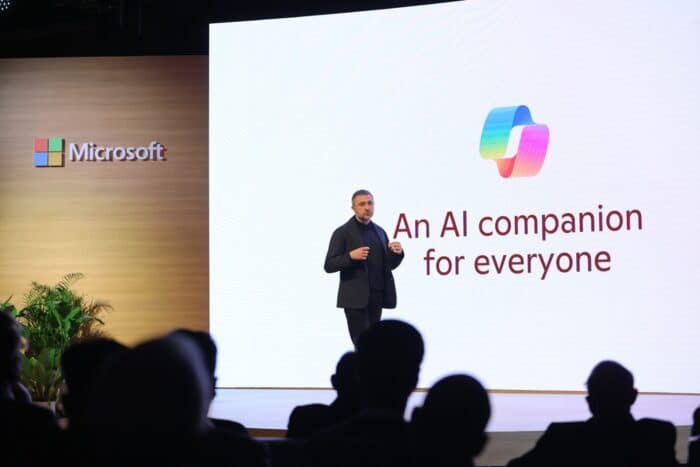
Last week, Microsoft announced some leadership changes to its experiences and devices division, as long-time leader Rajesh Jha announced to retire this June. Now, the company is making yet another internal restructruing as it looks to double down on its AI goals. In an internal email shared with employees this morning, Microsoft CEO Satya Nadella confirmed that the company is restructuring its Copilot organization to bring consumer and commercial versions under a single unified system.
At a time when AI tools are rapidly evolving beyond simple assistants, Microsoft appears to be positioning Copilot as a more integrated, end-to-end experience. The company says this move will help transition from separate AI products into a connected system spanning apps, platforms, and underlying models.
Microsoft unifies Copilot across products and platforms
As part of the restructring, Jacob Andreou will lead the Copilot experience across both consumer and enterprise segments. He will oversee design, product, growth, and engineering, and will report directly to Nadella. Microsoft says the goal is to streamline how users interact with AI across different services.
Meanwhile, Mustafa Suleyman will continue to lead the company’s AI and “superintelligence” goals. His focus will remain on advancing core AI models, which Microsoft sees as critical to long-term competitiveness. Notably, the restructuring also brings together key leaders including Ryan Roslansky, Perry Clarke, and Charles Lamanna to oversee Microsoft 365 apps and the Copilot platform. Together, they will form a new Copilot Leadership Team which will aim to align product strategy with AI development.
Focus shifts toward AI models and agentic future
Microsoft’s message highlights a bigger shift happening behind the scenes. The company is doubling down on building advanced AI models that can power more complex, multi-step tasks, often referred to as “agentic” capabilities.
Speaking about the change, Suleyman says, “The next phase of this plan is to restructure our organization to enable me to focus all my energy on our Superintelligence efforts and be able to deliver world class models for Microsoft over the next 5 years. These models will enable us to build enterprise tuned lineages that help improve all our products across the company. They’ll also enable us to deliver the COGS efficiencies necessary to be able to serve AI workloads at the immense scale required in the coming years. Achieving all this will be a huge challenge, and I’m committing everything we have – and I have personally – to make it happen.”
Meanwhile, Nadella, speaking about the company’s superintelligence effort and Suleyman’s importance, says, “Mustafa Suleyman and I have been working towards this plan for some time, and he will continue to lead this high ambition work, reporting to me. Mustafa is uniquely qualified to drive this forward, with his deep focus and commitment to advancing the frontiers of model science, while also ensuring that human control, agency, and economic opportunity remain at the center of these advancements.”
With competitors like OpenAI and Anthropic pushing aggressively into enterprise AI, Microsoft’s latest move to unify Copilot under a single umbrella could play a vital role in shaping the next phase of AI-powered productivity.

Read our disclosure page to find out how can you help Windows Report sustain the editorial team. Read more



Improve this guide



User forum
1 messages