
AMD Unveils Kintex UltraScale+ Gen 2 FPGAs for Industrial and Defense Markets


 3 min. read
  Published on
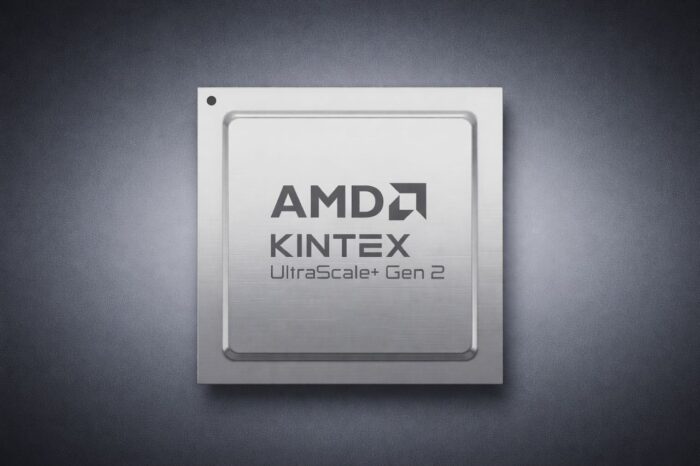
AMD has unveiled a new product that sits far outside the consumer PC space, following the recent launch of its Ryzen 7 9850X3D desktop CPU. According to TechPowerUp, the company has officially introduced the Kintex UltraScale+ Gen 2 FPGA family, aimed squarely at long-lifecycle and reliability-focused industries.
Kintex UltraScale+ Gen 2 is designed for long-term, mission-critical use
The Kintex UltraScale+ Gen 2 family targets the mid-range FPGA segment, where it competes with solutions such as Intel Agilex 5 and Lattice Avant. AMD positions the new lineup for medical imaging, industrial automation, broadcast video, aerospace, and defense applications, rather than home or enthusiast users.
Unlike a simple node shrink, Gen 2 represents a substantial architectural refresh of the original 16 nm Kintex UltraScale+ platform. The first-generation series gained wide adoption thanks to its strong performance-per-watt profile, especially in ultrasound systems and 5G radio heads. However, rising edge bandwidth requirements eventually exposed limitations in I/O and memory support.
Modernized memory and connectivity
AMD addresses those constraints by overhauling the memory subsystem. Kintex UltraScale+ Gen 2 adds support for LPDDR4X, DDR5, and LPDDR5X, fully replacing DDR4. LPDDR support specifically targets compact IIoT and edge deployments, while also enabling demanding workloads such as 4K and 8K broadcast video processing.
Serial connectivity also receives a major upgrade. AMD moves from PCI Express Gen 3 to PCI Express Gen 4 and integrates dual 100G Ethernet MAC blocks. These changes enable real-time data aggregation for industrial networking and high-throughput edge systems.
Stability over node scaling
Despite competitors moving to newer manufacturing nodes, AMD continues to produce Kintex UltraScale+ Gen 2 on TSMC’s 16 nm FinFET process. The company prioritizes platform stability, reduced non-recurring engineering costs, and long-term supply guarantees over raw density gains.
AMD also highlights architectural advantages over rival offerings, including higher operating frequencies and LUT6-based logic instead of LUT4 designs, which can improve efficiency in complex designs.
Security and long-term availability
Security plays a central role in the Gen 2 platform. AMD adds CNSA 2.0-grade cryptography, bitstream encryption, and built-in anti-cloning protections. These features support deployment in zero-trust environments and safeguard sensitive intellectual property.
AMD has committed to product availability through 2045, aligning with the extremely long lifecycles common in regulated and mission-critical industries. Toolchain support arrives with Vivado and Vitis updates scheduled for Q3 2026, while engineering samples are expected in Q4 2026. AMD plans mass production for the first half of 2027.
Outside the FPGA space, AMD continues to explore SOCAMM2 memory for future AI hardware platforms. At the same time, an increasing number of Ryzen 9000-series CPUs have reportedly shown POST issues on certain ASRock motherboards, highlighting ongoing challenges on the consumer platform side even as AMD expands its industrial portfolio.

Read our disclosure page to find out how can you help Windows Report sustain the editorial team. Read more



Improve this guide




User forum
0 messages