
See Environment Variables in Windows: Quick Steps and Tips


 4 min. read
  Published on
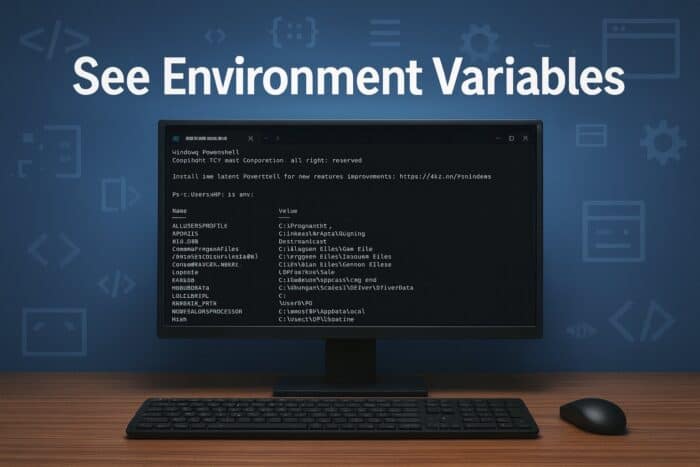
Want to see environment variables in Windows to understand what paths or configurations your system uses? Environment variables define important values like system directories, user paths, and temporary folders that affect how Windows and apps run.
Here’s how to view, edit, and manage them properly.
Table of contents
- How to See Environment Variables in Windows?
- 1. View Environment Variables via System Properties
- 2. Check Environment Variables Using Command Prompt
- 3. See Environment Variables Using PowerShell
- 4. View Environment Variables Temporarily in Task Manager
- How to Edit or Add Environment Variables
- Why Environment Variables Matter
- What Are Environment Variables in Windows?
- FAQs
- Conclusion
How to See Environment Variables in Windows?
1. View Environment Variables via System Properties
Follow these steps to quickly access and view variables from the Windows interface.
- Press Windows + R to open the Run dialog.
- Type sysdm.cpl and press Enter.
- In the System Properties window, go to the Advanced tab.
- Click Environment Variables near the bottom.

- You will see two sections:
- User variables for your account
- System variables for all users

You can view or edit any variable by selecting it and clicking Edit. For more details on managing variables and system paths, see how to edit the PATH environment variable in Windows.
2. Check Environment Variables Using Command Prompt
You can also list all variables directly from the command line.
- Press Windows + S, type cmd, and press Enter.
- In the Command Prompt, type set and press Enter.

- Scroll through the list to see all environment variables currently set for your session.
- To check a specific variable, type echo %VARIABLE_NAME%, for example echo %PATH%.
If you are using Windows 11, check this tutorial on how environment variables work in Windows 11.
3. See Environment Variables Using PowerShell
PowerShell gives you a structured view of your system variables.
- Open PowerShell by typing it in the Start menu.
- Run the command Get-ChildItem Env:

- You will get a table showing variable names and their current values.
- To view one variable only, type $Env:PATH.
You can also learn how to display them clearly by following how to print environment variables in PowerShell.
4. View Environment Variables Temporarily in Task Manager
You can check runtime variables for specific processes.
- Press Ctrl + Shift + Esc to open Task Manager.
- Go to the Details tab.
- Right-click a running process and select Properties.
- Under the Details tab, look for Environment (available in newer Windows 11 builds).
This is useful when troubleshooting app-level configurations.
How to Edit or Add Environment Variables
- Open System Properties again using sysdm.cpl.
- Click Environment Variables.
- To add a new one, click New under the relevant section.
- Enter the variable name and value, then click OK.
- To edit existing ones, select and click Edit, or Delete if not needed.
Changes take effect after restarting the app or signing out.
Why Environment Variables Matter
- PATH helps Windows locate executable files.
- TEMP and TMP store temporary data.
- USERPROFILE directs apps to your user folder.
- Developers use them to configure Java, Python, or Node.js runtimes.
Incorrect editing can break app behavior, so modify with caution.
What Are Environment Variables in Windows?
Environment variables are key-value pairs that store system settings and user preferences. For example, the PATH variable tells Windows where to find executable files, while TEMP defines where temporary files are stored.
They can be system-wide (apply to all users) or user-specific (apply only to your account).
FAQs
Typing “set” in Command Prompt or “Get-ChildItem Env:” in PowerShell gives instant results.
Yes. You can edit them through System Properties > Advanced > Environment Variables.
Yes, changing system-wide variables requires administrator privileges.
You can export them in PowerShell using the Export-Csv command to save a copy for later.
Conclusion
Viewing environment variables in Windows helps you understand how your system handles commands, file paths, and app configurations. Whether you are troubleshooting a program or setting up a development environment, using tools like System Properties, Command Prompt, and PowerShell gives you complete control over how Windows runs behind the scenes.

Read our disclosure page to find out how can you help Windows Report sustain the editorial team. Read more



Improve this guide

User forum
0 messages