
Google Homepage Pushes Chrome Download Prompts on Rival Chromium Browsers
Chrome download prompts appear on the Google Search homepage in Brave, Vivaldi, and Comet browsers.


 3 min. read
  Published on

Google Search is now showing Chrome download prompts right on its homepage when you visit through rival Chromium browsers like Brave, Vivaldi, and Comet.
The prompt shows up as a large floating card in the bottom-right corner with the message “Choose Chrome, the browser built by Google,” plus a “Download Chrome” button. Clicking the button opens the Chrome download page in a new tab and starts the download. When you try to dismiss the prompt, you get a second option that says “Do not use Chrome.”
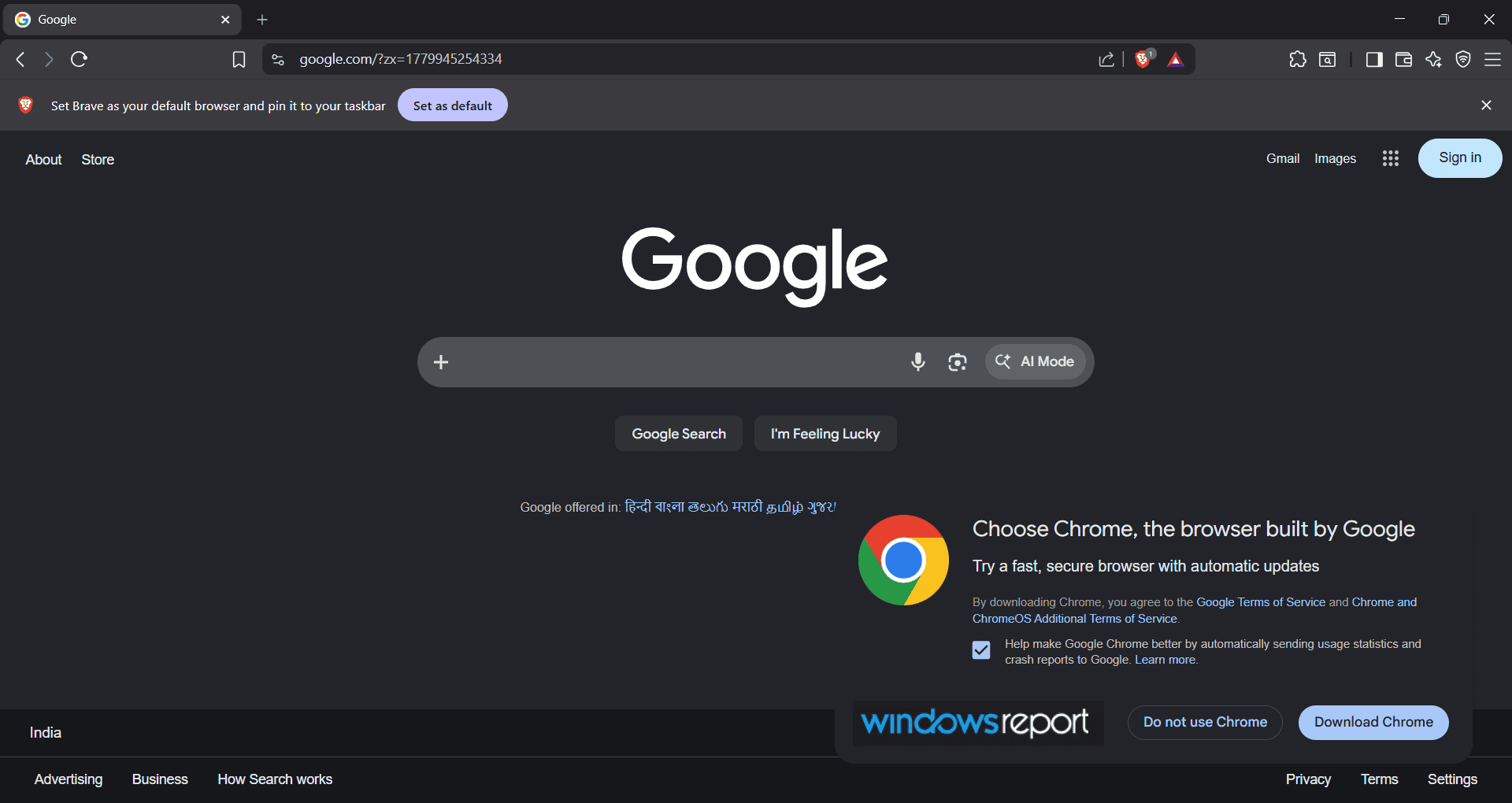
In our testing, this banner popped up in Brave, Vivaldi, and Comet browsers on Windows. Since these browsers run on Chromium, the same open-source engine Chrome uses, the recommendation is less about compatibility and more about getting users back onto Google’s own browser.

Here is how it works. Google checks your browser’s User-Agent string. Even though these browsers use Chromium under the hood, they have their own identifiers, so Google Search knows you are not on Chrome and serves the download prompt.

The placement is especially noticeable in Brave. The browser already shows its own banner at the top asking you to set Brave as your default and pin it to the taskbar. Meanwhile, Google is pushing Chrome from within the Search page itself. You end up with both companies fighting for attention in the same window.
Google has promoted Chrome across its properties for years, including Gemini, but past prompts were much more passive. They usually showed up as thin notification bars at the top of the page or subtle text links under the search box. Google changed the design. It is now a heavy, floating card anchored in the lower right, with a large full-color Chrome logo that stands out against dark mode.
The wording also stands out. Instead of a simple “X” or “Not now” option, the dismissal text reads “Do not use Chrome.” That keeps Chrome’s name front and center, even when you are rejecting it.
For privacy-focused browsers like Brave, this creates an added headache. Brave blocks trackers and ads, yet this prompt is first-party content on Google’s own site. That makes it much harder to block without breaking parts of the page.
We have not seen the same Chrome download prompt on the Google homepage in Edge or Opera. However, we recently spotted a separate Chrome prompt encouraging users to set Google Search as their default search engine in Edge.
Chrome dominates with 68% market share worldwide, while Brave has roughly 1-1.8% with over 100 million monthly active users. Vivaldi has about 4 million active users and less than 1% market share. Comet is even newer, having only gone public in 2025.
Despite Brave, Vivaldi, and Comet combined holding less than 3% of the browser market, what we can confirm is that all three displayed the Chrome download prompt during our testing. The prompt appears even on browsers built from the same Chromium codebase as Chrome. We do not yet know how widely this has rolled out or if it is limited to certain browsers, signed-out sessions, or specific platforms.


Read our disclosure page to find out how can you help Windows Report sustain the editorial team. Read more



Improve this guide


User forum
0 messages