Earning free Xbox store credit is easier than ever

In the quest to make Xbox Game Pass popular, Microsoft is getting rather generous in distributing rewards via Xbox Game Pass Quests and Microsoft Rewards.

You can now participate in the current Quests from your phone or Xbox, complete simple objectives to earn rewards, claim and track your points, and then go to Microsoft Rewards to redeem them for Xbox gift cards. To participate, you need to be a Game Pass Ultimate and Console plan member.

Unlike Sony’s PS Stars, you can take part in amazing competitions and donate to charity. Another great way to get store credit is through Microsoft Rewards.

With this scheme, the Redmond tech giant encourages you to use the Microsoft Bing web browser. Earning points with Microsoft Rewards is simple; you only need to do daily tasks like web browsing, buying apps and games, and completing one or two quests.

Once you get enough points, you can redeem them against store credit and spend them on the Microsoft Store. The process has been simplified and improved, and users are taking full advantage of it.

Users, as reported on Reddit, are very happy with Rewards; here is what MAGGhost, a Reddit user, has to say:

OMG FINALLY!!!!!
Sweden has now more opportunities to earn points aside from searching. Thanks Microsoft, daily streaks were never a thing before.

So, if you maintain a daily streak with Microsoft Rewards, you may win additional points. As confirmed by fellow Reddit users, the scheme has reached Poland, Norway, and even Asia.

We hope Microsoft Rewards will become available worldwide. Is it available in your region? If yes, share your experience with our readers in the comments section below.

VLOGGER AI: Now create a lifelike avatar from a photo & use your voice to control it

Researchers at Google are working on making its AI technology smarter every day. One of the latest research projects that they are working on is VLOGGER.

VLOGGER is explained as

A method for text and audio driven talking human video generation from a single input image of a person, which builds on the success of recent generative diffusion models.

Our method consists of 1) a stochastic human-to-3d-motion diffusion model, and 2) a novel diffusion based architecture that augments text-to-image models with both temporal and spatial controls. 

According to the blog post on GitHub, this approach allows for the generation of high-quality videos of desirable length. Without the need for training for every person, it doesn’t depend on face detection cropping; it can generate the complete image and take a broad spectrum into account, which is important for synthesizing humans who communicate.

As of now, VLOGGER is not available for use as it is still under development, but when it hits the market, it could be a great way to communicate in a video conference on Skype, Teams, or Slack.

Google is quite confident in the project and has tested it through various benchmarks; here is what it says:

We evaluate VLOGGER on three different benchmarks and show that the proposed model surpasses other state-of-the-art methods in image quality, identity preservation and temporal consistency. We collect a new and diverse dataset MENTOR one order of magnitude bigger than previous ones (2,200 hours and 800,000 identities, and a test set of 120 hours and 4,000 identities) on which we train and ablate our main technical contributions. We report the performance of VLOGGER with respect to multiple diversity metrics, showing that our architectural choices benefit training a fair and unbiased model at scale.

How does VLOGGER work?

VLOGGER is a framework that acts as a two-stage pipeline and works on stochastic diffusion architecture that powers text to image, video & even 3D models but also adds a control mechanism.

The first step is to take an audio waveform as an input to generate intermediate body motion controls like gaze and facial expressions. Next, the second network uses a temporal image-to-image translation model to identify these movements and a reference image of a person to generate frames for the video.

Another important feature of VLOGGER is the ability to edit existing videos. It can take a video and change the expression of the person in the video.

Furthermore, the VLOGGER can also help in video translation; it can take an existing video in a specific language and edit the lips & face area to make it consistent with new audio or different languages.

As VLOGGER is not a product but a research project and is not complete, it can’t be relied upon. Yes, it can create realistic-like motion, but it may not be able to match how a person really moves. Given its diffusion model, it could show unusual behavior.

Its team also mentioned that it is not versed in large motions or diverse environments and can only work for short videos.

According to the features mentioned on the GitHub page, it can help create talking and moving virtual avatars, chatbots, and more.

Do you think it could be helpful for you? Share your opinions with our readers in the comments section below

Copilot will be successful long-term, even though it struggles with adoption now, says Microsoft

Microsoft says its AI assistant model, Copilot, will be a successful product in the future, as for now, the Redmond-based tech giant is aware of its limitations.

At the Morgan Stanley Technology, Media, and Telecom 2024 conference, Jared Spataro, corporate vice president of Modern Work & Business Applications at Microsoft believes Copilot will be a great moneymaker for the Redmond-based tech giant over the long term.

However, investors will need to keep their expectations low, for now, as Microsoft is still dealing with adoption issues when it comes to the AI tool.

But for this group, I would say, my job here is to temper your expectations. Over the long term, we think this will be a great moneymaker for us

Jared Spataro

Spataro admitted that Copilot might somehow not be worth the $30/month price it currently has in Microsoft 365, when it comes to some versions of it, such as Copilot in Excel, but it’s more than worth it for other apps, such as Teams or Outlook.

So if you look at Copilot in Excel, like, we all can’t wait until it’s an Excel jockey and can do a lot, but it’s coming. It’s learning and people have very high expectations. Same is true of PowerPoint and it’s going to disappoint there because we’re still learning the commanding surface of Excel.

Jared Spataro

The Microsoft executive agrees that Copilot is having a bit of trouble with adoption: customers and organizations, especially, are having a hard time figuring out how to integrate the Microsoft Copilot AI into the equation.

People are definitely trying understand, who should I get this for? Is this for everyone in my organization? Is this for a certain segment or population? And it’s just based on hard facts. Are we saving enough in terms of time? Are we generating enough value? Previous Microsoft-commissioned research found Copilot testers worked 29 percent faster, and 77 percent that used it for two weeks found it indispensable.

Jared Spataro

However, Microsoft conducted studies showcasing that commercial customers, such as startups and SMBs can save up a great of money by investing in AI tools, such as Copilot. A study says that $1 invested in AI, generates a return of $3.5X, while another states that 47% of small business owners see AI as a game changer.

Even so, our survey clearly shows that users are somehow reticent to work with Copilot: If Copilot included fees or subscriptions, 46% of current users would stop using it.

But Spataro is optimistic about Copilot: in the future, the AI tool will be capable of sophisticated information retrieval and sophisticated task completion on all platforms currently available, and users will be more inclined to integrate it into their work.

It’s also worth mentioning that Copilot was available on Windows 10, and Windows 11, to more than 75 million users at the beginning of 2024, so this number has most likely increased since then.

This Outlook trick will make sure that your emails are read but don’t abuse it

You’re probably familiar with the situation where you don’t get any replies to your emails and you have to insist with follow ups. It can become pretty annoying after a while because you really need that important information to reach your recipient.

The key to solve this problem is to use the Add reminder feature in Outlook.

How do I use Add reminder in Outlook?

The trick here is that when you send an email, you can set a reminder for both you and the recipient. However, this works only if the recipient also uses Outlook.

To do this, just create a new email, and click on Follow Up in the Tags group and choose Add Reminder from the dropdown menu.

Not only you will flag the message for them, but you will also be able to trigger a reminder for them at a certain date and time.

Moreover, the email will also be embedded into their To-do list if they use one. That’s it! No mere excuses that they didn’t see your email.

However, the only recommendation is that you don’t abuse this feature. If the recipients become annoyed by your reminders, they might block you. Not only that your emails will be ignored, but they won’t be seen at all.

We also have a helpful guide on how to add and remove Outlook reminders if you need more information.

Did you use this feature? Share your experience in the comments below.

New AI processors to be announced during Nvidia’s AI developer conference

Nvidia has started its annual developer conference, and many are looking forward to new products from Nvidia.

Many are excited about the upcoming products and services, so here’s what we can expect to see.

The Nvidia AI developer conference starts today, new chip announcement is expected

As you may know, Nvidia is dominating the data center AI chip market, and last year it held around 80% of the market. However, its market share is expected to drop since there’s strong competition coming from Intel and AMD.

As Yahoo Finance reports, investors are eager to find out more about the new chip announcement, since the new chip will determine the company’s fate as the lead manufacturer of the AI chips.

Many are eager to see the new B100 chip that should succeed the H100 model. In addition to new chips, we expect to see new software products as well.

Nvidia is holding GTC in person first time since 2019, with around 16,000 attendees, and everybody is excited about the Chief Executive’s keynote which should take place at 1:00 p.m. (2000 GMT).

As for Nvidia, the company is facing a class lawsuit because of the NeMo AI framework. That’s not all, as many users are claiming that Nvidia is limiting GPU power on Linux laptops as well.

For more Nvidia news, be sure to stay tuned.

New script, Inplace_Upgrade_Helper, lets you quickly switch Windows edition

Most of us previously thought that switching to another Windows edition requires a clean installation. And process turns out to be both time-consuming and complex for a few. But a new script, Inplace_Upgrade_Helper, allows you to do that rather quickly!

Developed by TheMMC and available on GitHub, Inplace_Upgrade_Helper works both on Windows 10 and Windows 11. With it, you can easily switch from the Home edition to Pro, Pro Education, or Enterprise.

As per the official description, the script offers the following four functions:

  • Use Slmgr to change the key
  • Run setup and let it automatically choose the best edition: It doesn’t change anything
  • Lets you upgrade to the preferred Windows edition: Setup doesn’t automatically read the built-in BIOS, UEFI, or firmware key.
  • Perform a forced Windows edition upgrade without affecting the apps or stored data: It modifies the Registry and OEM-GLVK keys. It’s an unsupported method, so the developer recommends creating a backup beforehand.

On running the batch file, you will be asked to choose your preferred edition for upgrade. It will provide 20 options, including Windows Pro for Workstation, Windows SE, and Windows 10 IoT Enterprise.

Different upgrade options

The Inplace_Upgrade_Helper_readme.txt file shared alongside the tool describes its purpose and all the steps in detail.

The only problem, the script (batch file) and the instructions are in German, which may confuse a few. And when you are up for a task like this, even slight confusion could prove disastrous!

Inplace_Upgrade_Helper_readme.txt file

As for the functioning of the tool, developers describe it as (translated from German using Google Translate),

This is not an activation tool, only official pre-installation keys are used. Simply copy this batch to the setup.exe in the installation medium and start it.

It’s vital to highlight that Inplace_Upgrade_Helper does not activate Windows but simply relies on the publically available OEM-GLVK keys. Developers confirm that they are working on translating the tool, and an English version should be released soon.

Until then, it’s best to rely on an effective translator or, if you are confused, not use the tool at all!

Have you used Inplace_Upgrade_Helper to switch Windows between editions? Share your review with our readers in the comments section.

Microsoft changes to the Power Apps license could see customers paying 10 times more

Microsoft apparently made some drastic changes to the Power Apps license, which would force customers to move into more expensive licensing, according to a now-deleted blog post.

The new rules would have seen multiple software-developing organizations using the platform, having to move users from the Power Apps license to the Dynamics 365 Enterprise, which is, more or less, ten times more expensive.

Under previous rules, users would be able to access data in Dynamics 365 Enterprise, as long as they didn’t modify it in restricted labels. However, under the new rules, the definition of restricted labels changed in a way that would have increased licensing costs.

The rules would also add more non-restricted policies to the list of restricted data, and accessing them would have required a full Dynamics 365 Enterprise license, effectively forcing customers to pay more for the same services they once had with their Power Apps license.

For a comparison, imagine this:

  • A Power Apps subscription is currently priced at $20 per month.
  • Dynamics 365 subscriptions are priced as follows:
    • Dynamics 365 Team Member is $8 per user per month
    • Dynamics 365 CRM Enterprise licenses are $95 per user per month

An organization of 1000 employees paying for 1000 Power Apps subscriptions would pay $240,000 per year, while the same organization would pay $1.14 million per year for the monthly Dynamics 365 CRM Enterprise licenses, almost 10 times more.

However, after being questioned for clarification, Microsoft decided to delete its blog post where the company discussed the changes, and it released a statement through The Register, saying:

We are not introducing any changes or updates to our licensing requirements for Dynamics 365 or Power Apps solutions. The new Solution Checker provides an improved and simplified way for customers to understand licensing requirements and optimize user licensing.

The Solution Checker specifically addresses adherence to the most common Dynamics 365 Sales license requirements when building custom Power Apps applications. These new capabilities, along with upcoming new tools and features reports, first cover Dynamics 365 Sales and will be extended to additional Dynamics 365 Customer Engagement workloads soon.

Microsoft

Dynamics 365 recently saw the integration of the Nuvei services, which could be a game-changer for SMBs. However, those SMBs focusing on developing software could be equally affected by these new licensing rules.

Kubernetes security flaw lets hackers obtain elevated privileges and take over nodes

Kubernetes are often used by developers, but it was recently discovered that the default installation of Kubernetes had a severe security flaw.

The good news is that this isn’t an ongoing issue anymore, but keep on reading to learn how to properly protect yourself.

A critical Kubernetes security flaw was recently patched

As TechRadar writes, this flaw was discovered by Akami researchers, and it was tracked as CVE-2023-5588.

To utilize this vulnerability, hackers had to apply malicious YAML files on the cluster. This would allow them to perform remote code execution with SYSTEM privileges on all Windows endpoints within a cluster.

Essentially, the attackers were able to completely take over all Windows nodes in a cluster. This isn’t the only issue, the same researchers found another flaw and tracked it as CVE-2023-3676.

This flaw had a severity of 8.8 and was triggered by the lack of sanitization of the subPath parameter in YAML files. This allowed hackers an opportunity to perform a malicious injection and run their code.

To prevent issues such as these, it’s crucial to verify the configuration of YAML files. Luckily, the issue was patched last November, and if you’re using v1.28.4, v1.27.8, v1.26.11, or v1.25.16 you’re safe.

Other services can be impacted by vulnerabilities, and we recently wrote about Microsoft Office and Skype critical vulnerabilities that are giving users trouble.

Speaking of security, did you know that 87% of UK companies are vulnerable to AI cyberattacks?

Apparently, spreadsheets are all you need to understand how a LLM works

We all use LLM right now, whether is ChatGPT, Gemini, or the newest Grok-1 released as open source. But do you know how they work to provide you with an answer?

Ishan Anand, a software developer who also admits he’s passionate about spreadsheets, conducted an experiment to explain the mechanism behind LLMs that everyone can understand.

He embedded a small version of GPT-2 into an Excel spreadsheet and tracked its algorithm on how it answers a simple question.

How does ChatGPT 2.0 work in Excel?

First, you must understand that GPT -2 was released in 2019, and it has not been possible to converse. The first conversational AI bot came in 2022 with GPT-3.

While it was all over in the media headlines, GPT-2 could only use 1,5 billion parameters while GPT-3 extended that figure to 175 billion parameters.

Open AI didn’t release it as a conversational bot simply because it had limited input tokens. Ishan Anand’s GPT-2 in Excel can only handle 10 tokens of input which is a tiny amount for any possible query.

However, in his experiment, he tested the LLM to complete the sentence Mike is quick. He moves… If you watch the video above, you will see exactly how GPT-2 used the spreadsheet to come with the deduction that the missing word was quickly.

The point of the developer was to make us believe that if we understand Excel spreadsheets, we can also understand how a LLM works. If you want to experiment yourself, you can grab the spreadsheet from the GitHub page. You can also read more about it on Tom’s hardware.

Did you understand the explanation in the video? Let’s discuss in the comments section below.

Study finds exploits in ChatGPT, hackers can read all your conversations

If you share personal matters with ChatGPT or ask questions where private information is disclosed, stop that right away. A recent study suggests that chatbots, including ChatGPT, could be hacked, and all your conversations/chats may be accessible to attackers!

In the study conducted at Israel’s Ben-Gurion University, researchers have found a side channel exploit present in almost every popular AI-based chatbot, except Google Gemini, that could reveal the entire conversation with high accuracy, though not 100%.

In an email to Ars Technica, Yisroel Mirsky, head of the Offensive AI Research Lab at the Ben-Gurion University, said,

Currently, anybody can read private chats sent from ChatGPT and other services. This includes malicious actors on the same Wi-Fi or LAN as a client (e.g., same coffee shop), or even a malicious actor on the Internet—anyone who can observe the traffic. The attack is passive and can happen without OpenAI or their client’s knowledge. OpenAI encrypts their traffic to prevent these kinds of eavesdropping attacks, but our research shows that the way OpenAI is using encryption is flawed, and thus the content of the messages are exposed.

Researchers shed light on the vulnerabilities in AI-based chatbots

The study is complex and slightly tricky for a regular user to comprehend. In simple terms, researchers exploited the side channel vulnerability to acquire tokens (data that helps LLMs translate user inputs) and then used them to infer the conversation with a 55% accuracy.

Researchers leveraged the side channel attack technique because, with it, instead of directly attacking the system, they could gather the information it shared inadvertently. This way, they could bypass the built-in protection protocols, including encryption.

These tokens were then run through two specially trained LLMs (Large Language Models), which could translate the contents into text format. This is practically impossible if you take a manual approach.

However, since chatbots have a distinct style, researchers were able to train LLMs to effectively decipher the prompts. One LLM was trained to identify the first sentence of the response, while the other worked on inner sentences based on the context.

In the email to Ars Technica, they explain it as,

It’s like trying to solve a puzzle on Wheel of Fortune, but instead of it being a short phrase, it’s a whole paragraph of phrases and none of the characters have been revealed. However, AI (LLMs) are very good at looking at the long-term patterns and can solve these puzzles with remarkable accuracy given enough examples from other games.

This breakthrough is also mentioned in their research paper.

We observed that LLMs used in AI assistant services exhibit distinct writing styles and sometimes repeat phrases from their training data, a notion echoed by other researchers as well. Recognizing this characteristic enables us to conduct an attack similar to a known-plaintext attack. The method involves compiling a dataset of responses from the target LLM using public datasets or via sending prompts as a paid user. The dataset can then be used to further fine-tune the inference model. As a result, the inference model is able to reduce entropy significantly, and sometimes even predict the response R from T perfectly, word for word.

The researchers have shared a demo video of the entire process, from Traffic Interception to Response Inference, on YouTube.

So, your ChatGPT chat isn’t as safe as you thought, and hackers may easily read it! Even though the side channel exploit wasn’t present in Google’s chatbot, researchers have hacked into Gemini AI and Cloud Console previously.

Besides, there has been a significant rise in cyberattacks after AI became mainstream. A recent report by Microsoft suggests that in the UK, 87% of companies stand the risk of facing AI-powered cyber attacks.

Microsoft’s President, Brad Smith, had his share of concerns regarding AI and called for immediate regulations!

What do you think about the rise of AI? Share with our readers in the comments section.

This dangerous Apex Legends hack requires a Windows reinstallation to fix it

A dangerous Apex Legends hack happened during the Apex Legends Global Series, and the finals of the event have been delayed after two streamers were hacked while having a match. After being hacked, Noyan “Genburten” Ozkose of DarkZero started to see other players through walls, and Phillip “ImperialHal” Dosen of TSM was given an aimbot.

On Twitch, you can see the exact moment one of the streamers is being hacked. Being able to see other players through walls, as well as being given an aimbot meant the players would have been cheating. Fortunately, one of them was able to spot it moments after being hacked and left the game shortly. The other streamer continued playing, but the game was ultimately abandoned.

The Anti-Cheat Police Department released a statement on X (formerly known as Twitter), confirming the hacks, and saying that they could be further used to spread malware on affected devices.

PSA: There is currently an RCE exploit being abused in @PlayApex. It is unsure whether it comes from the game or the actual anti-cheat (@TeddyEAC ). I would advise against playing any games protected by EAC or any EA titles once they have fixed this or can comment. Currently, the RCE is being abused to inject cheats into streamers machines, which means they have the capabilities to do whatever, like installing ransomware software locking up your entire PC.

Anti-Cheat Police Department 

What to do to prevent or combat this hack? From changing the passwords to the Discord platform, and emails, to enabling MFA (multi-factor authentication). Affected users are advised to not share any personal and sensitive information, and reinstalling the OS (in this case Windows) is mandatory, as soon as possible.

Attention to all players who participated in the ALGS tournament, I strongly recommend that you take immediate measures to protect your personal information. It is advisable that you change your Discord passwords and ensure that your emails are secure. also enable MFA for all your accounts if you have not done it yet perform a clean OS reinstall as soon as possible. Do not take any chances with your personal information, your PC may have been exposed to a rootkit or other malicious software that could cause further damage.

Anti-Cheat Police Department

Fortunately, all these recommendations are quite easy to implement, including reinstalling Windows 11, which can be done in 2 simple steps.

Due to the ongoing hacking issues, the Apex Legends Global Series finals have been delayed, but Apex Legends Esports announced that more details will be released soon.

Did you know that you can get Persona 3 Reload DLC for free? Here’s how

Persona 3 Reload, the complete remake of the PlayStation 2 classic was released for Xbox in February 2024. However, the Expansion Pass DLC has upset a lot of gamers due to its hefty price tag of $34,99.

Well, we have great news because, as reported by Wario64 on Reddit, it seems that if you have a Game Pass Ultimate account, you can get Persona 3 Reload for free.

The fun part is that you don’t even need to keep the Game Pass Ultimate. You can downgrade right after getting the Persona 3 Reload DLC and keep it.

We don’t know yet how long will this offer will stand, but according to the Reddit thread, not everyone has access to it. We have confirmation that it is available in the U.S., so hurry up and grab it while it lasts.

The Persona developers also announced that they will release additional DLCs in May and September, and we’ll keep you posted with the latest information.

If you didn’t know it yet, Persona 6 could be released on Xbox soon. If you like the Persona game saga, let us know about that in the comments section below.

New update on Spotify desktop app brings the Jam feature & other changes

Spotify recently added a new feature, Jam, to its desktop app. This feature allows you to share a synced listening experience in real-time with others. The Jam feature is better than sharing links to your favorite songs or playlists with your people.

The feature is rolling out for Spotify Premium members on a desktop app. To use it, right-click the song or playlist and choose the Start a Jam option from the context menu.

Once you start a jam, the Queue will open on the right sidebar. Click the Invite button to copy a link and share it with people no matter where they are. If you want to share the playlist or sing with the person in the same room, ask them to scan the QR code.

Remember, only Spotify users with premium subscriptions can join your Jam remotely. However, free and premium Spotify users can jam with you in person. Free users can also join an in-person Jam via their mobile app.

If your friend shares a link to join the Jam, click on it to open the Jam invite link in your web browser. A pop-up will then enable you to open the link in the Spotify desktop app. Once the link is in the desktop app, you will get the pop-up to join the Jam.

All participants in the Jam session can change songs, albums, playlists, or podcasts from anywhere in the app. However, the Jam host can turn off the Let others change what’s playing feature, which allows participants to change the song.

Another change introduced is the new Queue experience. With the latest update, the Queue now opens in the right sidebar, enabling you to browse content in the main area while watching the current Jam session or what’s playing.

While in Jam, the Jam options will show at the top of the Queue in the right sidebar. You can choose to keep the Now Playing View or click the Friend Activity feed to check what your friends are listening to.

Once the update was rolled out, many people complained they couldn’t open Now Playing and Queue together, which frustrated them. Here is one of the users Charbreon mentioned on Reddit:

The queue is showing up on the side bar where I almost always have view on (I like being able to see the info sometimes so I leave it on). It wasn’t doing that earlier when I was using Spotify. I’ve tried to restart everything and it’s still happening. Is this happening for anyone else? If this is a new update it kinda sucks not having the queue in the bigger area.

Another one commented:

There’s already four pages of negative feedback about this on their shitty “community forums.” It would be incredible if they actually paid any attention to user feedback, especially from paying customers, but I will eat my hat if anything actually changes.

Edit: WOW, to add insult to injury, you can no longer click on album art, whether small or in the oversized “Now Playing” sidebar, to jump to the currently-playing playlist. They have now literally removed all of the features I used MOST OFTEN on their app.

Unrelated, does anyone have a recommendation for porting Spotify libraries over to a different platform?

After the update, you will see the homepage whenever you launch the app. You can now use the right sidebar to switch between the Queue and what’s playing, but you can’t see track length in the queue sidebar.

You can hover over the song playing and click Expand, but it opens the now playing on the right side in a limited view, hiding most of the queued songs. To check the queued songs, you need to expand the queue.

The Jam could be helpful for those who would like to jam with their friends; however, it is not an essential feature and might not be used as often.

Spotify made many changes to introducing this feature, claiming it would help us to browse quickly, but instead, it has cluttered everything and even removed the important things.

This is not the first time Spotify has made a controversial move. However, to avoid backlash like this, we think companies should get user feedback before making major UI changes.

What are your thoughts on the matter? Share your opinions with our readers in the comments section below.

Pixel’s Live Translate feature has made its way to Chrome Canary

Google Chrome never lacked innovative features, and speaking of which, it seems that a new and exciting feature is on the horizon.

Google Canary has been updated recently and it now comes with an improved translation feature.

Live Translate is now available in Chrome Canary, coming soon to other versions

Chrome Canary is the first version of Chrome that gets new features, and we recently wrote about improved link previews, and the ability to minimize Custom Tabs in PiP mode.

That’s not all, and according to NewsBytes, Chrome Canary now has Live Translate. If this feature rings a bell, it’s because it was previously available only on Pixel phones.

This feature isn’t enabled by default, and to activate it, you need to head to the Accessibility settings and enable Live Caption.

As for availability, if you’re on Chrome Canary 124, you can already try it. We expect to see this feature available in Dev and Beta channels soon.

The stable release should get Live Translate on April 10, so stay tuned to not miss it.

Would you buy Microsoft-manufactured SSDs? Because its 1 TB Z1000 SSD has been discovered

Microsoft is well known for its software products and services, such as Windows, Office 365, or Microsoft 365, rather than its hardware products. But besides its Surface devices that proved over and over again why there are some of the best Windows laptops around, apparently, Microsoft has been experimenting with other kinds of hardware, as well.

More specifically, we’re talking about the Microsoft Z1000, a 1 TB SSD apparently manufactured by the Redmond-based tech giant itself, and discovered recently by tech enthusiast, @yuuki_ans, who shared the pictures of it on X (formerly known as Twitter).

There isn’t much to say about the Microsoft Z1000 SSD: it is a 1TB NVMe M.2 drive capable of sequential read speeds of up to 2,400MB/s and write speeds of 1,800MB/s. According to the pictures leaked by @yuuki_ans, it is also made up of a CNEX Labs controller, Toshiba NAND flash chips, and Micron’s DDR4 RAM cache.

It has an exact capacity of 960 GB spread across 4 Toshiba BiCS4 96-layer eTLC chips, each carrying 256 GB, and it also has a 1GB Micron DDR4 RAM chip, that boosts the SSD’s performance.

The Microsoft Z1000 SSD also has additional unused solder pads, which means the Redmond-based tech giant might have wanted to upgrade it with additional space, up to 2TB, or maybe 4TB storage.

This wouldn’t be the first time Microsoft experimented with hardware: the Redmond-based tech giant announced in 2023 the Azure Cobalt 100 and Maia 100 processors, its first in-house AI chips, designed to power Azure cloud-based services.

Maia is the first complete liquid cooled server processor built by Microsoft. The goal here was to enable higher density of servers at higher efficiencies. Because we’re reimagining the entire stack we purposely think through every layer, so these systems are actually going to fit in our current data center footprint.

Microsoft

While these chipsets are indeed different from the SSDs, this shows that Microsoft is indeed capable of coming up with its own hardware; should we expect these SSDs to hit the market soon?

Well, most likely, not. The Redmond-based tech giant won’t focus on them unless it wants to change its business strategy and try other endeavors. But until then, just know it’s entirely possible.

How to Use the Microsoft Teams AI Note Taker

During a Microsoft Teams meeting, it can be difficult to multi-task concentrating on what is being said while manually taking notes and that’s why the AI note taker is a significant addition to the platform.

How does the Microsoft Teams AI note-taker work?

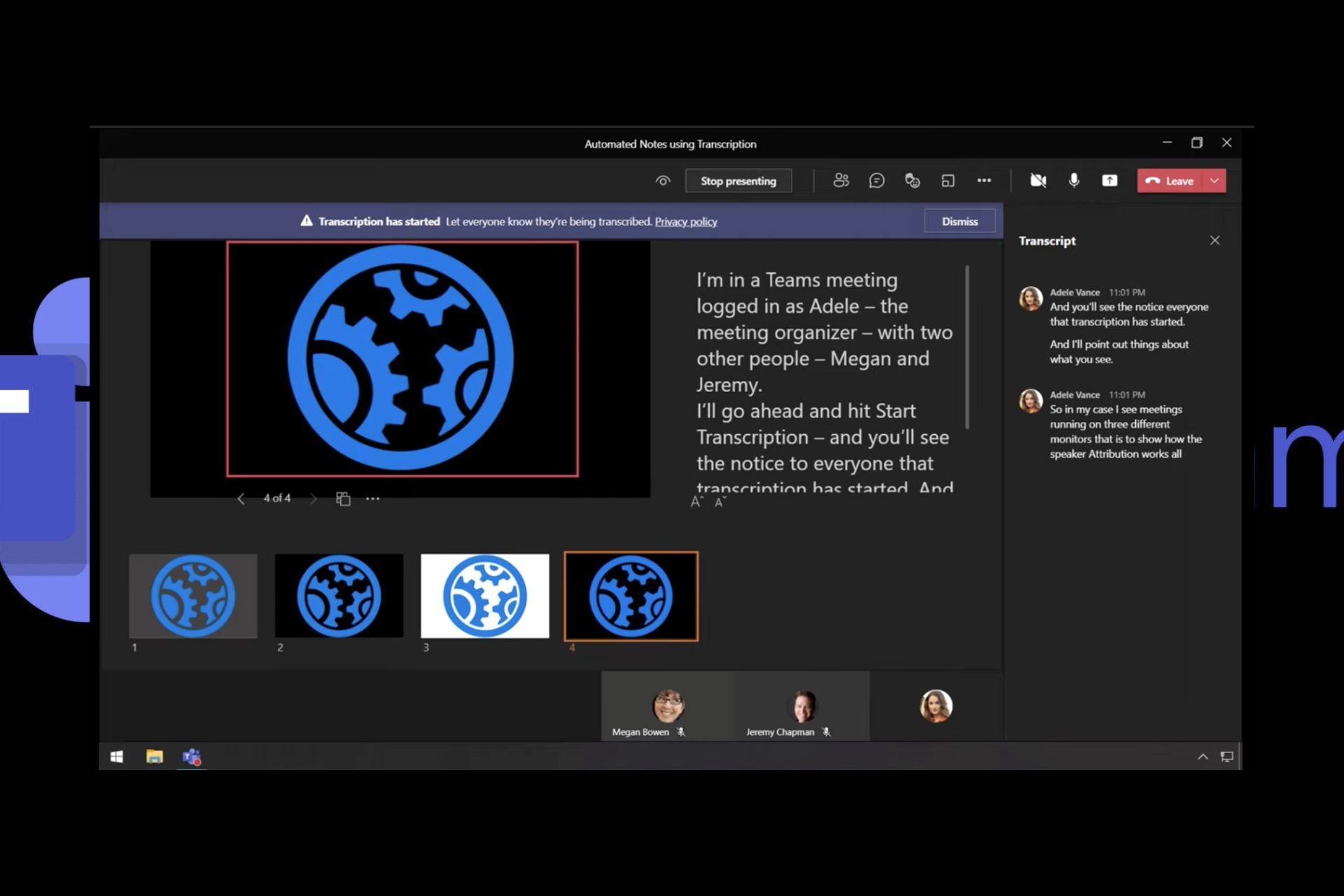
The Microsoft Teams AI note taker uses speech recognition technology to transcribe audio from the meeting in real time. It also has a high level of accuracy as it can detect various languages, multiple accents and diverse pronunciations for inclusivity.

To ensure you don’t waste time scrolling back and forth to look out for sections you might have missed, the AI note taker has a summary of topics discussed in the meeting. This way, you can jump directly to a specific section and catch up.

Also, if you’re looking for what a specific participant said, you can jump to the mentions section. By using this tool, not only do you save time, but also ensure active participation in the meeting for a more productive outcome.

How do I use the Microsoft Teams note-taker?

Note icon NOTE
You’ll need a Microsoft Teams premium subscription and enabled the transcription feature to use the AI note taker.
  1. Once you’ve concluded and recorded your Teams meeting, launch your Microsoft Teams app or on the web and click on Recap.teams intelligent recap
  2. Here, you’ll find your recorded meeting.
  3. You can also navigate to the Mentions tab to view by meeting participants and see what they said.
  4. When you navigate to the AI notes, you’ll find a transcript of the meeting.
  5. If you scroll down, you can also find the AI-suggested tasks.teams intelligent recap

What are some drawbacks of using the Teams note taker?

  • Cost: Although an excellent tool, the note taker requires a premium subscription which may not make financial sense in the long run, especially for a small team.
  • Accuracy: Whereas the note taker has proven to be diverse and flexible when it comes to transcription, it might take notes that are out of context and confuse a non-participant.
  • Compatibility: The feature is not compatible with all devices or operating systems so this limits its usage.

The benefits of the Microsoft Teams’ AI Note taker are obvious from saving your time to enhanced collaboration. It therefore makes it a no-brainer for any organization that is looking to enhance its productivity.

Finally, if you cannot afford to upgrade to Teams Premium, there are other alternatives to take your notes such as integrating ChatGPT in Teams or installing the Tactiq Chrome extension. It works just as good as the built-in tool for Teams so you may want to explore its features.

You can even install two Microsoft Teams on your Windows 11 and compare their performance. This will inform your decision whether to pay for the premium version or go with an extension.

And it’s not just Microsoft Teams that you can have your notes automatically transcribed. You can make use of other AI-note-taking apps for your Windows 11 that can help you get through your tasks a little faster.

Have you used the Microsoft Teams AI note taker? Would you say it’s a valuable addition to the platform? We’d love to get your thoughts on the good and bad so drop your comments down below.

OneDrive may soon get Magic Erase to let you edit pictures like a pro

At a time when more and more companies are integrating artificial intelligence into their products, Microsoft has a clear lead. From Copilot, an AI-based chatbot, to a new AI-powered File Explorer, the list is endless. And now, Microsoft has added a Magic Erase feature to OneDrive on Android.

First reported by Android Authority, the AI-driven Magic Erase feature strings were spotted in Microsoft OneDrive v7.1 beta 1.

As per the information deduced from the strings, Magic Erase comes with an Auto Apply feature, which ensures that changes are automatically saved. Besides, there will also be a warning highlighting that this is an AI-powered feature and some changes may not be perfect.

The exact warning reads, This feature uses AI to infill the removed area and may not be perfect or what you expect. If you find the results to be unexpected, please send us feedback.

Google Photos has had a similar Magic Eraser feature for over a year now, and it is pretty refined. Magic Eraser allows you to quickly remove unwanted object(s) from the picture in one go. Google’s feature also provides quick suggestions about clearing undesirable objects and people from the photo.

Last month, Microsoft added an AI-powered eraser in Windows Photos, the native image viewer on Windows PCs. So, we expect the AI-driven Magic Erase to make its way to the stable version of OneDrive on Android soon. As for iOS, there’s no official confirmation so far.

Have you tried OneDrive’s Magic Erase? Share your feedback with our readers in the comments section.

Elon Musk launches Grok-1 AI to counter ChatGPT

Elon Musk’s X launched their first AI named Grok-1 based on a 314 billion parameter Mixture-of-Experts model, as the publisher explained on a blog post.

For those who don’t know yet, Musk has chosen this name as a reference to Hitchhiker’s Guide to the Galaxy.

Previously, Grok was only available to Premium X users, but now, Musk has kept his promise to launch an open source version.

How can I get Grok-1?

Before anything, don’t get to excited because the new X model is not yet tuned up for optimal usage.

This is the raw base model checkpoint from the Grok-1 pre-training phase, which concluded in October 2023. This means that the model is not fine-tuned for any specific application, such as dialogue.

X.ai blog

Anyway, if you want to get the code and play with it, you can find it on the Grok-1 GitHub page. It is released under the Apache 2.0 license so you can mod it freely.

However, there is not so much information about Grok-1. The folks from X only disclosed a few hints:

  • Base model trained on a large amount of text data, not fine-tuned for any particular task.
  • 314B parameter Mixture-of-Experts model with 25% of the weights active on a given token.
  • Trained from scratch by xAI using a custom training stack on top of JAX and Rust in October 2023.
X.ai blog

However, interestingly enough, the cover of the post, which we also displayed on top, was created with Midjourney based on a prompt proposed by Grok: A 3D illustration of a neural network, with transparent nodes and glowing connections, showcasing the varying weights as different thicknesses and colors of the connecting lines.

If you decide on trying the new model, tell us all about it in the comments section below.

The latest Dev build of Windows 11 lets you choose your Copilot provider

Microsoft and other tech companies encountered issues with the EU’s DMA laws recently. If you’re not familiar, these laws are in place to prevent the monopolizing of services and ensure a fair market.

As a result, Microsoft is now testing a feature that allows you to switch to a different chat provider in Copilot.

The new build lets you select a different chatbot in Copilot

As you know, Copilot might read all your files and private data, and this comes as no surprise since Microsoft plans to integrate Copilot into the right-click menu.

The new build is here, and it allows you to have Copilot in a separate window, but that’s not all. As Gizchina writes, you can now switch your chatbot starting from build 26080.

Microsoft is currently testing this feature, and there are only two options available, Copilot, and Copilot Enterprise. Although the choice between providers is extremely limited, we expect to see additional options soon.

By having the option to choose their chat provider, enterprise users can protect their privacy since the Enterprise version offers improved data protection.

This is a welcome change since now users will be able to customize their Copilot experience and choose the best version for their needs.

This build is currently available for testing in the Dev channel, so go ahead and check it out if you’re interested.

Apple might pair its iPhones with Google’s Gemini AI, and Microsoft should be worried

Apple is reportedly looking to license Google’s Gemini AI for its next iPhones, and the tech company is also considering collaborating with OpenAI to integrate GPT into the upcoming iOS 18, which will be unveiled in the following months.

According to Bloomberg, Apple has even developed its own AI model, called Ajax, and even experimenting with a basic chatbot, Apple GPT. However, compared to Microsoft or Google, the company lacks the technology to develop a potent AI, and instead, it’s looking to other directions to update its phones with it.

For now, the talks are ongoing, and there are still matters to be discussed on branding, agreements of the AI implementation, and the technology itself, but more details about it should be unveiled at the upcoming WWDC which will be held in June, when the company is expected to unveil the next iOS.

Apple and Google have a history, so this is not entirely unexpected: Google is reportedly paying Apple $18 billion a year to be the default browser on Apple devices, so now, that the tables are somehow turning, it will be interesting to see how the partnership between the two companies will develop further.

Either way, this is not entirely good news for Microsoft, and its Copilot cohort: the company has been investing quite the resources in AI, and it’s making this technology the essence of the Windows experience. AI is also a prominent part of its B2B products, such as Microsoft 365, and Microsoft Teams, and the Redmond-based tech giant is seen somehow at the forefront of the whole technology.

A possible partnership between Google and Apple, when it comes to AI, could potentially diminish Microsoft’s market share in the AI industry, and it could become a case similar to the Google Chrome and Microsoft Edge rivalry. Even though Edge is on par with Chrome, or even better, for that matter, it still lives under Chrome’s shadow.

If Apple gears up its upcoming iPhone with the Gemini AI, Microsoft will have to catch up swiftly and effectively.

New Windows 10 Preview brings changes to lock screen and introduces Windows Spotlight & more

Recently, Windows 10 build 19045.4233 was released to the preview channel for Windows Insiders with Windows 10, version 22H2. The update includes changes to the Lock screen, Windows spotlight, and Windows Hello for Business,

With this update, you can add traffic, weather and financial information to your lock screen and other customization features per your preferences, making it quite useful. Here’s what the blog post on Microsoft says:

New! This update adds more content to your lock screen. In addition to weather, sports, traffic, and finance content will appear.  To turn on this feature, go to Settings > Personalization > Lock screen. Note this feature might not be available to all users because it will roll out gradually.

You can check out our detailed guide to learn ways to customize your lock screen. The next significant change is the addition of Windows Spotlight to your wallpaper. To avail of the feature, you need to enable it on your lock screen.

The feature changes the lock screen’s background every day, and you can click a button available on the lock screen to learn about the picture on the Spotlight. Here’s what Microsoft said in its blog post:

New! This update adds Windows Spotlight to your desktop background. This feature displays new images as your desktop wallpaper. If you want to know more about an image, click or tap the Learn More button, which takes you to Bing. To turn on this feature, go to Settings > Personalization > Background > Personalize your background. Choose Windows spotlight. Note this feature might not be available to all users because it will roll out gradually.

The update also brings Windows Hello for Business; using the feature, IT administrators can use mobile device management to turn off the prompt when the user signs in to an Entra-join device. Here’s what Microsoft said about the feature:

New! This update affects Windows Hello for Business. IT admins can now use mobile device management (MDM) to turn off the prompt that appears when users sign in to an Entra-joined machine. To do this, they can turn on the “DisablePostLogonProvisioning” policy setting. After a user signs in, provisioning is off for Windows 10 and Windows 11 devices.

The update also brought many other changes to Windows 10, including support for daylight saving time and fixes for issues affecting the COM+ component, deadlock issues in CloudAP, and more. You can check out the Windows Insiders blog for details.

We are glad to know that Microsoft is still introducing new features and addressing issues promptly on Windows 10, given the end of support time is approaching.

The features are currently available for Windows Insiders but will soon be released for the general public. We have a separate guide for those who want to join the Windows Insider program.

What do you think about the new features? Share your opinions with our readers in the comments section below.

Asus Rog Ally is hit by Windows & AMD driver updates

If you have an Asus Rog Ally portable game console and run into problems running apps and games, that is caused by the latest Windows updates, coupled with the AMD .8001 graphics driver update.

As reported by Windows Latest, users also had to confront nasty BSoD errors, FPS drops, stuttering and more.

Apparently, the major culprit is the already infamous Windows 11 KB5035853, which is creating havoc among PC and laptop owners as well.

According to a Reddit thread, many users complain about the same issues on Asus Rog Ally with BIOS versions 336 and 337.

What can I do to fix the issue on Asus Rog Ally?

Although the issue is affecting your console pretty seriously, you can still fix the problem pretty fast.

There are three tested solutions to get rid of this problem right now. First, disable the in-game overlay feature from the AMD Adrenaline app. You will find this setting in Settings > Preferences.

Another solution is to uninstall the March 2024 Windows Update. To do that, search for Uninstall Updates in the Start menu and press Enter, then find the KB5035853 update and hit the Uninstall button.

Ultimately, you can try resetting the AMD Adrenaline app from its Advanced Settings menu. The problem with this solution is that you will need to create a new profile after resetting the app.

In conclusion, people are very mad about the problems caused by the KB5035853 update. It seems that for now, the safest thing to do is not to install it in the first place or uninstall it until further notice.

Have you had problems with the latest Windows update on Asus Rog Ally? Tell us all about that in the comments section below.

You can use Samsung Notes on any Windows 11 PC. Here’s how

Samsung Notes is one of the most useful features that comes pre-installed with any Samsung mobile device, and that can be easily installed in any Samsung laptop. Paired with a Samsung phone, users can easily transfer notes on their Windows 11 PCs, with just a few taps.

Not to mention, the app automatically syncs data, so any changes made in Notes in Samsung, will carry over to the Windows 11 PC.

However, there is a downside: Samsung Notes can only be installed on Windows 11 Samsung laptops, officially. Unofficially, though, you can tweak your device to be able to install this useful app, and we’ll show you how.

First off, download and install Samsung Notes on your Windows 11 device. You’ll have 2 options for this. You can either download and install it from Microsoft Store and if that doesn’t work, you can install it using Windows Terminal.

How to download it from the Microsoft Store:

  1. Click this link, or look up Samsung Notes in the Microsoft Store.
  2. Open the installer, and initiate the installation process.samsung notes windows 11

If you can’t find Samsung Notes on the Microsoft Store, you can install it with Windows Terminal:

  1. On your Windows 11 Desktop, right-click, and select Open In Terminal. samsung notes windows 11
  2. Insert this command: winget install "Samsung Notes"
  3. Press Enter, and then Y.

Windows Terminal should install Samsung Notes, and the app should make itself visible when accessing the Start menu. However, when trying to open it, you’ll see that you won’t be able to. This is because you’re trying to run it from a non-Samsung Windows 11 device.

Don’t worry, though. You’ll be able to bypass it by masking your Windows 11 device with Galaxy Book Mask, a third-party app you’ll download from GitHub.

  1. Go to GitHub, and download Galaxy Book Mask.
  2. The app comes in 3 versions:
    • Startup – this one will mask your device at the startup, so you won’t have to manually run the Galaxy Book Mask every time you want to use the app.
    • No startup – this version will make you manually run the Galaxy Book Mask every time you want to open Samsung Notes.
    • Direct launch – this version will directly open Samsung Notes, right after Windows 11’s startup.
  3. Download your preferred version, and install the Galaxy Book Mask.

To have a seamless experience, you can go with the Startup version, but every time you need your real device information, you’ll have to uninstall Galaxy Book Mask.

Once you apply the mask to your Windows 11 device, Samsung Notes should be working properly and without any issues.

As you can see, running this app on non-Samsung Windows 11 devices takes quite an effort, but once you get the hang of it, it should be easier.

However, given that Samsung phones are quite popular among users, the tech company won’t make this app available to all Windows 11 devices naturally, as it can be an incentive for customers to get Samsung laptops, in the first place.

The company has been making its apps widely available to Windows 10, and Windows 11 devices, such as the Samsung Internet browser, which can be downloaded from the Microsoft Store now. But don’t expect Samsung Notes to be available this way anytime soon.

Tesla Bot Optimus Gen 3 to cost less than a car, confirms Elon Musk

The humanoid market is growing exponentially, adding new players every day. Though Tesla remains one of the biggest and most popular humanoid developers. Its latest offering, Tesla Bot Optimus Gen 3, could be the game changer if released at the expected price.

Elon Musk, when asked about the cost of Tesla Bot Optimus Gen 3 during an event, said,

It is expected to cost much less than a car. I would say, probably less than $20,000.

This revelation by Musk, if true, could significantly alter the dynamics of the humanoid market, giving Tesla an early lead and allowing it to capture a large section of the user base.

Typically, humanoids similar to Tesla Bot Optimus Gen 3 are priced in the $100,000-$150,000 range. Boston Dynamics’ Atlas robot costs $150,000, and Xiaomi’s CyberOne is expected to cost between $89,000 and $105,000.

The only humanoid in Tesla Bot Optimus Gen 3’s price range is Kepler, which may cost anywhere between $20,000 and $30,000, and mass production should commence later this year, a few months before Tesla.

Will Tesla Bot Optimus Gen 3 cost $20,000?

If history teaches us anything, we can’t take Elon Musk’s statements regarding the pricing of Tesla Bot Optimus Gen 3 at face value, meaning the humanoid could be priced higher when it hits the market. Experts have different opinions on how much higher it would be!

Farzad Mesbahi, an expert in the field, believes that Tesla Bot Optimus Gen 3 should likely cost $25,000-$50,000. He pegs the sales numbers at 20 million/annually by 2030.

Others are of the opinion that the Tesla humanoid robot should ideally be placed in the $50,000 to $85,000 range. They believe that if Tesla Bot Optimus Gen 3 can be sold at, say, $70,000, given the pricing of rival products, why should Tesla go with a lower price tag.

While this may be a viable approach, higher prices would keep Tesla’s innovation away from the middle class and industries that want to deploy it for trivial tasks (with zero or low financial returns).

On the other hand, a lower price tag, coupled with Tesla’s popularity, would allow Bot Optimus Gen 3 to find massive applications in households and industries.

Whichever way Tesla goes, it has to be quick with the decisions because other tech giants are fast catching up.

Last month, Microsoft and OpenAI invested $500M in FigureAI, a Tesla competitor developing humanoids. FigureAI has signed another deal with BMW to deploy its Figure 01, an AI-powered robot that can communicate, in the automaker’s factories.

Besides, transitioning from the development to the mass production phase takes time. For Boston Dynamics, the makers of Atlas, it took roughly 28 years, from 1992 to 2020.

What do you think would be the right cost for Tesla Bot Optimus Gen 3? Share with our readers in the comments section.

Microsoft puts Copilot at your fingertips with upcoming right-click integration

Copilot is a focal point of Microsoft, and the company is determined to integrate it into various services.

It seems that Microsoft has no plans of stopping, and we should see Copilot available in the context menu on Windows 11 soon.

Leaked screenshot shows Copilot menu when right-clicking files

Copilot went through some changes recently, and the KB5037133 update lets you move Copilot freely. There are also reports that Copilot in OneDrive will be available right from the file viewer.

That’s not all, and as MSPowerUser writes, we’ll soon see a better integration between Copilot and File Explorer.

This was first spotted by PhantomOcean3 on X:

As you can see, the Copilot will be available when you right-click a file, and you’ll have the option to send the file to Copilot or to Summarize it.

We don’t know exactly how this feature will work, but we do know that different file types will be supported. The list includes text, PDF, PowerPoint, and Excel files.

This feature isn’t available to the Insiders, and there’s no way to test it, but we hope to see it available soon.

When it comes to AI, AMD Ryzen is performing better than Intel Core Ultra

AMD, with its latest Ryzen chips, is performing better than Intel Core Ultra at AI-based tasks, according to new benchmark tests made by the tech giant, which saw the Ryzen 7 7840U APU at 15W competing against Intel Core Ultra 7 155H at 28W.

The AMD Ryzen 7 7840U APU came back as a winner, even though both CPUs were equipped with 16 GB of LPDDR5-6400 and the latest drivers available.

Both processors run several LLMs, including Llama 2, Code Llama, Mistral AI, and RAG, and the results were impressive for AMD: when it comes to tokens per second, Ryzen 7 7840U APU performed 14% faster in Llama 2, and 17% faster in Mistral AI, as you can see below.AMD Ryzen AI

When it comes to time to first speeds, AMD Ryzen 7 7840U APU also has an impressive 79% faster in Llama 2, and 41% faster in Mistral AI.

AMD Ryzen 7 7840U APU is cheaper than Intel Core Ultra 7 155H, at $899 compared to Intel’s $999, and it’s specifically more powerful than the Ultra 7, but there are some reasons for it. First, AMD has been experimenting with AI PCs for a longer time now, and the company has updated its chipsets to be able to handle such tasks at a more optimal performance.

On the other hand, the Intel Core Ultra 7 155H has only been out for a few months, and Intel hasn’t managed to fully address the performances, but the company has an AI strategy for the months ahead, and there is no doubt it will catch up.

Qualcomm is also expected to make its CPU debut this summer and the company will release processors suited for AI tasks, with some of them being integrated into future Windows AI PCs, so it will be interesting to see just how these 3 companies will manage to compete with each other.

87% of companies in the UK are at risk of AI cyberattacks, says Microsoft

Cyberattacks are constantly occurring, therefore companies must be able to address them properly.

According to Microsoft’s report, things aren’t looking too well for the UK business, and here’s why.

Only 13% of UK businesses are resilient to cybercrime

As TechRadar writes, Microsoft has conducted research and found that 87% of UK businesses aren’t ready to handle cyberattacks.

According to Microsoft, 48% are ranked as vulnerable while 39% are high-risk targets. Hackers are using AI for cyberattacks, and companies need to adapt properly to handle these new threats.

Paul Kelly, Director of the Security Business Group at Microsoft UK said the following:

The same AI technologies can help leaders better secure their organisation and tip the balance back in their favour. AI has the potential to make your business and data more secure, but also, if a cyberattack were to occur, to lessen the impact on your bottom line.

The research also listed a few guidelines for the UK to become an AI and cybersecurity superpower:

  • Better support for implementing AI in the cybersecurity industry.
  • Improved guidance when it comes to the adoption of AI in both private and public sectors.
  • More investment and prioritization of AI solutions focusing on buy and build and off-the-shelf solutions.
  • Proper education of employees via partnerships with academic institutions.
  • Improved research and sharing the research data with the private sector to better utilize the expertise of experts.

This is unfortunate news for the UK, but with the new pricing model for Copilot for Security, some companies can already start incorporating AI into their security system.

While Microsoft is doing its best to combat online threats, it seems that Microsoft might lose government customers due to security breaches, and we hope that the company will be able to address those issues.

Apple acquires DarwinAI in the latest push, bought 32+ AI companies last year

Apple was a little late in deploying artificial intelligence, but when it did pick things up, there was no looking back. In the last year, Apple acquired over 30 startups operating in different stages. DarwinAI, a Canadian startup, is the latest addition to the list.

DarwinAI works on AI-driven technologies that better assist in the manufacturing process, but its primary focus is on making AI systems smaller, faster, and more efficient.

As reported by Bloomberg, Apple acquired DarwinAI earlier this year, though there has been no official confirmation so far. Some say that DarwinAI disabling its social media handles is in line with the established pattern of startups acquired by Apple.

Besides, Alexander Wong, the startup co-founder’s LinkedIn profile reads Director of Machine Learning at Apple since January’24, and a large number of DarwinAI’s employees have been inducted into Apple’s AI teams.

Apple’s plans with AI

Apple hasn’t shared too much regarding its plans for artificial intelligence. We reported previously about Apple developing its native chatbot, AppleGPT, which still finds application within the company and is not accessible to people.

Then, Apple dropped plans for electric vehicles and moved most of the affected employees to the AI teams. The Cupertino-based tech giant realizes it still has much to cover up since its competitors, Google and Microsoft, are way ahead in the race!

Apple previously introduced some AI-powered features in iOS 17, then added the functionality to Apple Vision Pro, and also released a text-to-image editing tool, MLLM-Guided Image Editing or MGIE, which was called a gamechanger.

With Apple on a spree to acquire AI startups encompassing different domains, we could see more being added to Apple’s list of acquisitions in the coming days. Plenty of AI-driven features should be seen in iOS 18 and some exclusives in iPhone 16, both to be released later this year.

What do you think of Apple’s AI push? Share with our readers in the comments section.

Soon, Copilot might read all of your files and access private data

Microsoft tries to integrate Copilot everywhere, and the newest feature, which allows it to read your files, shows it. Additionally, you can find AI in most of their apps and services, such as Microsoft 365, Outlook, and OneDrive. As if having it everywhere wasn’t enough, the company faces lawsuits for data harvesting. Yet, there are good parts to having an AI assistant that knows everything.

Does Copilot collect your data?

The new feature lets Copilot collect your data and read your files, and Microsoft won’t share it with third parties unless you agree. However, you may have agreed to their Terms and Conditions. The company is one of many that have access to your data. Many other applications require your approval to access and use your information and tools. So, before you think of what AI does after reading your files and private data, concentrate on the positive side.

The new feature allows Copilot to read your files. The virtual assistant can then use everything it learns to help you. For example, it can send emails and look for files faster than the search option. Another great feature is that it can summarize your files. Thus, it’s great if you are in a hurry. Also, you can use the AI to verify the source of emails to avoid threat actors. To access this feature, you will have to opt in.

If you allow Copilot to read your OneDrive files, the AI assistant can access data about your work and business. Afterward, if you are good at generating prompts, it can summarize information in various ways. For example, it can answer questions about your business.

As you can see, letting Copilot read your data has many benefits. However, there are some negative aspects. Microsoft can access your data freely, and inventive people could use the chatbot to steal your data. Overall, if you do not fear for your data, the feature that allows Copilot to read your files will help you greatly.

What are your thoughts? Are you going to opt in and let Copilot assist you? Let us know in the comments.

Windows 11 will replace speech recognition with the Voice Access app

In September 2024, the new Voice Access app will replace the old Speech Recognition for Windows 22H2 and newer versions. You can continue using the old app, but only on Windows 10 and older Windows 11 versions. Also, if you use the 21H2 build, it will forcefully update to 22H2 or 23H2.

Why is Windows replacing speech recognition with Voice Access?

Windows replaced speech recognition with the Voice Access app because it uses a newer AI technology. So, it has increased accuracy, better control, and greater accessibility. Also, with it, you can add and use customized voice commands. Yet, you will need an internet connection to set up the application and voice commands and to download the language models.

An additional feature of the new Voice app will help you use it on multiple monitors. This option comes as a handy gimmick, especially if you are working. To use the new application on Windows, follow the instructions below:

  1. Press Win and go to Settings, afterward to Time & Language, next to Speech.
  2. Look for the Microphone settings and press Get Started.

Windows Speech Recognition (WSR) and Voice Access appear on the same Accessibility settings page. While the new tool is the first on the list, you can find WSR under the Other Voice Commands section. After all, the legacy app is not internet-dependent. Also, the speech recognition app is easier to use.

Ultimately, the new Voice Access is a great replacement for the legacy Windows Speech Recognition app. While the new app offers more features, is more accessible, and lets you command with your voice. It has some disadvantages, such as internet dependency. Also, the legacy app is compatible with more languages, but the new one will receive further updates and features.

What are your thoughts? Are you going to give Voice Access a try? Let us know in the comments.

Copilot gets its own separate window and becomes an AI assistant

Windows 11 Build 26080 brings a new app-like design and features for Copilot. The new UI lets you move and resize the application freely. This option that emphasizes accessibility will be available for everyone with the next cumulative update. Combined with the new attributes, Copilot will get closer to being a great AI assistant.

Unfortunately, for now, we are forced to use Copilot on the right side of the desktop.

What does the build 26080 bring for Copilot?

The Windows 11 build 26080 lets you undock AI assistant from the taskbar and the right side of your desktop. In this way, the app-like design makes Copilot far more accessible. After all, the new UI lets you move around the app where you want. Also, with it, you can use the split screen option or multiple monitors.

Windows fixed an annoying error that prevented the app from showing up after turning it on and off. In addition, more features are coming to the AI assistant. For example, after the patch, you can open Copilot by hovering over it. The popup will vanish if you do not interact with the application afterward.

Expect to see new built-in capabilities for the application. They are convenient because you can ask the AI for details about your device, and you can make it perform a few tasks. For example, you can ask Copilot about your IP and device information and instruct it to open the power-saving mode and clear the recycle bin. 

There are some new accessibility features, such as asking the AI to turn on the narration or to enlarge the text. Additionally, the new build will introduce Power Automate via Copilot. A plugin that lets the AI write emails, create lists, rename, and move documents.

Last but not least, the new Windows build will make Copilot more accessible by giving it a new app-like design. Also, the assistant will get new built-in features to make it more useful. In addition, you can open the AI by hovering over it. Hopefully, the changes will help you accommodate Copilot in your daily tasks.

What are your thoughts? Are you going to use Copilot more? Let us know in the comments.

Microsoft is updating OneNote’s Meeting Details to improve user efficiency

Microsoft is updating OneNote’s Meeting Details feature by integrating Teams’ intelligent meeting recap. The update is in the works and is available in the Microsoft 365 Roadmap under Feature ID 388747. It is worth noting that this feature will be available on desktops across Worldwide (Standard Multi-Tenant) cloud instances starting April 2024.

A new feature update is in the works and coming to Microsoft OneNote

Here’s what the new OneNote Meeting Details update will bring:

  • The basic details such as meeting date, description, and attendees, will automatically be added to the OneNote Meeting Details.
  • A summary of AI-generated notes with the key points discussed in the Teams meeting is said to be added to the OneNote Meeting Details.
  • Analyzing the Teams meeting, OneNote will suggest related tasks.
  • Any documents shared in the Teams meeting will be readily available in OneNote. 

We believe that the motive behind the upcoming update is to improve user efficiency and workflow. That’s because the AI-generated notes will give users clarity about the topics discussed in the meetings. Additionally, the suggested tasks will allow users to follow up on the agendas of the meeting.

Moreover, users can access details about the meetings and documents shared in one place, eliminating the post-meeting hassle. 

Reddit faces FTC inquiry over the sale of user data to AI companies

The Federal Trade Commission (FTC) inquired Reddit about the sale, licensing, or sharing of user data with AI companies. On March 15, the company disclosed the news in its filing with the Security and Exchange Commission. 

Talking about the FTC inquiry in its recent filing, Reddit wrote:

Given the novel nature of these technologies and commercial arrangements, we are not surprised that the FTC has expressed interest in this area. We do not believe that we have engaged in any unfair or deceptive trade practice.

Reddit mentioned as a part of the FTC inquiry, officers questioned their plans and asked for various information and related documents. The company also included that the inquiry is ongoing.

It is worth noting that Reddit has recently been showing interest in several business deals with AI companies. It plans to allow third parties to access databases of human-written text that AI models can train upon.

Let’s not forget that Reddit struck a $60 million deal with Google last month for a similar purpose. This deal allows Google’s AI models to train on Reddit users’ content that aims at improving internal search and other features.

The latest filing also revealed some less-known details about the San Francisco-based company. For example, OpenAI’s Sam Altman is one of the top investors who owns about 9 percent of the company’s stake. 

Microsoft to suspend access to its cloud services in Russia

Microsoft will suspend access to its cloud services for companies in Russia starting March 20. Elena Volotovskaya, VP for investments at Russian IT company Softline, recently confirmed the news to RBC Russia.

Microsoft to suspend access to its cloud products for companies based in Russia

As per a recent RBC Russia report, Softline has warned all its customers to expect restrictions on other services offered by Microsoft. Microsoft said it would suspend cloud services in Russia due to the 12th package of EU sanctions, EU 833/2014. 

The Russian IT firm has also created a dedicated Telegram channel for all its clients to address and mitigate the impact on businesses. As per the company, the Telegram channel will be helpful for clients as it will provide updates, guidance, and workarounds relating to this matter.

Softline also mentioned that Amazon and Google are also closing access to their cloud products and services. Softline has also urged all its users who used Microsoft, Amazon, and Google cloud services to back up data immediately.

Talking about this matter, the general director of the Basalt SPO company (developer of Viola OS) said:

Those companies that had purchased subscriptions to Microsoft or other foreign service providers for data storage had been short-sighted. There was always a risk of being cut off from access, and now that has come true. This is a serious problem for those organizations that have avoided switching to domestic software and service providers.

Let’s not forget that Microsoft announced that it was stopping the sale of its products and services in Russia. The decision came in March 2022, right after Russia’s full invasion of Ukraine. It is worth noting that the tech giant has also stopped renewing Microsoft 365 Office suite subscriptions since August 2023.

LinkedIn is bringing in-app games to boost user engagement

According to a recent report, LinkedIn games will soon debut as an attempt to boost user interaction and engagement. LinkedIn is a Microsoft-owned social and professional networking platform with over a billion users. The platform primarily allows users to create professional profiles, share knowledge, build connections, and find jobs.

LinkedIn is undoubtedly a super platform for finding your dream job. And now, LinkedIn is looking to break into a new horizon of gaming that it believes will boost the time users spend on the platform. So, what are LinkedIn games?

LinkedIn games will soon give boring job search experiences a playful twist

A recent report from TechCrunch confirms that LinkedIn is working on a new gaming experience. It will do so by introducing three in-app puzzle games: Queens, Inference, and Crossclimb.

One such person, Nima Owji, recently tweeted some images of the games. And, mentioned LinkedIn is working towards an idea where firms will rank in the games based on their employees’ scores. 

TechCrunch reached out to a LinkedIn spokesperson to confirm the speculation. In reply, the source mentioned: 

We’re playing with adding puzzle-based games within the LinkedIn experience to unlock a bit of fun, deepen relationships, and hopefully spark the opportunity for conversations.

The spokesperson also shared some screenshots of the games and added that images of games on X (formerly Twitter) are not of the latest version. Moreover, the spokesperson refused to mention Microsoft’s involvement in LinkedIn’s gaming project. 

You can check out the screenshots of the LinkedIn in-app games below. 

Queens desktop
Crossclimb mobile
LinkedIn game Inference mobile
LinkedIn game Crossclimb desktop
Image credit: TechCrunch

Are you excited about the LinkedIn games? Let us know your thoughts about LinkedIn’s move in the comments below. 

Windows 11 KB5035853 update is causing multiple issues

The recently released Windows 11 KB5035853 update is causing multiple issues. Although it may seem like a usual Windows update, it is not. Many took to Reddit to report several issues they have been facing after the KB5035853 update. 

Users complain about several issues after installing the Windows 11 KB5035853 update

Here’s the list of known issues users are facing after the update:

  • Blue screen of death with different error codes
  • Transparent taskbar issue
  • Screen freezing issue
  • Blurry image problem
  • Abrupt shutdown issue
  • Stuttering issue
  • Performance issue
  • The ‘Explorer.exe’ error isn’t still fixed
  • Slow-loading ribbon in File Explorer is still not fixed

The above issues are affecting Windows 11 users for now. Time will tell when Microsoft addresses these annoying issues.

Let’s not forget that the KB5035853 update also brought a few changes and improvements. The Phone Link settings page has a new name – Mobile Devices. Besides, you can use the Snipping Tool to edit screenshots you take on your Android devices. Moreover, the KB5035853 update adds support for the USB 80Gbps standard and fixes the infamous 0x800F0922 update error.

Are you enjoying these features or facing issues after installing the Windows 11 KB5035853 update? Please let us know in the comments below.