Layoffs have been rampant across tech industries. Every now and then, we come across some other report like this—this time, it’s Microsoft again. According to Bloomberg, Microsoft is planning to lay off thousands of employees, mostly from sales, as it closes out its fiscal year.
The announcement is expected in early July, though the timeline could still shift. While sales teams are expected to take the biggest hit, other departments may also be affected.
Microsoft hasn’t confirmed anything officially at the time of writing. If the report is accurate, the fresh round of layoffs will follow the layoffs in May that cut 6,000 roles. Back then, layoffs affected mostly the engineering and product teams. Sales and marketing were mostly untouched back then.
The company had reportedly hinted at things earlier. In April, it told employees that more sales for small and mid-sized customers would be handled by third-party firms.
Microsoft is spending tens of billions on AI infrastructure—servers, chips, data centers—and has made it clear that it plans to limit spending in other parts of the business.
As of June 2024, Microsoft had 228,000 employees, with 45,000 in sales and marketing. The company usually reshuffles its workforce around the end of its fiscal year, which wraps up this month.
Mark Zuckerberg really wants Meta to win the AI race—so much that his company reportedly offered $100 million signing bonuses to some top OpenAI employees. That’s according to Sam Altman, OpenAI’s CEO, who revealed it during a podcast hosted by his brother Jack.
“They started making giant offers to a lot of people on our team,” Altman said. “You know, like $100 million signing bonuses.” Still, he added, “None of our best people have decided to take them up on that.”
Apparently, Zuckerberg is personally recruiting a team to build AI that’s smarter than humans. He’s even been hosting experts at his homes and reorganizing Meta’s offices to put the AI team closer to his desk.
Just last week, Meta dropped $14.3 billion to buy nearly half of Scale AI—another big name in the space. The company’s CEO and some employees are also joining Meta.
Altman wasn’t shy about calling out the competition either. “I don’t think they’re a company that’s great at innovation,” he said, though he added he respects Meta’s push to keep trying.
The rivalry is heating up, and so is the money behind it. Meta wants to move fast, but for now, OpenAI says its top talent isn’t going anywhere.
If you’ve been holding onto your Xbox library, there’s finally good reason to feel confident about its future. Microsoft has confirmed that backwards compatibility will be a key part of the next generation of Xbox.
While the Xbox team has been dropping quiet hints over the past year, we finally got the big-picture confirmation during yesterday’s announcement.
Sarah Bond, President of Xbox, when announcing partnership with AMD, mentioned that future Xbox hardware will deliver “a deeper level of visual quality and immersive gameplay… all while maintaining compatibility with your existing library of Xbox games.”
That means your current games aren’t getting locked away when the next console shows up. Whether you’re gaming on a traditional console, something portable, or streaming from the cloud, your existing library is coming along for the ride.
Now, before you get too excited, Bond specifically mentioned “existing” titles. So no, it doesn’t sound like new backwards-compatible games are being added to the list just yet. But still, this early commitment shows that Xbox is thinking long-term and making sure players keep what they’ve already paid for.
If you’re someone who thinks your data should be off-limits to AI training bots, Mastodon has some news you’ll probably appreciate. Mastodon has updated its terms of service to ban AI scraping.
“We explicitly prohibit the scraping of user data for unauthorized purposes, e.g. archival or large language model (LLM) training,” the platform noted. “We want to make it clear that training LLMs on the data of Mastodon users on our instances is not permitted.”
The updated terms go into effect July 1 and aim to block any kind of automated data extraction. That includes bots, crawlers, scrapers, offline readers—basically anything that pulls data in bulk without a human behind it. If it’s not for standard search or browser functions, it’s off-limits.
There is one catch, though. These rules only apply to Mastodon.social, which is just one server in the larger fediverse. Since Mastodon is decentralized, other instances can still set their own rules. So technically, AI companies could still scrape from other servers—unless those servers also ban AI scraping.
The move comes not long after X (formerly Twitter) updated its own terms to ban model training, following a growing trend. Reddit, OpenAI, and even The Browser Company have also laid down similar rules to prevent outside companies from turning public content into training fodder.
Mastodon’s update also introduces a new age restriction. The platform is raising its minimum age from 13 to 16, and this one applies globally.
If you pay monthly, that number jumps to $18. For current users, renewing before that date gives you a way to hold onto the old rate for a bit longer. For new users, the higher price is already in effect.
While the Pro plan price stays put, Salesforce has quietly introduced a new Enterprise+ option. That one’s got more bells, more whistles, and, of course, a flexible, custom price tag. This isn’t just about charging more, it’s about baking AI into the platform.
Slack’s upcoming update, arriving July 17, brings a bundle of new AI features to every paid plan. Pro users get summaries of threads and conversations, plus automatic huddle notes. If you’re on Business+, you’ll get all of that, plus some added power: AI search, file and channel summaries, automatic translations, and even tools to generate workflows.
Enterprise+ adds even more control. Think of broader search capabilities, extra layers of security, and new governance tools. It’s basically built for larger organizations that want fine-tuned command over everything.
If you’re after a reliable laptop for everyday tasks, this HP 2025 model is now available on Amazon for just $369 — a steep 69% off its original $1,199 price. The deal includes Windows 11 Pro, a lifetime Microsoft Office license, and even a wired mouse.
It’s powered by an Intel N150 processor, which offers four cores, four threads, and speeds up to 3.6GHz. It outperforms the older N4120 chip and can handle web browsing, document editing, streaming, and light productivity apps with ease. Not a powerhouse, but more than enough for daily use.
The laptop comes with 16GB DDR4 RAM and a combined 384GB storage setup — 128GB UFS onboard and an included 256GB microSD card. That’s plenty of room for apps, files, and media without needing an external drive.
Image: HP
The 14-inch HD screen runs at 1366×768 resolution with anti-glare and BrightView technology. It’s not full HD, but it works for most tasks and offers wide viewing angles with a slim-bezel design. A 720p webcam and dual mics support decent video calls, even in less-than-ideal lighting.
Ports include USB-C, two USB-A, HDMI, and a multi-format SD card reader. Wi-Fi 6 and Bluetooth are included for faster wireless performance and better device pairing.
You also get Windows 11 Pro, which brings more control over system settings, and Microsoft’s Copilot AI assistant for help with tasks and projects. Just make sure not to install Microsoft 365, or it’ll override the included lifetime Office license. If you are looking for school work or light gaming, check this article.
Runtime libraries are essential code files (usually DLLs) that many Windows 11 programs need to run. Most apps rely on Microsoft Visual C++ Redistributables to function. If the right version isn’t installed, the program may fail to launch and show a missing DLL error.
Windows 11 doesn’t always include these libraries by default. On clean installs, apps may not find the runtime files they need. Some developers even advise users to manually install the correct Visual C++ package, like the 2015–2022 redistributable.
In this guide, we’ll explain common causes and symptoms of missing runtime libraries in Windows 11 and give step-by-step fixes (with easy instructions) so even beginners can resolve these errors.
Common causes of missing runtime libraries
Runtime errors often happen because Windows or the applications are missing needed files. Common causes include:
Missing or corrupted files: DLLs like MSVCP140.dll or vcruntime140.dll aren’t installed or have become damaged.
Wrong version installed: The app may require a specific version (or 32-bit vs 64-bit) of the Visual C++ runtime that isn’t present.
Broken installations: Failed installs, registry issues, or Windows updates can leave runtimes incomplete or unusable.
Outdated system: Missing system updates can lead to incompatibility with newer software or runtime requirements.
Conflicts or bugs: In rare cases, the app itself or another program can interfere with runtime detection.
In summary, missing runtime errors usually mean Windows lacks some needed library files (especially Visual C++ libraries). It could be because the app didn’t install them, they got corrupted, or Windows hasn’t been updated to include them.
Step-by-step solutions to fix missing runtime libraries in Windows 11
Below are practical steps to fix missing runtime libraries. You can try them in order until the problem is resolved. Each step includes simple instructions:
1. Install or repair Visual C++ Redistributables
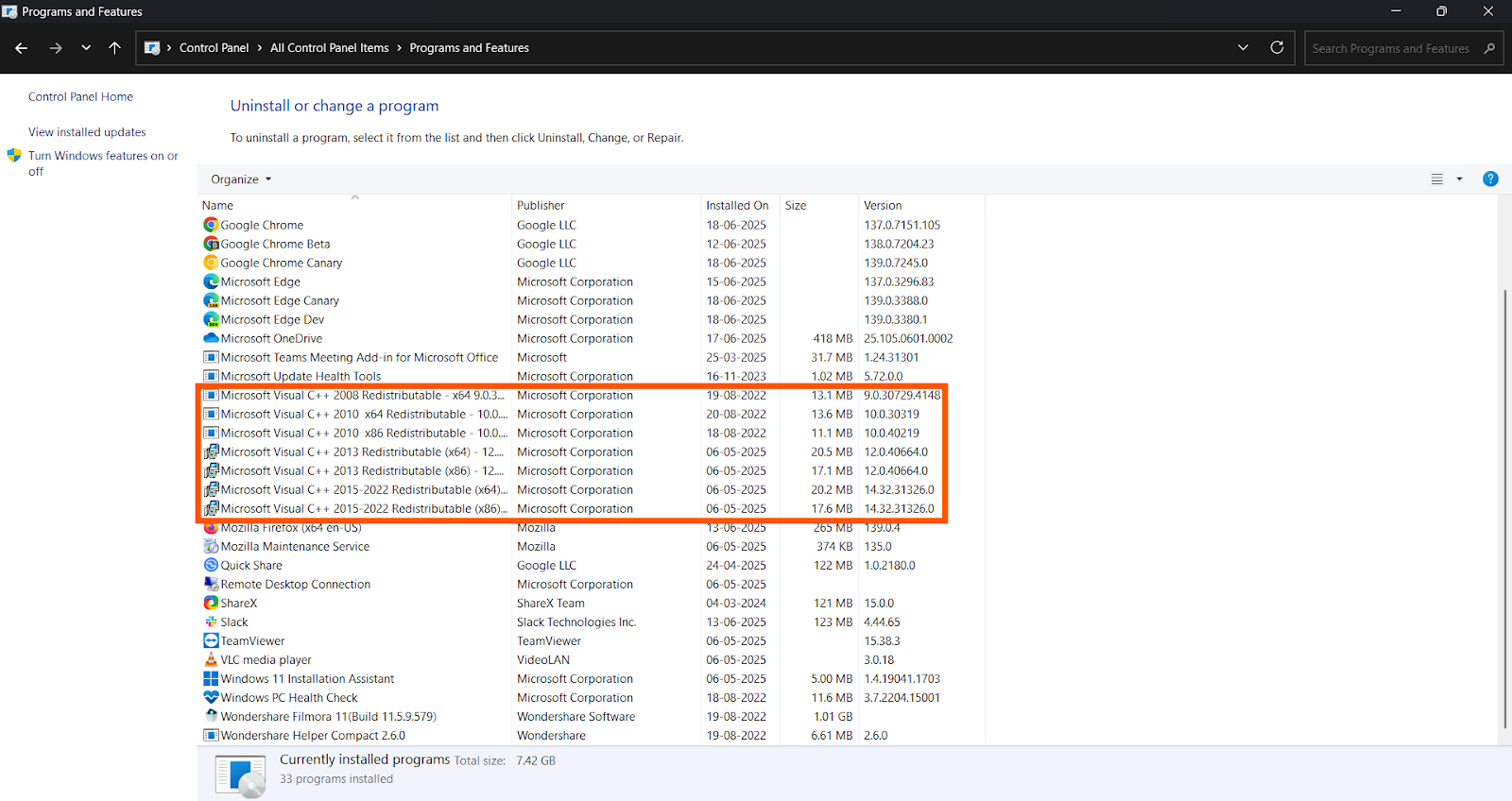
Open Control Panel and go to Programs and Features (or Settings → Apps in Windows 11). Look for any entries named Microsoft Visual C++ Redistributable (different years, like 2012, 2013, 2015–2022, etc.).
For each one, try clicking Modify (or double-click) and choose Repair. This fixes corrupt files in that runtime. If that’s not available or doesn’t work:
Uninstall all versions of the Visual C++ runtimes listed. Then reboot.
Go to the Microsoft Visual C++ Downloads page (as linked by Microsoft). Download the latest Visual C++ redistributable (for example, “Visual C++ 2015-2022”) in both x86 and x64 versions (download links provided there). Run each installer to install fresh copies of the runtime libraries.
If you saw a specific DLL missing (e.g. vcruntime140.dll), make sure you match the Visual Studio version (e.g. Visual C++ 2015 or 2019) to that file. In most cases, installing the latest “Microsoft Visual C++ Redistributable (2015-2022)” will cover it. This process ensures the correct runtime libraries are present.
2. Run System File Checker (SFC)
Windows has a built-in tool to fix corrupted system files. To use it:
Click Start, type cmd, right-click on “Command Prompt,” and choose Run as administrator. In the command window, type: sfc /scannow and press Enter. This scans Windows system files (including some runtime DLLs) and automatically repairs any issues.
It may take a few minutes. When it finishes, reboot and check if the error is gone. This can restore missing or damaged libraries that are part of Windows. It should be noted that running sfc /scannow will automatically repair any corrupted Windows system files, including the missing runtime files.
Run these commands one by one (wait for each to complete): DISM / Online / Cleanup-Image / RestoreHealth.
After it completes (it may take several minutes), reboot. DISM will check the Windows image for corruption and replace bad files from Windows Update. This can fix deeper issues that SFC can’t. The above command will check for system corruption and automatically repair any issues it finds.
4. Run Windows Update
Missing libraries can sometimes be fixed by installing the latest Windows updates, which may include updated runtimes. To update:
Open Settings → Windows Update and click Check for updates.
Install any available updates, then reboot. Keeping Windows current ensures you have the newest system files and libraries. In particular, Microsoft often delivers updated Visual C++ runtime patches via Windows Update.
5. Update graphics and other drivers (for games/apps)
If the error happens with a game or graphics-heavy app, updating your graphics driver can help. Outdated GPU drivers sometimes conflict with C++ runtimes.
First, Open Device Manager (right-click Start), expand Display Adapters, right-click your GPU, and choose Update driver → Search automatically. Install any found updates. Then reboot and try again.
6. Reinstall the affected program
If only one specific program is failing, try uninstalling and then reinstalling it. This ensures it installs any needed components properly. For many games and apps, the installer includes prerequisites (Visual C++, DirectX, etc.). After uninstalling, reboot, then reinstall the program. Also, temporarily disable antivirus during install in case it blocks runtime files. DiskGenius suggests that reinstalling the app can fix missing-file errors.
7. Other checks
If an error names a specific file (e.g. api-ms-win-crt-runtime-l1-1-0.dll), sometimes installing the Universal C Runtime Update or the Visual C++ 2015-2019 Redistributable fixes it. Microsoft’s site has specific updates for older OS versions if needed.
Try launching the program as Administrator (right-click → Run as administrator). Some apps need higher privileges to access certain libraries.
In rare cases, use the System Restore utility to roll Windows back to a point before the errors started (if such a point exists).
By following the above steps – repairing/reinstalling runtimes, scanning for corrupt files, and updating Windows – you should replace the missing libraries and allow programs to run again. Many users find that simply installing the latest Visual C++ Redistributables (step 1) fixes the missing DLL errors immediately.
Identifying missing libraries (symptoms and error messages)
When a runtime library is missing, you’ll typically see an error when opening the program. Common symptoms include:
An error pop-up like “MSVCP.dll is missing” or “VCRUNTIME.dll not found”. The exact filename (e.g. MSVCP140.dll, MSVCR120.dll, etc.) tells you which runtime component is missing. For example:
“The program can’t start because MSVCP120.dll is missing from your computer.”
A message “The application was unable to start correctly (0xc000007b)”. This can also indicate a missing or mismatched runtime library.
Errors about “side-by-side configuration” or a manifest failure. This often happens with .NET or C++ apps when their runtime dependencies aren’t installed.
The program simply refuses to open or crashes immediately with no obvious message. Often, the Event Viewer or error log will mention a missing DLL or Visual C++ runtime.
Sometimes, you might see “Visual C++ Runtime Library” errors in the taskbar when a program crashes (usually saying it needs a specific version of the runtime).
To pinpoint the issue, note the exact error text. If it names a DLL (like MSVCP140.dll), you know which Visual C++ redistributable to install. If it’s the 0xc000007b error, try checking your app’s bitness (32/64-bit) and whether the corresponding runtimes are installed.
Also check in Control Panel → Programs & Features for entries like “Microsoft Visual C++ 2015 Redistributable” – missing ones point to what needs installing.
Prevention tips
To avoid missing runtime errors in the future, keep these practices in mind:
Keep Windows updated: Regularly run Windows Update so that system files and runtimes stay current.
Install needed runtimes during setup: When installing new software or games, ensure you also install any prompts for “redistributables” or prerequisites. Many modern installers will do this automatically, but if not, manually install the Visual C++ packages they require.
Use reputable sources: Download software only from trusted websites. Corrupt downloads can lead to missing or bad runtime files.
Maintain your system: Run occasional scans like sfc /scannow and DISM /RestoreHealth as part of routine maintenance to catch file corruption early.
Avoid deleting DLLs: Don’t delete or move DLLs from the Windows folder. If cleanup is needed, use official uninstallers or tools rather than manual file deletion.
Balance bitness: On a 64-bit Windows 11, install both x64 and x86 redistributables if you run 32-bit applications, to prevent architecture mismatch errors.
By keeping your system clean, updated, and having the correct redistributables installed, you greatly reduce the chance of runtime library errors on Windows 11.
Conclusion
Missing runtime libraries in Windows 11 often cause frustrating “cannot start” errors, but they have straightforward fixes. In most cases, simply installing or repairing the Visual C++ Redistributable packages and running Windows repair tools will resolve the issue.
The key is to identify the missing component (often by its DLL name) and make sure the matching runtime package is present. Following the steps above – repairing runtimes, scanning system files, updating Windows, and reinstalling any problematic apps – will restore the needed libraries and allow your programs to run normally.
Once everything is updated and correct, you should be able to use Windows 11 without those startup errors.
As nostalgia swirls around Windows Vista’s boot sound popping up in a recent Windows 11 preview build, Microsoft’s past is back in the spotlight. Now, longtime engineer Raymond Chen is here with one of the strangest stories yet. Apparently, Windows 95 testing was so intense it crashed a store’s cash register.
There was just one problem. The cash register crashed. Chen explains, “The presumption was that anyone who wanted to buy products exceeding $10,000 would use a purchase order instead.” Unfortunately, that assumption didn’t hold up when one person tried to buy everything. The system couldn’t handle the transaction and froze.
To get around the issue, the developer simply broke the total into smaller purchases to stay under the limit. This very workaround solved thre problem. Well, the story doesn’t stop there.
Back at Microsoft, the team dropped all the software in the cafeteria. Each Windows 95 dev picked two programs, ran them like end users, and filed bugs for anything that didn’t work.
“In exchange for taking responsibility for ensuring that Windows 95 was compatible with your adopted programs, you got to keep them after Windows 95 shipped,” Chen recalled. “If you did a good job with your two, you could come back for more.”
It’s a rare look at the kind of scrappy, all-in work that shaped one of Microsoft’s biggest OS launches. That too, all starting with a truck full of software and a broken cash register.
According to the report, people are checking emails as early as 6 AM. By 8 AM, Teams chats take over. Most meetings happen between 9–11 AM and again from 1–3 PM — when we’re supposedly at peak focus.
Tuesdays are packed. Fridays, not so much. But here’s the kicker: meetings after 8 PM are up 16% compared to last year. Even weekends aren’t safe. Nearly 1 in 5 people check email before noon on Saturdays and Sundays. Some are back at it Sunday night.
Image: Microsoft
On average, workers now get hit with 117 emails and 153 Teams messages per day. That’s a distraction every 2 minutes. Microsoft says this “infinite workday” is being driven by hybrid work, rising demands, and, ironically, the very tools meant to keep us productive.
So how to fix this? Not just more AI — smarter use of it. AI can ease the load, but only if we rethink how work fits into life. The company further warns that “the future of work won’t be defined by how much drudgery we automate, but by what we choose to fundamentally reimagine.”
Broken Arrow is a newly released large-scale modern warfare RTS developed by Steel Balalaika, known for its ambitious real-time battles. Despite its popularity and thousands of players, many Windows users report that Broken Arrow simply does not work correctly on their PC.
In some cases, the game fails to launch or gets stuck on a black loading screen (with only background music playing), while others experience crashes to desktop with no error message. These issues are frustrating early adopters of the release, preventing them from playing even on high-end Windows 10/11 rigs.
Who is affected? Any PC gamer trying to play Broken Arrow on Windows could encounter these problems, especially right after release, when bugs and server stress are common. Players on unsupported operating systems (e.g. Windows 7 or 8) are particularly at risk, since Broken Arrow requires Windows 10 64-bit as a minimum. Even if your PC exceeds the game’s recommended specs, you might still run into launch failures or crashes due to software conflicts or missing components.
Possible causes for Broken Arrow not working
Several factors can trigger launch and gameplay issues in Broken Arrow on Windows PCs. Here are the most common causes:
Outdated drivers or OS: Old GPU drivers or missing Windows updates can cause crashes or black screens.
Missing libraries: If DirectX 12 or Visual C++ redistributables aren’t installed or are corrupted, the game may fail to start.
Software conflicts: Overlays or background apps (Discord, OBS, RivaTuner, vJoy, etc.) can cause black screens or crashes.
Antivirus/firewall interference: Security tools might block the game from launching or connecting to servers.
Server or network problems: Server outages or unstable internet may result in infinite loading or unresponsiveness.
How to fix Broken Arrow not working on Windows PC
If you’re struggling to play Broken Arrow on your PC, work through the fixes below. We’ll start with simple tips and then move on to more complex solutions. Each fix includes a brief explanation and step-by-step instructions. By the end, you should be back on the battlefield!
1. Restart Steam and check Broken Arrow’s server status
Before changing any settings, ensure the issue isn’t just a temporary glitch or server outage. Many launch problems are resolved by simply restarting the game or Steam, especially if the game was updated or stuck. Also, Broken Arrow’s online nature means server issues can prevent it from working. Verifying the server status will tell you if the problem is on your end or the game’s servers.
Steps to follow:
Exit Broken Arrow and Steam completely. If the game is frozen or stuck, close it (you might need to use Task Manager to end the BrokenArrow.exe process). Then right-click the Steam icon in your system tray and choose Exit to shut down the launcher fully. Ensure no Broken Arrow or Steam processes are running in the background.
Check Broken Arrow server status. Visit the official Broken Arrow social channels (such as the Steel Balalaika Twitter/X or the game’s Discord server) for any maintenance announcements and other news.
You can also check community hubs or a site like Downdetector for player reports of server outages. If servers are down, the game won’t work – you’ll have to wait for the developers to fix the server issues before playing.
Relaunch Steam and Broken Arrow. Open Steam again and log in. Click Play on Broken Arrow to start the game fresh. A clean restart can clear minor glitches – for example, some players found that completely restarting Steam allowed their game to launch properly.
Reboot your PC if needed. If the game still doesn’t launch after restarting Steam, try restarting your computer entirely. This clears any lingering processes or locks. After the reboot, open Steam and launch Broken Arrow again.
2. Run the game as an administrator and close background apps
Running Broken Arrow with administrator privileges can bypass permission issues that might be blocking the game. It ensures the game has full access to necessary files and system resources.
Additionally, you should close unnecessary background programs – especially ones with in-game overlays or high CPU/GPU usage (e.g. Discord, GeForce Experience, OBS) – as they can conflict with Broken Arrow or its anti-cheat processes. By closing these apps and running as an admin, you minimize interference from other software.
Steps to follow:
Close unnecessary programs. Save your work and exit any applications you don’t need while gaming. Press Ctrl + Shift + Esc to open Task Manager and look at the Processes or Startup tabs. End tasks for screen recorders, hardware monitoring tools, RGB software, or overlay apps that could be hooking into games.
This frees up resources and prevents conflicts.
Run Broken Arrow as administrator. Locate the Broken Arrow game icon or .exe file. If you’re using Steam, find Broken Arrow in your Library, right-click it, and go to Manage > Browse local files to open the installation folder. Right-click BrokenArrow.exe (or the application file) and select Run as administrator.
Confirm the UAC prompt if it appears. This gives the game elevated rights to avoid any file access restrictions.
(Optional) Run Steam as an admin. If launching the game with admin rights alone didn’t help, try closing Steam and then reopening it with admin rights. Right-click your Steam shortcut and choose Run as administrator, then launch Broken Arrow from Steam. This can sometimes help if Steam lacks permission to initiate certain game services.
Launch the game again. With background apps closed and admin mode enabled, start Broken Arrow and see if it passes the point where it was getting stuck. Many players report that running games as admin and disabling overlays resolved black screen freezes and crashes in new titles.
3. Update your graphics card drivers (and Windows OS)
Broken Arrow is a new, graphics-intensive game, so having the latest GPU drivers is crucial. Developers often optimize games for the newest drivers, and outdated drivers are a common cause of crashes or visual glitches for new games. By updating your Nvidia, AMD, or Intel graphics drivers, you can fix issues like black screens, low FPS, or startup crashes caused by driver bugs. Likewise, make sure your Windows 10/11 is fully updated – system updates can improve compatibility with new games.
Steps to follow:
Identify your GPU. Determine whether you have an NVIDIA GeForce, AMD Radeon, or Intel graphics card. On laptops, you might have both integrated and dedicated GPUs – usually the game will use the dedicated GPU (e.g. NVIDIA). Open Device manager from Search Bar on your Windows PC and check as in the screenshot below:
Download the latest driver. Go to your GPU manufacturer’s website (NVIDIA, AMD, or Intel) and download the newest driver for your graphics card model. For NVIDIA users, you can also use the GeForce Experience app to automatically fetch driver updates; AMD users can use the Adrenalin software.
Ensure you get a driver dated June 2025 or later (since Broken Arrow’s release) for best results. Tip: NVIDIA released new Game Ready drivers around Broken Arrow’s launch to address stability, so installing those is highly recommended.
Install the graphics driver update. Run the downloaded driver installer and follow the prompts. You can choose an “Express” installation for simplicity. If using GeForce Experience or AMD Adrenalin, just hit the Update button and let it install. Wait for the installation to finish – your screen may flicker during the process.
Reboot your PC. After updating the driver, restart your computer. This ensures the new driver is fully applied and any old driver components are cleared from memory.
Run Windows Update. It’s also wise to update Windows. Press Windows + I to open Settings, go to Update & Security (Windows Update on Windows 11), and click Check for updates.
Install any pending updates for Windows and restart if prompted. Having the latest Windows patches can fix compatibility issues with games.
Launch Broken Arrow. Try running the game again with updated drivers and OS. With the newest graphics drivers, Broken Arrow is less likely to crash or show a black screen during startup. Many early crashing issues are resolved simply by driver updates.
4. Install the latest Visual C++ redistributables and DirectX components
One common reason games won’t launch is missing runtime libraries that the game depends on. Broken Arrow, like many PC games, requires Microsoft’s Visual C++ Redistributables and up-to-date DirectX 12 support.
If these components aren’t present on your system (or if they’re corrupted), the game may fail to open without any clear error. Ensuring you have all the necessary Visual C++ packages installed, as well as the proper DirectX files, can resolve instant crash or no-launch scenarios. In fact, players often find that installing these libraries and rebooting fixes the problem where the game doesn’t start at all.
Steps to follow:
Download Visual C++ Redistributables. Go to Microsoft’s official download page for Visual C++ Redistributable packages. Download the latest supported versions (VC++ 2015-2022) for both x64 and x86 – Broken Arrow is a 64-bit game, but some components might need the 32-bit packages too. Microsoft often provides a unified installer or separate files for each architecture.
Run the VC++ installers. Double-click the downloaded .exe files (for example, VC_redist.x64.exe and VC_redist.x86.exe). If you already have these installed, you might see options to Repair or Uninstall – choose Repair to fix any missing elements.
Otherwise, follow the prompts to install the redistributables. Accept the license terms and finish the setup for both 64-bit and 32-bit packages.
Update DirectX (if needed). Broken Arrow uses DirectX 12, which comes with Windows 10/11. Typically, if your Windows is updated, you already have the necessary DirectX components, but you might want to install the Latest DirectX to be sure.
However, it doesn’t hurt to run the DirectX End-User Runtime Web Installer from Microsoft, which can refresh older DirectX 9.0c/June 2010 components that some games still call on. Download the installer from Microsoft’s site and run it to ensure no DirectX libraries are missing.
Reboot your PC. After installing Visual C++ and any DirectX updates, restart your computer. This ensures all new library files are registered with the system.
Launch the game. Try starting Broken Arrow again. If missing runtime libraries were the issue, the game should now launch properly instead of immediately closing. You won’t see a specific “missing .dll” error in many cases – the game just won’t open – so installing these packages preemptively covers that base.
5. Verify the integrity of Broken Arrow’s game files
If Broken Arrow still isn’t working, the installation itself might be faulty – perhaps some game files are missing or got corrupted during download. Steam has a built-in feature to verify the integrity of game files, which will scan your Broken Arrow installation and replace any broken or missing files. Running this scan can fix issues where the game crashes or won’t load because a critical file is damaged.
Steps to follow:
Open Steam Library. Launch the Steam client and go to your Library tab. Find Broken Arrow in the list of games on the left.
Open Properties. Right-click on Broken Arrow and select Properties from the context menu.
Go to Local/Installed Files. In the Properties window, click on the Local Files tab (in newer Steam versions this may be called Installed Files). This section has options for managing the game’s files.
Run “Verify Integrity of Game Files”. Click the button that says Verify Integrity of Game Files. Steam will begin comparing each of Broken Arrow’s files on your PC with the files on the Steam servers.
Wait for validation to complete. This process may take a few minutes. If Steam finds any file that’s missing or different from the official version, it will automatically re-download that file. You’ll see a message when the validation is 100% finished, and it will note if any files were reacquired.
Launch Broken Arrow again. Once the verification finishes (and any replacements are downloaded), click Play to start the game. If corrupted game data was causing the issue, Steam’s repair should allow the game to run properly now without errors or missing content. For example, players stuck on certain missions or loading screens found that verifying files replaced the bad data so the game could proceed.
6. Temporarily disable your antivirus/firewall
Sometimes, new games are blocked by antivirus programs or the Windows Defender Firewall due to false positives or overly strict security settings. Broken Arrow uses online features and possibly anti-cheat, which can appear suspicious to some security tools.
If the game isn’t launching at all, or if it’s stuck while connecting, your security software might be interfering. Temporarily disabling your antivirus and firewall can help determine if that’s the cause. Just remember to turn them back on afterward (and add exceptions for Broken Arrow) to stay protected.
Steps to follow:
Turn off real-time antivirus protection. If you use Windows Security (Windows Defender), click the Start menu and type “Windows Security” to open it.
Go to Virus & threat protection > Manage settings (under Virus & threat protection settings).
Toggle Real-time protection to Off for now (you’ll turn it back on later). For third-party antivirus software, right-click its icon in the system tray and look for an option to pause or disable protection (for example, disable for 10 minutes or until reboot).
Disable the firewall temporarily:
Open Control Panel and navigate to Windows Defender Firewall or search “firewall & network protection” in Settings. Select your active network (e.g. Private Network) and switch the Firewall setting to Off.
If you have a third-party firewall or security suite, disable that firewall similarly. (Note: As an alternative to turning it off entirely, you could go to “Allow an app through firewall” and ensure Broken Arrow is allowed, but disabling briefly is a quick test.)
Launch Broken Arrow with protections off. Try starting the game while your antivirus and firewall are disabled. If Broken Arrow runs normally now (when it didn’t before), then it was indeed being blocked by your security software. This tells us the antivirus/firewall saw the game as a threat or unknown application and prevented it from fully launching or connecting.
Add Broken Arrow to your security exceptions. Now that you’ve identified the issue, go into your antivirus settings and add an exclusion for Broken Arrow’s installation folder or the game’s .exe file. In Windows Security, for example, you’d go to Virus & threat protection > Manage settings > Exclusions (Add or remove exclusions) and add the Broken Arrow folder.
Do the equivalent in your third-party AV if needed. Also, add a firewall exception to allow Broken Arrow’s network traffic (you can allow it when Windows Firewall prompts, or manually add a new rule to allow BrokenArrow.exe).
Re-enable antivirus and firewall. Turn your real-time protection and firewall back On now. With the game whitelisted, your security software should no longer block it.
Run the game again. Open Broken Arrow one more time with your protections active. It should launch and function normally if the security blocks have been removed. If the game still doesn’t start even when antivirus/firewall were off, then security software wasn’t the culprit – be sure to keep your protections enabled and proceed to other fixes.
7. Flush DNS and reset network settings (for online issues)
If Broken Arrow launches but gets stuck on an infinite loading screen or fails to connect to multiplayer matches, the problem might be with your network configuration rather than the game files. Connection glitches can make it seem like the game is “not working.”
Flushing your DNS cache and resetting network settings can resolve weird connectivity issues, especially if you see messages like “not all players are connected” or endless matchmaking queues. This fix is mainly for online connection problems that prevent gameplay. We’ll also set a public DNS to rule out DNS resolution issues.
Steps to follow:
1. Open Command Prompt as admin:
Press Win + R, type cmd, and press Enter to launch the Command Prompt. (For best results, you can run it as administrator: click Start, type “cmd”, right-click Command Prompt and choose Run as administrator).
Flush DNS cache. In the Command Prompt window, type the following command and hit Enter: ipconfig /flushdns
This will clear your DNS resolver cache, removing any incorrect DNS entries.
2. Reset the network Winsock:
Next, type this command and press Enter:
netsh winsock reset
This resets the Windows network socket to default settings, which can fix networking bugs or conflicts.
3. Reboot your PC. Restart your computer to apply the network reset. After rebooting, your network adapters will reinitialize.
(Optional) Change to a public DNS. Using a reliable DNS server can help with connection stability. You can switch to Google DNS: Press Win + R, type ncpa.cpl and Enter to open Network Connections. Right-click your active network (Ethernet or Wi-Fi) and select Properties. Click on Internet Protocol Version 4 (TCP/IPv4) and then Properties. Set the DNS to Use the following DNS server addresses and enter 8.8.8.8 as Preferred and 8.8.4.4 as Alternate. Click OK to save.
4. Power cycle your router (if possible). It’s also a good idea to restart your modem/router. Unplug the power for 30 seconds, then plug it back in. This clears any router-side caches or hiccups.
5. Launch Broken Arrow and test online play. Start the game and try to play an online match or connect to the servers. With your DNS flushed and reset, and using a fast public DNS, you should be able to connect if the issue was on your end. Many players have reported that doing a DNS flush and network reset resolved infinite loading screens and connection errors in new online games.
If none of the above fixes worked:
Consider reinstalling Broken Arrow as a last resort. Uninstall the game via Steam, then navigate to C:\Users\<YourName>\AppData\Local\BrokenArrow (if it exists) and delete any leftover files. Reboot, then download and install Broken Arrow fresh.
A clean install can fix any persistent file corruption or misconfiguration. Also, keep an eye out for official patches – the developers may release post-launch updates to address known bugs and stability issues.
For example, they’ve already acknowledged and are fixing certain mission load bugs and server problems in early updates. With patience and the steps above, you should be able to enjoy Broken Arrow on your Windows PC without further issues.
FAQ
🔧Why is Broken Arrow not launching on my PC? The game may fail to launch due to missing components (DirectX 12, Visual C++), outdated GPU drivers, or blocked access from antivirus/firewall software. Update drivers and install the latest runtime libraries to fix it.
⏳ Why is Broken Arrow stuck on the loading screen?
This usually points to network issues or server downtime. Check server status on Twitter or Discord, flush your DNS, reset network settings, and make sure the firewall isn’t blocking the game.
💥 Why does Broken Arrow keep crashing?
Crashes often come from old graphics or audio drivers, background app conflicts (like overlays), or hardware not meeting system requirements. Update drivers, close unnecessary apps, and lower in-game settings.
🌐 How can I check if Broken Arrow servers are down?
Check the game’s official Twitter/X or Discord for outage notices. You can also visit Downdetector or Steam forums to see if other users report similar problems. If servers are down, you’ll need to wait.
Microsoft just revealed a major piece of its next-gen gaming plan, and it’s all about AMD. In a new video, Xbox president Sarah Bond confirmed a multi-year partnership with AMD to build future Xbox hardware.
Honestly, the news isn’t surprising, since AMD already powers the Xbox Series X|S and the new Xbox Ally handhelds. But this time, the focus isn’t just on more power.
Speaking about the Microsoft and AMD partnership, Bond says:
Together with AMD we’re advancing the state of art in gaming silicon to deliver the next generation of graphics innovation to unlock a deeper level of visual quality and immersive gameplay and player experiences enhanced with the power of AI, all while maintaining compatibility with your existing library of Xbox games.
You can check the partnership announcement video below:
Bond says the goal is “graphics innovation,” better AI, and a smoother way to carry your existing Xbox library into the next generation. So, yes, backward compatibility is sticking around.
What really stood out, though, was the shift in tone when announcing the partnership. Bond said that Xbox is building “a platform that’s always with you,” and made it clear the experience won’t be locked to a single device or store.
That lines up with what we’ve seen lately. Take an example of the Windows-powered Xbox Ally handhelds, which brings lighter, portable setups. Microsoft also says it’s working to make Windows “the number one platform for gaming,” which is more like a hint toward a broader Xbox experience.
Microsoft is quietly working on how we handle everyday tasks with Copilot, its AI assistant in the Edge browser, by introducing a new “Action Mode.” This feature for Copilot is currently being tested in Edge Canary.
Now, Microsoft is taking another step in evolving Copilot from just a chatbot into a true browser assistant. A new mode titled “Action” has quietly appeared in Edge Canary builds on the New Tab Page, listed alongside the existing Explore, Quick Response, and Think Deeper options.
Its purpose is to help users hand off everyday tasks directly to Copilot, using AI to automate tasks such as scheduling, reminders, or online actions that typically require multiple steps.
Here are the current options available in the Copilot chat box on Edge’s New Tab Page:
Explore – Search the web or interact casually with Copilot
Ask Copilot – Get quick answers to everyday questions
Think Deeper – Tackle more complex or detailed topics
Action – Hand off everyday tasks
Microsoft recently announced Copilot Actions, allowing users to prompt Copilot to complete real-world web tasks, such as making reservations, booking travel, or sending gifts. This feature is currently available to Copilot Pro subscribers in the U.S. and works in modern browsers.
It’s also available on Copilot.com under the Labs section as part of Microsoft’s experimental AI initiatives, giving users early access to automation features outside of Edge.
Once a task starts, users can pause, stop, or adjust it at any time. Microsoft also shared some example prompts to try with Copilot Actions. The more specific your prompt, the better the results:
Order me a bouquet of flowers using 1800Flowers.com
The integration of Action Mode into the Copilot compose box on Edge’s New Tab Page means one thing: less time managing tasks, and more time focusing on what matters.
Right now, the feature is not working. But soon, even without Copilot Pro, you may be able to test Copilot Actions directly in the Canary version of Microsoft Edge.
Nintendo Switch 2 users are reporting an odd and inconsistent system notification: “Rumble has been turned off due to prolonged use.” Reddit user Wonderful_Guava1533 was the first one to report it and shared an image of the Switch 2 screen displaying the notification.
The post went viral within hours, and many users complained of experiencing the same problem. What’s worse is that they are getting rumble notifications even during relatively short play sessions.
Image: Reddit/u/Wonderful_Guava1533
As IGN reports, this isn’t just a one-off glitch. Multiple players are seeing the rumble cut out unpredictably, sometimes after 90 minutes, other times after just a few. Worse, it doesn’t seem to follow any obvious pattern, and in some cases, rumble turns itself back on a few minutes later.
Nintendo hasn’t made any official confirmation about the rumble notification in Switch 2. Neither has it said anything about what’s been triggering it. However, some Switch 2 users believe it’s a power-saving feature kicking in when the console thinks you’ve been using rumble too much. Others argue it’s just buggy behavior that needs patching.
While power conservation might sound reasonable, especially with haptic-heavy games like Cyberpunk 2077 and Sonic Generations, players aren’t amused by the lack of control. Some have even resorted to manually disabling rumble in system settings just to avoid the pop-up.
Until Nintendo weighs in, this surprise notification is just one more minor frustration in what’s otherwise been a pretty smooth Switch 2 launch.
Looking for something new to dive into? Microsoft just dropped a fresh wave of Xbox Game Pass titles for the second half of June. There’s a bit of everything this time: co-op shooters, nostalgic remasters, sports titles, and even a roguelike with dice.
Three new games are available starting June 17th. These include FBC: Firebreak, Remedy’s first multiplayer co-op title, and Lost in Random: The Eternal Die, a follow-up to the cult favorite. You’ll also get Crash Bandicoot 4 if you’re into precision platforming.
That’s not all; Rematch, a new soccer title from the Sifu devs, arrives June 19. On June 26, Blizzard’s remastered Warcraft trilogy lands on PC, finally making its way to Game Pass. That includes Warcraft I, II, and III: Reforged. It all wraps with Call of Duty: WWII on June 30 and a pair of July 1 additions: Little Nightmares II and Rise of the Tomb Raider.
All Xbox Game Pass additions for late June:
Now available: FBC: Firebreak, Crash Bandicoot 4, Lost in Random: The Eternal Die
June 18: Star Trucker, Wildfrost
June 19: Rematch
June 24: Volcano Princess
June 26: Against the Storm, Warcraft I–III Remasters
June 30: Call of Duty: WWII
July 1: Little Nightmares II, Rise of the Tomb Raider
Leaving June 30: Arcade Paradise, Journey to the Savage Planet, My Friend Peppa Pig, Robin Hood: Sherwood Builders, SteamWorld Dig, and SteamWorld Dig 2.
Until now, the feature was only available on the ChatGPT web app and mobile app. Now that you are here, we are assuming that you’re looking to create AI images in WhatsApp. Well, without wasting further time, let’s jump into the steps.
Step-by-step method to generate AI images using ChatGPT in WhatsApp
1. First of all, you have to make sure to save +1 (800) 242-8478 on your smartphone.
2. Once saved, users can simply go to WhatsApp and start a conversation with ChatGPT by saying “Hi,” “Hey,” or whatever you’d like to call it.
3. Next, you can simply drop your prompt to trigger ChatGPT to create an image. In my case, I prompted ChatGPT to“generate a picture of an IT professional sitting on a desk working on his laptop. The window on the side should have sun rays coming through it.“
4. Next, ChatGPT will require some time to come up with the image based on your text prompt.
5. Finally, ChatGPT generates a solid image; in my case, it created a highly detailed image.
Here’s the original image created based on the prompt:
AI image generated by ChatGPT inside WhatsApp
Moreover, it’s worth noting that after creating an image, ChatGPT informs the user to wait for about 24 hours to create another image.
Microsoft is joining the Aduna community as a technology partner to help scale its platform on Azure, integrate AI capabilities, and accelerate the adoption of CAMARA-standardized network APIs across industries.
Aduna, the global aggregator of network APIs, confirmed the partnership today, noting that Microsoft will host Aduna’s aggregated APIs on Azure while offering them as native services via the Azure Marketplace.
These APIs—covering features like SIM Swap detection, phone number verification, and real-time device location—will be standardized under the CAMARA open-source framework, co-led by GSMA and the Linux Foundation.
Per the press release, Anthony Bartolo, CEO of Aduna, said:
This engagement marks a pivotal step in enabling programmable networks at scale. Built on Azure and aligned with CAMARA, Aduna will deliver intelligent, real-time network capabilities that are exposed via GitHub and Azure to the developers and enterprises who are shaping the digital economy.
Microsoft also plans to promote network APIs and CAMARA through its go-to-market channels and partnerships with Infobip and Vonage. The collaboration promises to drive visibility, education, and developer adoption across sectors, including finance, logistics, and identity.
A statement by Rick Lievano, CTO at Microsoft, in the press release reads:
Our collaboration will focus on the expansion and optimization of the Aduna cloud platform, using Microsoft AI to drive insights and intelligence for both Microsoft and Aduna customers when using Network APIs. Microsoft will also be actively marketing the benefits of network APIs and GSMA Open Gateway to its customer and developer community via partnership with Aduna CPaaS partners, Azure Marketplace and GitHub.
Aduna’s CPaaS partners have welcomed the move. Viktorija Radman, Global Director of Telecom Business at Infobip, said:
At Infobip, we see Aduna as an important enabler in bringing the CAMARA vision to life, making network APIs more accessible, consistent, and scalable across markets. Our collaboration with Aduna is rooted in shared goals: simplifying integration for enterprises, accelerating developer adoption, and driving innovation through open standards. With Microsoft and the Azure Marketplace, we’re extending that reach even further where Azure Marketplace co-sell ready CAMARA solutions are key for acceleration —ensuring CAMARA-based APIs are available where developers build, and where businesses innovate.
Moving on, Christophe Van de Weyer, President and Head of Business Unit API at Vonage, added:
Through Vonage’s partnership with Aduna, we are getting access to network APIs that enable us to create demand for network-powered digital solutions through our global community of developers, developer events, and a dedicated startup program to leverage high performance programmable networks to their full potential and drive AI-led digital transformation of businesses worldwide.
Aduna’s APIs, built on the CAMARA framework, are openly published with documentation and code samples on GitHub for easy integration by developers around the world.
Update – July 23, 2025: Chrome’s “Save to Google Drive” button for PDFs is now live in Canary. This article has been updated to reflect the current status.
Google is adding the ability to save PDF documents directly to Google Drive from the built-in PDF viewer in Chrome. A new “Save to Drive” button now appears in the top toolbar when viewing PDF files in Canary version, making it easier to store documents in the cloud with a single click.
Currently, Google Chrome allows users to save PDFs to their devices using the Print option. Additionally, the latest iOS version of the browser now supports saving PDFs directly to Google Drive. Now, Chrome is introducing this capability within the PDF Viewer on Windows, Mac, and Linux.
The Chromium Gerrit commit we spotted states that the new option will work the same as the Download button.
“Create a new save to drive button in the PDF viewer. This button is largely the same as the existing download button, which is why it is also extending ViewerSaveControlsMixin. This new button has a component of circular progress indicator that represents the current upload percentage.” the commit message reads.
Google has already added a flag to enable this feature in Chrome Canary. The “Save PDF to Drive” flag “enables the ability to save PDFs to Google Drive” on Mac, Windows, and Linux.
Image Credit: Venkat/WindowsReport.
Currently, the flag is working and displays the “Save to Drive” option for PDFs in Chrome, but the button is not working yet, as Google is still developing the feature.
The new “Save to Giigke Drive” button is visible in Chrome’s PDF viewer. Image Credit: WindowsReport.
In case you don’t know, Google’s “Save to Drive” extension allows users to save files—including PDFs—to Google Drive. However, once this new feature rolls out, users who rely on the extension for PDFs may no longer need it.
Dune: Awakening is a brand-new survival MMO set in the Dune universe, and many PC players are struggling to get it running. The game may crash immediately after the intro screen or fail to launch at all, sometimes without displaying any error message.
This issue is frustrating because it’s affecting even high-end gaming rigs, not just low-end PCs. Players who eagerly awaited this Unreal Engine 5 title are understandably upset when it won’t work after installation.
Other frequent problems are:
game freezes
closes unexpectedly
crashes on startup
refuses to launch.
Fortunately, these launch and crash issues are common with new PC games and can usually be fixed by tweaking some settings or updating software.
How to fix Dune: Awakening not working on PC
You don’t have to reinstall Windows or do anything drastic. Try these solutions in order, from the easiest to the most complicated, until the game runs properly. Each fix below is proven to help players get Dune: Awakening working again.
1. Update your graphics drivers
Outdated graphics card drivers are a leading cause of game crashes. Dune: Awakening is optimized with the latest GPU drivers in mind, and NVIDIA even released a special hotfix driver to improve this game’s stability. Ensure you have the newest drivers for your GPU:
Download the latest driver for your GPU from the official site (NVIDIA GeForce or AMD Radeon). NVIDIA users should install driver version 576.66 or newer, as it fixes hard lock issues seen with 576.52.
Run the driver installer and follow the on-screen prompts to update. If you use GeForce Experience or AMD Adrenalin software, you can update through those apps as well.
Once installation completes, restart your PC to apply the changes.
Launch Dune: Awakening and see if the crashing or not launching issue is resolved.
Updating your GPU driver ensures any known bugs are patched. For example, Funcom (the game’s developer) identified a specific NVIDIA driver as a problem and recommended upgrading it. With the newest driver, your game is less likely to crash on startup.
2. Install the latest Windows updates
Keeping Windows up-to-date is essential for new games. Important patches can fix compatibility issues or performance bugs that cause Dune: Awakening to malfunction. For instance, on Windows 11 version 24H2, a specific update KB5058499 improves stability in CPU-intensive games. Here’s what to do:
Press the Windows key, type “Check for updates”, and open the Windows Update settings.
Click Check for updates and allow Windows to download and install any pending updates.
If you’re on Windows 11 24H2, look under Optional updates for KB5058499 and install it (this patch specifically targets game stability issues).
After updates install, restart your PC.
Try launching Dune: Awakening again.
Installing all recommended Windows updates ensures you have the latest fixes and drivers from Microsoft. This can solve random crashes or freezes, and in some cases, it’s required for Dune: Awakening to run smoothly on the newest Windows builds.
3. Verify the game files on Steam
If Dune: Awakening still won’t launch, it might be due to missing or corrupted game files. Steam can automatically detect and repair any broken files:
Open Steam and go to your Library.
Right-click Dune: Awakening in the game list and choose Properties.
In the Properties window, go to the Installed Files tab.
Click the Verify integrity of game files button.
Wait for Steam to scan the game’s files and download replacements for any it finds corrupted or missing.
After verification, relaunch the game.
This process ensures you’re not dealing with a bad installation. Even one missing file can prevent the game from launching properly. Verifying through Steam is quick and often fixes startup crashes without any further effort.
Windows has an option called Hardware-accelerated GPU scheduling that can sometimes conflict with games like Dune: Awakening. Disabling this feature has helped some players improve stability. Here’s how:
Press Win + I to open Windows Settings and navigate to System > Display.
Scroll down and click on Graphics (or Graphics settings in some versions).
Under Graphics settings, click Change default graphics settings.
Find Hardware-accelerated GPU scheduling and toggle it Off.
Restart your computer to ensure the change takes effect.
Launch Dune: Awakening and check if it runs without freezing.
HAGS is meant to reduce latency, but in Unreal Engine 5 games it can actually cause performance issues or crashes. Turning it off will let your GPU operate in the traditional way, which in this case can make the game more stable.
5. Enable the “Limit CPU Usage” setting in-game
Dune: Awakening includes an experimental setting to reserve one CPU core for system tasks, helping prevent total freezes. Enabling this can stop the game from maxing out your CPU during heavy loads (like shader compilation) and crashing your PC. If you can get into the game’s menu, do the following:
Open Dune: Awakening and go to Settings from the main menu.
Navigate to the Graphics section.
Find and enable the option labeled “Limit process CPU usage (experimental)”.
Apply the settings, then restart the game.
If the game won’t stay open long enough to change this, you can set it via a config file:
Under the section [Settings.Video], add or change the line to:
LimitProcessCpuUsage=1
Save the file and close it, then try launching the game again.
Turning on CPU limit ensures one core is always free for background tasks, which significantly improves system stability during gameplay. This may slightly reduce performance, but it’s worth it to stop crashes and hard freezes. Many players with high-end CPUs found this setting prevents the game from overwhelming their processor.
6. Stop overclocking and close background apps
Pushing your hardware beyond stock speeds can make Dune: Awakening unstable. If you’ve overclocked your GPU or CPU, it’s wise to revert to default settings while troubleshooting. Additionally, close any unnecessary background programs or overlays, as they can interfere with the game. To do this:
Disable overclocking: Open your overclocking software (e.g. MSI Afterburner) and reset your GPU/CPU to default clock speeds. If you overclock via BIOS, restart and enter BIOS (usually by pressing Del or F2 on startup) and load the default settings. Save and reboot.
Close background apps: Press Ctrl + Shift + Esc to open Task Manager. In the Processes tab, look for any high-CPU or high-RAM programs not needed while gaming (web browsers, video recording tools, etc.). Select each and click End Task to close them.
Turn off overlays: Disable overlays from apps like Discord, Steam, or GeForce Experience (they often run in the background). For example, in Discord go to Settings > Game Overlay and turn it off.
Once you’ve normalized your hardware and closed extra apps, launch Dune: Awakening again.
Overclocking can cause system instability and crashes in demanding games, so running your PC at stock speeds removes that variable. Likewise, background applications (or overlay features) might hog resources or conflict with Dune: Awakening. By eliminating these factors, you free up maximum CPU/GPU power for the game and reduce the chances of a crash.
By following these steps, most players have managed to fix Dune: Awakening not working issues and enjoy the game. Remember to apply the fixes one at a time and test the game, so you’ll know which solution worked for you. If none of the above works, you might consider contacting Funcom support or keeping an eye out for official patches – the developers are actively releasing updates to improve stability.
FAQ
Why is Dune: Awakening not launching on my PC? Dune: Awakening might not launch due to outdated drivers, missing updates, or corrupted game files. If your graphics driver is old or your Windows isn’t up to date, the game can fail to start. Ensuring you have the latest GPU drivers and Windows patches, and verifying the game files, usually resolves launch issues.
How do I fix Dune: Awakening crashing on startup? To fix startup crashes, first update your graphics card driver to the newest version (NVIDIA’s 576.66 hotfix or latest, or the latest AMD driver). Next, install all Windows updates available. You should also verify the game’s file integrity on Steam and consider disabling GPU scheduling or turning off any overclocks. These steps address the common causes of crashes and have proven effective for many players.
Does Dune: Awakening work on Windows 10? Yes, Dune: Awakening works on Windows 10 64-bit (as well as Windows 11), provided your system meets the game’s requirements. The game’s minimum specs list Windows 10 or newer as supported. Just make sure your Windows 10 is fully updated so that you have the necessary patches and drivers for the game to run smoothly.
What are the PC requirements for Dune: Awakening? Dune: Awakening requires a 64-bit Windows 10/11 OS, a fairly modern CPU (e.g. Intel Core i5-7400 or AMD Ryzen 3 1200 for minimum), 16 GB of RAM, and a graphics card around the level of a NVIDIA GeForce GTX 1060 (6GB) or better for minimum settings. For higher settings, you’ll want an even stronger GPU and CPU. Ensure your PC meets these specs; otherwise, the game may not run or could crash frequently due to hardware limitations.
Meta recently rolled into Cannes Lions with a fresh batch of generative AI upgrades for advertisers. The company is expanding its Advantage+ Ad Creative suite, offering tools designed to speed up content creation without sacrificing brand consistency. As first reported by Adweek, these features are part of Meta’s ongoing push to blend automation with control.
Smarter branding, faster videos
One standout update is “consistent branding at scale.” This lets agencies lock in logos, color palettes, and fonts across AI-generated ads. The idea is to preserve visual identity while still moving quickly. Meta is also testing new video generation tools.
These allow brands to animate still images with music, text, and transitions—perfect for teams who need to spin up engaging content without a full production crew. Another AI feature, called “video highlights,” pulls out product keywords and visuals to better sell a message.
There’s also new voice support in Business AI, letting brands auto-generate ad prompts and FAQs. New placements are coming too, including Instagram Stories and Facebook Reels.
Some interactive tools are expanding as well. Virtual Try-On, which lets users preview clothes on different body types, is being tested with a wider audience. Meta is also debuting Creative Sticker CTA buttons—custom graphics and slogans with tappable call-to-actions—starting with Facebook.
Meta says these updates already show promise. Advantage+ campaigns using current AI features are averaging 22% higher returns on ad spend. Meanwhile, backend tech like Meta GEM is driving ad conversions up by as much as 5%.
Lossless Scaling just made life easier for gamers running older hardware. The latest 3.1 update brings a new “Performance Mode” that slashes GPU usage, without fully sacrificing image quality.
The notable feature is the reduction in GPU load. Depending on your hardware and settings, the new mode can cut GPU strain by up to 2x. That might mean a bit of image quality loss, but in some cases, it actually improves things by helping games hit higher base frame rates.
That’s a win-win for underpowered GPUs trying to keep up. Also, this is especially useful for systems that can’t use DLSS or FSR. Lossless Scaling, developed by THS, already worked well as a workaround. Now it’s even better.
All this will combine to help you have fewer distracting artifacts and smoother gameplay. For those outside the English-speaking countries, the update adds support for Finnish, Georgian, Greek, Norwegian, Slovak, and even Toki Pona.
AMD has rolled out a new chipset driver update—version 7.06.02.123—for all supported Ryzen CPUs and platforms. You won’t see big flashy features here, but there’s an important tweak under the hood: a security boost to the AMD PPM Provisioning File driver.
CET support lands in AMD’s power management tools
The big change in this update is the addition of CETCOMPAT support. That’s short for Control-flow Enforcement Technology compatibility—a Windows security feature that’s designed to block common malware tricks like memory hijacking and redirection to malicious code.
Intel originally developed CET, and Microsoft began supporting it in Windows 10 20H1 and 20H2 back in 2021. AMD started rolling out CET support across parts of its driver suite in late 2024. Now, it’s being extended to a key component that handles power and core parking.
The PPM Provisioning File driver might not sound critical, but it plays a role in how efficiently your Ryzen chip manages its resources, so adding CET support here is a quiet but meaningful improvement.
Why this matters for Ryzen users
This isn’t a flashy upgrade, but it helps harden systems against low-level attacks. AMD hasn’t shared specific bug fixes included in this update, but the security bump alone makes it worth grabbing, especially if you’re already running a TPM or Pluton-enabled system.
If you’re on a supported Ryzen setup, you can download the driver update by clicking here. The installer will walk you through selecting which components you want to update. For most users, just choosing the default recommended options should be enough.
Microsoft is tightening up cybersecurity triage inside its Defender suite. The company just rolled out a major improvement to Security Copilot’s Guided Response feature—now powered by TITAN, a real-time threat intelligence system built on global telemetry.
TITAN uses machine learning and reputation propagation to flag suspicious infrastructure before it’s used in attacks. In short, it sees bad actors coming.
The system draws on Microsoft’s vast pool of first- and third-party telemetry. Then, it uses guilt-by-association methods to label new entities—IP addresses, emails, files—based on their connections to known threats.
Security Copilot’s Guided Response already walks analysts through response flows. Now with TITAN, those suggestions are far more precise. The tool can suggest when to contain a malicious email sender or block a suspicious IP, based on current global threat behavior.
Here’s what changes:
TITAN gives coverage to incidents that lacked context before.
Analysts now get real-time containment suggestions for malicious entities.
Recommendations are scored, explained, and are easier to act on quickly.
Initial testing shows an 8% jump in triage accuracy, bumping ML performance from 55% to 76%. Analysts also say they trust the insights more, thanks to the clear scoring and threat intelligence backing each recommendation.
Microsoft says this marks a shift from reactive defense to proactive disruption. TITAN-backed recommendations now help teams make faster, more confident decisions in the middle of an attack. As the tool evolves, Microsoft is inviting feedback from analysts already using it.
Microsoft’s June Patch Tuesday updates caused a major headache for Surface Hub v1 users. After installing updates like KB5060533 for Windows 10, Surface Hub v1 devices were hit with a Secure Boot validation issue that stopped them from starting.
The bug leaves Surface Hub v1 stuck at boot
The issue triggered a “Secure Boot Violation: Invalid signature detected” message, effectively bricking affected units. Surface Hub 2S and 3 weren’t impacted, but Microsoft quickly flagged the problem in its support documentation. A warning was posted: “DO NOT install this update. Instead, install update KB5063159.”
Microsoft paused the rollout of the faulty update for Surface Hub v1, using a safeguard hold similar to one it applies during major Windows version upgrades.
To fix the issue, Microsoft released a new out-of-band patch yesterday—KB5063159. It contains all the fixes from the original update without the Secure Boot problem.
“This update prevents Surface Hub v1 devices from encountering a start failure issue,” Microsoft confirmed. The buggy KB5060533 rollout was officially paused on June 11 to stop the issue from spreading to more devices.
The fix installs automatically for affected Surface Hub v1 users. For those who prefer manual installation, it’s also available through the Microsoft Update Catalog.
Microsoft is under pressure after a top House Democrat raised concerns about possible misuse of its GitHub platform. Rep. Stephen Lynch has asked CEO Satya Nadella to provide records tied to a DOGE staffer’s GitHub account. That account allegedly hosted code designed to pull data from a sensitive NLRB case system.
The project, called “NxGenBdoorExtract,” was publicly visible before it was made private. Whistleblower Daniel Berulis says the code may have created a backdoor into the NLRB’s internal case system.
Image: Daniel Berulis via NPR
Cybersecurity experts believe the name alone suggests the tool was made for data extraction. Lynch says the staffers deleted system logs and built hidden exits to move government data without detection.
Roughly 10GB of data left the agency before a major spike in outbound traffic was logged, according to NPR’s report. The concern is that Microsoft’s GitHub may have unknowingly hosted code linked to that breach. Lynch wants all internal Microsoft documents related to that repository. So far, Microsoft has not publicly commented on the matter.
Also read:
House Democrats don’t have subpoena power but are urging watchdogs to launch full investigations. The concern is that sensitive labor records were leaked, possibly exposing workers to retaliation during union organizing.
The NLRB inspector general has already opened an inquiry. Lynch’s letter says this could be a serious breach of federal data protections. Microsoft is now being asked to help clarify whether its platform was involved in handling stolen government data.
Microsoft’s approach of advertising Copilot by relating it to everything at this point has started causing confusion. Employees have even joked about the company’s naming habits before. Now, a paywalled report by Business Insider suggests that Microsoft’s “Copilot everything” advertisement is drawing criticism from an advertising watchdog.
According to the Better Business Bureau’s National Advertising Division (NAD), Microsoft’s use of “Copilot” across all its AI tools may mislead customers. The watchdog says the tools don’t actually work “seamlessly across all your data” as advertised.
For example, using Copilot in Business Chat doesn’t provide the same in-app functionality you get in Word or PowerPoint—unless you copy and paste responses manually. NAD also took issue with Microsoft’s productivity claims, saying the improvement figures reflect self-reported perceptions, not actual performance data.
In a statement, Jared Spataro, Microsoft’s AI at Work chief marketing officer, said:
We take seriously our responsibility to provide clear, transparent, and accurate information to our customers. Companies choose Microsoft 365 Copilot because it delivers measurable value, securely and at scale.From Barclays rolling out Copilot to 100,000 employees, to Dow identifying millions in potential savings—the data speaks for itself.
Well, Microsoft isn’t backing down entirely. While it disagrees with some of NAD’s conclusions, the company says it’ll comply with the watchdog’s recommendations. That’s not all; a recent Microsoft presentation reportedly outlines plans to streamline how Copilot products are marketed. After all, even powerful AI needs a clearer pitch.
Intel’s next desktop CPUs might still be a year away, but leaked specs have started to make the rounds online. Hardware leaker chi11eddog just dropped details about the Nova Lake-S lineup, and if accurate, these chips are going to be packed with multiple cores.
There are seven models in total, possibly launching under the Core Ultra 300 series. At the top, the rumored Core Ultra 9 comes with 16 Performance (P) cores, 32 Efficient (E) cores, and 4 Low-Power (LP) cores. That’s 52 cores running at 150W. The Ultra 7 isn’t far behind, with 14P, 24E, and 4LP cores for a total of 42.
The Core Ultra 5 family is expected to include three chips, all at 125W. These may come in 8P/16E/4LP, 8P/12E/4LP, and 6P/8E/4LP configurations. Meanwhile, the Ultra 3 lineup should stay cooler with 65W chips offering 4P/8E/4LP and 4P/4E/4LP layouts.
None of this is official yet. Intel hasn’t commented, and all the details come from a source with a strong—but not flawless—track record. So take this information with a pinch of salt.
Nova Lake-S isn’t expected until 2026. Until then, Intel’s likely to release refreshed Arrow Lake-S chips later this year. But if these Nova specs hold up, it’s clear Intel’s aiming to scale up—fast.
Even though Satya Nadella is quite optimistic about the partnership with OpenAI, the latest reports suggest otherwise. According to The Wall Street Journal, OpenAI executives have considered accusing Microsoft, its biggest financial partner, of anticompetitive behavior.
The dispute centers on the terms of their partnership. OpenAI is reportedly weighing a federal antitrust complaint and a public campaign against Microsoft. If that happens, it could unravel one of AI’s most important collaborations.
Remember, OpenAI can’t complete its move to a public-benefit corporation without Microsoft’s approval. But even after months of talks, both sides are stuck. The sticking points include Microsoft’s future equity stake and its exclusive rights to host OpenAI models on Azure.
In a separate report, The Information claims that OpenAI is offering Microsoft a 33% stake in a restructured unit—but only if it gives up claims to future profits. Microsoft hasn’t agreed and is now asking for additional concessions.
Meanwhile, OpenAI is preparing to rely less on Microsoft. It’s bringing in Google Cloud to support its growing compute needs, reducing its dependence on Azure.
Despite the rising tension, both sides say they’re still talking. “Talks are ongoing and we are optimistic we will continue to build together for years to come,” the companies said in a joint statement to Reuters.
Microsoft seems all-in on getting people to switch to the New Outlook app, but Classic Outlook users are paying the price. After a string of bugs this year, another major issue has now hit the legacy version of Outlook, and it’s a frustrating one. Users have been reporting that opening or writing an email crashes the Classic Outlook app entirely.
The issue affects all Microsoft 365 Office channels, though most reports are coming from virtual desktop setups. According to Microsoft, the crash happens because Outlook can’t open the Forms Library. The faulty module is OLMAPI32.DLL, tied to the Messaging Application Programming Interface (MAPI).
The good news is that the company has shared a temporary fix in a support article. Users can manually create a missing FORMS2 folder at this location: C:\Users\<YourName>\AppData\Local\Microsoft\FORMS2.
Next, you have to:
Close Outlook and any Office apps.
Press Start > Run, type %localappdata%\Microsoft, and click OK.
Create a new folder called “FORMS2” in that directory.
That workaround may get your app running again while Microsoft continues to investigate. But for longtime Outlook users, it’s yet another reminder that the classic version isn’t the priority anymore, and bugs like this one are becoming all too common.
You can simply drag one tab into a pinned tab area, and it’s pinned. If you want to unpin it, simply drag it out, and you’re done. You don’t have to right-click menus, no extra steps. The gesture works whether you’re using horizontal or vertical tabs, so it’s flexible too.
There’s one catch, though. It only works if you already have at least one pinned tab. Otherwise, Firefox assumes you’re just rearranging tabs. Still, once you get the hang of it, the new system feels natural.
The change is currently live in Firefox Nightly, which means it’s still in testing. That also means it’s not the most stable experience, but it gives us a glimpse of what’s coming. Nightly builds often include early or experimental features that aren’t quite ready for everyone just yet.
Also read: Firefox’s Surprising Android Menu Redesign: A First Look at the Upcoming Changes
While this is a nice quality-of-life upgrade, some users think it could go further. Dragging is cool, but what about a keyboard shortcut to pin or unpin a tab instantly? Other browsers don’t offer that either, so there’s definitely room for Mozilla to stay ahead. If you’re curious, you can grab Firefox Nightly from Mozilla’s site and try it out.
If you’ve noticed Windows Hello refusing to unlock your PC in a dark room lately, you’re not alone. The change first showed up back in April, but little did anyone know that it was a feature. Windows Central today reported that the behavior isn’t a bug, but a feature.
Previously, Windows Hello relied on infrared (IR) sensors to scan your face in 3D. That’s why it worked great in low light—IR doesn’t need much to see your features clearly. However, Microsoft has now updated the system to require both an IR and a regular color webcam.
In other words, your face now has to be visible, not just scannable. This shift was buried in the April Patch Tuesday release notes, tied to a security fix. Microsoft says the new setup protects against spoofing attempts that could trick facial recognition.
While it’s a security feature, it can be annoying for some who use a PC in dim light, just like me. Most webcams don’t perform well in the dark, so Windows Hello can’t verify your face anymore. That’s why users are suddenly forced to turn on a light just to sign in.
Still, there’s a workaround floating around online. Disabling your webcam in Device Manager brings the old behavior back—IR-only login, no visible face needed. But that also means you lose the webcam for video calls. Remember, Microsoft isn’t planning to roll this back, either.
Microsoft is working on a major redesign of the PowerToys Dashboard, and it looks like a real upgrade. The proposed layout takes cues from the Windows 11 Settings app—cleaner, more structured, and easier to scan at a glance. It’s designed to handle the growing list of PowerToys tools without feeling cluttered.
With the new Dashboard, you’ll see a full list of modules with toggle switches, each linking directly to its settings page. Quick-launch buttons for commonly used tools will sit right at the top. A central shortcuts list is also included, so you won’t have to hunt for key combos anymore.
Image: Github/@niels9001
Microsoft plans to add helpful touches like a changelog link, an update button, and warnings for things like conflicting shortcuts. There’s even a search bar to help you find modules or settings instantly.
Right now, when you open the app, you’re greeted with a simple Dashboard that lists all the tools. While it works, many users feel it’s become too basic for such a feature-packed app. The growing complexity has outpaced the original layout.
Microsoft engineers have agreed. In a new pull request on GitHub, they said the Dashboard made sense when PowerToys had fewer tools. But now it needs more polish, more function, and a design that scales better. Developers are also pitching in. One suggestion is to implement a SplitView layout, so you can open module settings without leaving the main Dashboard.
The Trump Organization has launched a new mobile service called T1 Mobile, led by Donald Trump Jr. and Eric Trump. The release lines up with the 10th anniversary of Donald Trump’s first campaign launch. The service enters a crowded wireless market with a distinctly political identity and branding.
T1 Mobile’s main offer is “The 47 Plan,” priced at $47.45 per month. The name refers to Donald Trump’s current position as the 47th President of the United States. The plan includes unlimited calls, texts, and internet access on major 5G networks.
Customers also get full device protection, 24/7 roadside assistance, and access to telehealth, including mental health services. Free international calling is included to more than 100 countries, especially those with U.S. military bases.
There are no contracts or credit checks required. Users can keep their current phone and switch by calling 888-TRUMP45. Customer support is entirely U.S.-based, and Trump Mobile promises no bots or automated systems—just real people answering calls.
The company also previewed its first smartphone, the “T1 Phone,” arriving in September. The phone features a gold-colored metal case with an American flag etched into the back. It includes triple rear cameras, a 6.8-inch AMOLED display with a 120Hz refresh rate, a 50MP main sensor, and support for fingerprint and AI face unlock.
Image: Trump Mobile
However, the official specs page has multiple errors. One line describes a “5,000 mAh long life camera,” and RAM details are listed under storage. There’s no mention of the processor. Despite that, Trump Mobile says the phone will be designed and built in the United States and is already available for pre-order.
Microsoft is expanding its Sovereign Cloud offering across Europe, aiming to give governments and regulated industries more control over data, compliance, and digital infrastructure.
The company has unveiled new tools, including Data Guardian, External Key Management, Regulated Environment Management, and Microsoft 365 Local—all designed to strengthen privacy and operational autonomy without sacrificing productivity or innovation.
The Sovereign Public Cloud will now support all Microsoft Cloud customers in Europe, offering services like Azure and Microsoft 365 while ensuring data stays in Europe under European law.
Image: Microsoft
Data Guardian adds a layer of assurance by requiring remote access approval from Europe-based personnel. Meanwhile, External Key Management lets customers control encryption using their own hardware, and new management tools centralize policy and access oversight.
For organizations needing full control, Microsoft is introducing Sovereign Private Cloud, integrating Azure Local and Microsoft 365 Local to run productivity apps entirely in on-premises or partner data centers. The offering is built for governments, critical infrastructure, and highly regulated sectors.
Microsoft also continues to work with partners like Bleu in France and Delos Cloud in Germany to offer fully sovereign, nationally operated cloud services. The company is launching a new specialization for partners supporting sovereign cloud deployments as part of its AI Cloud Partner Program.
According to Capgemini’s CEO, this move marks a “pivotal moment” for Europe’s digital autonomy. Microsoft says this rollout is part of its ongoing commitment to European digital resilience, offering the broadest range of sovereignty-focused cloud solutions on the market.
Rematch is a new online 5v5 soccer game from Sloclap (the makers of Sifu), launching on June 19, 2025. It offers fast-paced matches with no fouls or stoppages, making for an intense experience. However, many PC players have encountered problems where Rematch simply doesn’t work as expected.
The game might fail to launch, get stuck on a loading screen, or even crash to desktop, preventing players from enjoying the game. These issues can affect anyone trying to play Rematch on a Windows PC, especially right after release, when bugs and server stress are common.
How to fix Rematch not working on PC
If you’re struggling with Rematch not working on your PC, try these solutions in order. We’ll start from the easiest fixes and move to more advanced ones. Each solution has a brief explanation and steps to follow. Work through them until the game is up and running again!
1. Restart Steam and check the Rematch server status
Before diving into complex tweaks, ensure the issue isn’t a simple glitch or a server outage. Restarting the game (and Steam) can clear temporary hiccups, and checking the server status will tell you if the problem is on your end or Rematch’s side.
Steps to follow:
Exit Rematch and Steam completely: Close the game if it’s stuck, then right-click the Steam icon in your system tray and choose Exit to shut it down fully. You can also open Task Manager and end any Steam or Rematch processes still running.
Verify Rematch’s server status: Visit the official Rematch or Sloclap Twitter (X) page or their Discord to see if there are any announcements of server downtime. You can also check community forums or a site like Downdetector for reports of outages. If servers are down, you may need to wait until they’re fixed.
Relaunch Steam and Rematch: Open Steam again and click Play on Rematch to try launching the game. A fresh start can resolve many minor launch issues – for example, some players fixed the problem by completely restarting Steam and then Rematch.
Reboot your PC if needed: If the game still doesn’t open, go ahead and restart your computer. After rebooting, launch Steam and try running Rematch once more.
2. Run the game as an administrator and close background apps
Running Rematch with administrator privileges can help bypass any permission issues that might be blocking it. Additionally, close any unnecessary background programs or overlays that could conflict with the game (or with its anti-cheat). This ensures Rematch has full access to resources and isn’t being interrupted by other software.
Steps to follow:
Close background programs: Save your work and exit applications that aren’t needed while gaming.
In particular, turn off apps with in-game overlays or heavy GPU use (e.g. Discord, OBS, NVIDIA GeForce Experience) as these can sometimes conflict with games. You can press Ctrl + Shift + Esc to open Task Manager, then end tasks like screen recorders, GPU tweak utilities, or other game launchers running in the background.
Run Rematch as an administrator: Locate the Rematch game icon or .exe (if on Steam, find Rematch in your Library, right-click it, and go to Manage > Browse local files to find the .exe). Right-click the Rematch application and select Run as administrator.
Confirm the UAC prompt if it appears. This gives the game elevated rights to access necessary files.
Run Steam as an admin (Optional): If running the game alone didn’t help, you can also try closing Steam and re-running Steam itself as an administrator before launching Rematch. Right-click your Steam shortcut and choose Run as administrator, sign in, and start the game.
Launch the game: With background apps closed and admin mode enabled, try launching Rematch again and see if it gets past the previous point of failure.
3. Update your graphics card drivers
New games like Rematch can crash or not start if your GPU drivers are outdated. Developers often optimize games for the latest drivers, and older driver versions may not support Rematch’s Unreal Engine 5 graphics features. Updating your video card driver to the newest version can fix black screens, crashes, or failure-to-launch issues caused by driver bugs.
Steps to follow:
Identify your GPU brand: Determine if you have an NVIDIA, AMD, or Intel graphics card. For example, if you use a gaming laptop, it might have an NVIDIA GeForce GPU; desktops could have NVIDIA GeForce or AMD Radeon, etc.
Open the GPU software or website: For NVIDIA cards, open the GeForce Experience app (or go to NVIDIA’s driver download page). For AMD Radeon, open AMD Adrenalin software or their driver website. If you have Intel integrated graphics, visit Intel’s Download Center for graphics drivers.
Check for driver updates: In NVIDIA GeForce Experience or AMD Adrenalin, go to the Drivers section and click “Check for updates”. If you’re using the website approach, enter your GPU model and download the latest driver package available.
Download and install the latest driver: If an update is found, let the software download it and then click Install (choose an “Express” or “Recommended” installation). Alternatively, run the driver installer you downloaded from the website and follow the prompts. This will update the graphics driver to the newest version.
Reboot your PC: After the installation completes, restart your computer to ensure the new driver is fully applied.
Launch Rematch again: Try running the game with the updated drivers. With up-to-date graphics drivers, Rematch should be less likely to crash or freeze during startup.
4. Install the latest Visual C++ redistributables (and DirectX)
One common reason a game won’t launch on PC is missing runtime libraries that the game depends on. Rematch, like many games, requires Microsoft’s Visual C++ redistributables and DirectX 12 support. If these aren’t present or are out-of-date on your system, the game may fail to open with no error message.
Ensuring you have the latest Visual C++ packages and DirectX files can resolve instant crash or no-launch scenarios. In fact, some players reported that installing the Visual C++ runtime and rebooting fixed their Rematch startup issues.
Steps to follow:
Download Microsoft Visual C++ Redistributables: Go to Microsoft’s official site and download the Visual C++ Redistributable packages. Download the latest supported versions for x64 (64-bit) and x86 (32-bit) – you may need both for different applications. (For convenience, Microsoft often offers a bundle, or you can download each one separately for Visual Studio 2015–2022, which covers most games.)
Run the installers: Execute the downloaded vc_redist.x64.exe and vc_redist.x86.exe files and follow the prompts to install or repair the Visual C++ runtimes on your PC. This will add any missing C++ library files that Rematch might require.
Install DirectX (if required): Rematch uses DirectX 12. Windows 10/11 comes with DirectX 12 by default, but if you suspect your DirectX files are corrupted or outdated, you can run the DirectX End-User Runtime Web Installer from Microsoft. This will ensure all DirectX 9.0c through 11 components are present (DirectX 12 is updated via Windows Update). Also, check that the file d3d12.dll exists in C:\Windows\System32 (it should, if DirectX 12 is installed).
Restart your computer: After installing the C++ redistributables (and DirectX, if you did), perform a full reboot of the PC. This makes sure any system changes take effect.
Launch Rematch: Now, try to open Rematch again. With the necessary runtime libraries in place, the game should be able to start. If it launches, you’ve fixed the issue – if not, proceed to the next solution.
5. Verify the integrity of game files
If Rematch still isn’t working, it might be due to a bad install – perhaps some game files are missing or corrupted. Steam (and other launchers) have a built-in feature to verify the integrity of game files, which will scan the Rematch installation and replace any broken or missing files. This can resolve issues where the game crashes or won’t load certain parts due to corrupted data.
Steps to follow:
Open Steam and find Rematch: Launch the Steam client and go to your Library. Locate Rematch in the list of games.
Open game Properties: Right-click on Rematch and select Properties from the context menu.
Go to Local Files: In the Properties window, click on the Local Files tab (it may also be called Installed Files in newer Steam versions).
Run Verify Integrity: Click the button that says Verify Integrity of Game Files. Steam will then start comparing your Rematch files with the official files on the server.
Wait for the process to finish: This may take a few minutes. If any file is missing or different from what it should be, Steam will re-download that file automatically.
Launch Rematch again: Once verification is complete (Steam will tell you if files were reacquired), start Rematch. If file corruption was the culprit, the game should now run properly without errors.
6. Temporarily disable your antivirus/firewall
Sometimes, new games can be blocked by antivirus programs or the Windows Firewall due to false positives or strict security settings. Easy Anti-Cheat (which Rematch uses) might also trigger some security software.
If Rematch isn’t launching or is stuck connecting, it could be your antivirus or firewall interfering. Temporarily disabling these protections can help determine if that’s the cause. Just remember to turn them back on afterward and add exceptions for Rematch.
Steps to follow:
Turn off real-time antivirus protection: If you use Windows Security (Defender), open the Start menu and type “Windows Security”. Go to Virus & threat protection and click on Manage settings under Virus & threat protection settings. Toggle Real-time protection to Off (you will turn this back on later). For third-party antivirus software, look for an option to pause protection for a short time (many have a right-click tray icon option to disable for 10 minutes, etc.).
Disable the firewall temporarily: Open Control Panel and go to Windows Defender Firewall (or search firewall & network protection in Settings). Choose your active network (e.g. Private Network) and switch Windows Defender Firewall to Off for now. If you have a third-party firewall, disable it similarly. (Alternatively, you can add Rematch as an allowed app through the firewall instead of turning it off entirely.)
Launch Rematch: With the antivirus and firewall turned off, try starting Rematch again. If it opens and works correctly now, it indicates that security software was blocking it. In this case, proceed to the next step before re-enabling protection.
Add Rematch to exceptions: Go back into your antivirus settings and add an exclusion for the Rematch game folder or .exe file (for Windows Security, the option is under Virus & threat protection > Manage settings > Exclusions). Do the same in your firewall: create a rule to allow Rematch (or simply allow it when the Windows Firewall prompt appears on launch). This ensures the game won’t be blocked in the future.
Turn protection back on: Re-enable your antivirus real-time protection and firewall. Now that Rematch is whitelisted, try running the game again. It should run without being blocked. If the game still doesn’t start even with antivirus/firewall off, then security software wasn’t the issue – remember to keep your protection on as you continue troubleshooting.
7. Flush DNS and reset network settings
If Rematch launches but gets stuck on the loading screen or cannot connect to online matches, the issue may lie with network configuration. Flushing your DNS cache and resetting network settings can resolve weird connectivity problems, especially if you’re seeing errors connecting to Rematch servers.
This is a proven fix for some “infinite loading” or “unknown network error” cases. We will also set your DNS servers to a reliable public DNS (Google’s DNS) to rule out DNS issues.
Steps to follow:
Open Command Prompt: Press Win + R, type cmd, and hit Enter. This will open the Command Prompt window.
Flush DNS cache: In the Command Prompt, type the following command and press Enter:
ipconfig /flushdns
This clears your DNS resolver cache.
Reset Winsock: Next, type this command and press Enter:
netsh winsock reset
This resets network socket settings to the default.
Reboot your PC: Restart the computer to apply the network reset.
Change DNS settings (optional but recommended): Using a known fast DNS can help with connectivity. Press Win + R again, type ncpa.cpl, and hit Enter to open Network Connections. Right-click your active network adapter (e.g. Ethernet or Wi-Fi) and select Properties. In the list, select Internet Protocol Version 4 (TCP/IPv4) and click Properties.
Use Google DNS servers: In the IPv4 properties, choose “Use the following DNS server addresses:”. Enter 8.8.8.8 as the Preferred DNS server and 8.8.4.4 as the Alternate DNS server (these are Google’s public DNS addresses). Click OK to save.
Restart your modem/router (if possible): It can help to power-cycle your network equipment. Unplug your router’s power for 30 seconds, then plug it back in.
Launch Rematch and test: Open Rematch and try to start an online match. With the DNS flushed and set to a reliable server, and your network fresh, you should be able to connect if the issue was network-related. This has resolved the infinite loading screen for many users by fixing DNS and connectivity errors.
If none of the above solutions worked, you might consider reinstalling Rematch completely as a last resort. Uninstall the game, delete its leftover files (in C:\Users\[YourName]\AppData\Local\Rematch), then download it fresh. This can fix any persistent corruption issues.
Also, keep an eye on official updates or patches from Sloclap – early post-launch updates might address many of these problems. With these steps, hopefully, you’ve got Rematch working on your PC and can get back to scoring goals!
FAQs
1. Why is Rematch not launching on my PC?
Rematch might not launch because your system is missing some required components or due to software conflicts. For example, if you don’t have the proper DirectX 12 or Visual C++ runtime libraries installed, the game can fail to start.
Outdated graphics drivers or even your antivirus could also be blocking the game. Ensuring all drivers are up to date and that you’ve installed the latest Visual C++ packages usually fixes this issue.
2. How do I fix Rematch stuck on the loading screen?
If Rematch is stuck on an endless loading screen, it’s often related to network or server problems. To fix it, try flushing your DNS cache and resetting your network settings, as this can resolve connectivity glitches. Also, check that Rematch isn’t being blocked by your firewall and consider verifying game files or updating drivers – these steps help the game load properly once any network hiccups are resolved.
3. How can I check if Rematch servers are down?
To see if Rematch’s servers are offline, check the official channels. Visit the official Rematch (Sloclap) Twitter/X account or join their Discord to look for any maintenance announcements. You can also use third-party services like Downdetector to find out if other players are reporting server issues. If servers are down, you’ll need to wait until the developers resolve the problem.
4. Why does Rematch keep crashing on PC?
Frequent crashes in Rematch are usually caused by some conflict or outdated software on your PC. Many crash reports from the beta were due to outdated or corrupted drivers (graphics or even audio), causing issues with the Unreal Engine 5 game engine.
To fix this, update your GPU drivers to the latest version and close any background programs that might conflict with the game. If crashes continue, lower your graphics settings (especially if using features like DLSS) and make sure your hardware meets the game’s requirements. With the right updates and settings, Rematch should stop crashing.
Just a week after Microsoft’s June 10 Patch Tuesday rollout, IT admins are reporting a serious issue with the DHCP Server on Windows Server editions. Systems running the latest cumulative updates—including Server 2016, 2019, 2022, and 2025—are experiencing intermittent DHCP service stops, which disrupt IP address allocation on local networks.
Bleeping Computer first spotted the updated Patch Tuesday documentation, where Microsoft warns that “the DHCP Server service might intermittently stop responding after installing this security update,” potentially affecting client IP renewal.
One Reddit user took to the subreddit r/sysadmin to describe the issue (via Neowin). The user notes, “Immediately after applying KB5061010, the DHCP server would fail after 30 seconds. Had to uninstall the update and reboot to fix it.”
Other commenters expressed frustration over recurring issues in recent updates. One user wrote, “The number of patches in recent times that are causing issues in server environments is too high.”
Microsoft confirms a fix is underway and should arrive within “the coming days.” In the meantime, rebooting the server can temporarily restore DHCP service. This isn’t the only hiccup from this month’s updates. Known issues with Noto fonts causing blurry CJK text were already flagged.
What should admins do now?
Monitor the DHCP Server closely on affected servers.
Plan for a server reboot if DHCP fails.
Watch for Microsoft’s promised fix in the days ahead.
Set test systems to defer updates briefly until the issue is resolved.
Microsoft has issued a major firmware update for its ARM-based Copilot+ PCs—the Surface Pro 11 and Surface Laptop 7—fixing critical bugs and improving stability across several core features.
According to Microsoft’s Surface Update History documentation (Surface Pro 11 and Surface Laptop 7), the June 2025 release targets issues ranging from display failures to Bluetooth audio drops.
Netflix users had reported sudden shutdowns while streaming, which this update directly addresses. It also fixes Slim Pen haptics going unresponsive in OneNote and incorrect battery icons after waking from Sleep.
The Surface Pro 11 gets further stabilization for USB-C monitor connections, camera switching bugs, and Windows Hello failures. One fix also tackles Settings app crashes when setting up fingerprint recognition.
Surface Laptop 7, meanwhile, receives improvements for audio handoffs between Teams and Bluetooth speakers, as well as a fix for USB Type-A devices not working during first boot. Thunderbolt 4 monitor support, which broke in April’s release, is now restored.
Microsoft warns that firmware updates can’t be rolled back, so users should back up important data before installing. Updates are now available under Settings > Windows Update for all Snapdragon-based variants.