Can VPN Cause Lag to Other Players? What Causes High Ping?

VPNs are more than often used to improve gaming sessions (ping reduction, look it up), but can use a VPN cause lag to other players?

If you’re not a selfish VPN user who doesn’t care about anyone else’s needs and you’ve ever considered this scenario, we’re going to debunk this mystery for you once and for all.

What causes high ping?

First things first, we’ve casually mentioned that you can use a VPN if you encounter high ping. And we’re going to explain how it works right away.

Generally speaking, the farther a game server is from your current location, the higher the ping you’ll get. Low-quality servers will make you experience even more severe latency values.

However, high ping can also be caused by a series of factors that don’t have anything to do with the game you’re about to play.

For instance, your ISP might throttle your bandwidth, which in turn slows down your connection speed and has a negative impact on your in-game ping.

Another similar factor is network congestion. If the network you’re on is heavily congested, you will receive a high ping whenever you’ll try to play your favorite game.

Can VPN improve high ping?

Luckily for you, a VPN can solve every issue we’ve mentioned above. If the game server is in another country, just connect to a VPN server that’s as close as possible to it. This could also improve matchmaking.

If your ISP’s bandwidth throttling is the culprit, VPN can also solve it. A VPN can bypass your default connection, routing your traffic through non-restricted servers, thus letting your connection breathe for a while, away from the ISP’s tight grip.

Last, but not least, network congestion. We’ve covered this topic extensively, but we’ll say it again. VPN can bypass your overcrowded network and reduce the harmful effects of network congestion.

Can VPN cause other players to lag?

With that in mind, we’ve heard some rumors that using a VPN while playing a game can cause other players to lag. It’s worth mentioning that in online games, every player influences on others.

Therefore, if a player has high latency (or lag), other players might experience the same issue, regardless of whether the one who lags has a VPN or not.

But given that VPN is actually used to reduce lag, it’s highly possible that the VPN isn’t actually the problem and what’s making everyone else lag.

VPN causing lag in Mobile Legends

We’ve stumbled upon a peculiar case of VPN causing lag to other players, but only with a specific game: Mobile Legends. Although, it seems that it’s not the VPN causing the lag.

In Mobile Legends, a user can invite other players to join a game. Upon their acceptance, the matchmaking process starts. Note that this only applies if you’re playing the game with your friends (i.e. in a party).

Note that using a VPN while playing Mobile Legends might help bypass long waiting times in queues.

If you’re connected to a VPN server that’s in another country while making the invites, you and the rest of your crew will be most likely queued for that specific country’s server.

For you, it’s no problem since you’re already virtually there (switching locations). However, your party members might lag, since they’re most likely playing on a foreign server without any VPN-assisted routing.

But, as we’ve previously said, the problem isn’t likely caused by VPN usage. Poor matchmaking and possibly queueing with players from other countries is probably what’s causing lag issues in this specific scenario.

More likely, the other players‘ connections might be poor, or their ISP might be throttling their bandwidth. These are both more plausible explanations.

VPN can’t increase the latency of other players

Well, we’re pretty confident that using a VPN can’t cause lag to other players. Not a significant amount, that is. It’s a known fact that one player’s high latency can affect the other players‘ lag.

However, using a VPN has been proven to reduce ping. Therefore, it would make sense to say that VPN can actually stabilize the connection. More so, it could help other users have lower latency.

In fact, most of the time lag is caused by improper server management, network congestion, ISP throttling, or low-speed/low-quality Internet connections.

Windows 10 2004 security baseline has 4 settings changes

Applying best practices to your Windows 10 security is no easy task, even with all the antivirus tools available to you, including Microsoft Defender Advanced Threat Protection (MDATP).

But the Microsoft security baseline can make things a lot easier for you when you’re configuring your environment to minimize its attack surface.

Well, Microsoft recently released the fundamental security configuration settings for Windows 10 and Windows Server 2004.

4 configuration settings updates for Windows 10 2004 security baseline

1. Extended Protection for LDAP Authentication

Microsoft has updated the MS Security Guide to make Extended Protection for LDAP Authentication part of Windows. The setting isn’t new though as it came with the Windows Server v1809 Domain Controller baseline.

With the latest security baseline changes, you can use Extended Protection for LDAP Authentication without having to create a custom ADMX. In addition, the policy is available to all Active Directory domain controllers.

The Extended Protection for LDAP Authentication baseline value remains the same though. Only its location has changed.

However, you need to have installed the March 10, 2020 security patch to configure the policy on Windows 10.

2. Microsoft Defender ATP file hash

MDATP users now have the option to turn on file hashing and enhance blocking for custom indicators in the Windows antivirus.

When the new setting is on, Windows computes a file hash for every executable file that MDATP scans.

But there’s a catch—MDATP file hashing may slow down your PC. It’ll certainly take a toll on your machine if you frequently install or develop executables or update your applications.

Microsoft explains:

The scenarios where you may want to test more thoroughly for performance include devices where you frequently create new executable content (for example, developers) or where you install or update applications extremely frequently.

The tool mitigates the performance impact by generating file hashes only once for each scanned executable. Still, you may want to keep the new setting off if you don’t use Microsoft Defender ATP.

If you really have to use the setting, Microsoft recommends that you implement it in a controlled manner. This will allow you to do a thorough performance cost analysis.

3. Windows 10 Account Password Length

Microsoft appears very committed to building systems that require no passwords to access. You can tell that from the latest improvements on features like Windows Hello.

After deprecating the Windows 10 account password expiry policy, the Redmond tech giant introduced two new password security settings.

Relax minimum password length limits is one of the new settings, and it allows admins to enforce user password lengths of up to 128 characters. Before this update, users couldn’t set passwords longer than 14 characters.

Longer passwords are obviously more difficult to guess and are an important safeguard against brute force attacks.

Microsoft says that the new setting may be incompatible with existing systems and processes, however. That’s why there’s the new Minimum password length audit setting.

The additional feature lets you assess the impact of changing your password length policy. Apart from that, it includes three new SAM events for configuration, errors, and awareness.

This way, you’re less likely to change your password length policies oblivious of the damage the changes may cause to other Windows systems.

Nonetheless, the new policy isn’t part of the security baseline for Windows 10 2004.

4. Behavior Monitoring

Microsoft doesn’t think Behavior Monitoring requires enforcement, so it removed it from the security baseline. As a result, the feature is no longer in its usual location.

Microsoft added:

We are removing Computer Configuration\Administrative Templates\Windows Components\Microsoft Defender Antivirus\Real-time Protection\Turn on behavior monitoring.

Besides announcing the security baseline changes, Microsoft revealed that it will be releasing updates for LGPO and Policy Analyzer.

What’s your take on the latest Windows 10 security baseline updates? Please share your thoughts in the comments section below.

[wl_navigator]

Can you keep VPN on all the time? How to always keep VPN on?

It’s a well-known fact that a VPN can solve a wide variety of privacy and security issues, but can you keep your VPN on all the time? Even casual users can appreciate that a VPN can save you from a lot of hassle.

Is your ISP snooping around your connection or throttling your bandwidth? VPN can take care of that. Want to bypass censorship or geographical restrictions? You can count on VPN to circumvent those.

However, some users believe that VPN usage should have a more occasional nature. In turn, they only use VPNs as needed, then turn them off whenever their online activity isn’t worth hiding from authorities.

If you’re curious if it’s possible to keep your VPN on all the time, then the answer is yes. VPNs offer a lot of configuration options that enable you to run the VPN at startup and automatically connect to the best server.

There are even kill switches that turn your default Internet connection off if no VPN is detected. So, yes, there are plenty of ways to make sure your VPN connection stays on at all times.

However, the real concern here is whether or not you should keep your VPN on all the time. Keep reading if you want to find out.

Should you keep your VPN on all the time?

1. If you frequently use public WiFi

VPN and Wi-Fi

Using public WiFi can be both a treat and a real threat. Free Internet is never something to turn down, so many overlook the importance of keeping themselves safe in this type of environment.

Public WiFi networks serve as honeypots to any ill-intended user. The moment you walk in without any means of protection, you’re virtually painting a huge target on your back.

Furthermore, the thrill of using the Internet without having to pay for it might make you forget about using protection.

Therefore, even if you do have a VPN in this case, you might forget to turn it on before you connect.

However, that wouldn’t happen if you had your VPN on, waiting on you to connect to that public WiFi so it can secure your connection and protect your privacy.

2. Does your ISP throttle your bandwidth?

If you remember paying for a lightning-fast Internet plan and you notice that your connection isn’t nearly as fast as advertised, your ISP might be throttling your bandwidth.

This means that even though your connection should take up to 1000 MB/s, your ISP might limit it to, say, 5 MB/s.

The reason your ISP might resort to doing that is usually cost reduction, or to circumvent network congestion instead of fixing the routing or managing subnets properly.

More often than not, bandwidth throttling isn’t occasional and you should be able to notice it all the time. It also happens that your bandwidth might be only limited during traffic peak hours.

Regardless, it’s still unfair and annoying when it happens. If you want to take your mind off of it, just connect to a fast VPN server, leave your VPN on at all times, and forget it even exists.

3. Are you downloading torrents?

torrenting

It’s already common knowledge that downloading torrents could land you a warm spot on many lists. And not the good ones, either. Due to various websites that facilitate pirated content through torrenting.

Whatever the reason is, you’d be better off downloading torrents while behind a VPN. Your ISP might be actively monitoring for torrenting activities and mark you with a red flag, even if your download is legit.

As we’ve said before, the thrill of downloading something fast might blindside you and you may forget about protection. Therefore, leaving your VPN on at all times might spare you the headaches.

More so, we also advise you to keep the kill switch feature toggled on at all times, too.

Your VPN connection might fail and your device will most probably default to a previously known-to-work connection that is not VPN-secured.

A kill switch will prevent this from happening by cutting your Internet access if no VPN connection is detected.

4. Frequently making online payments

shop online

If the stars align all wrong, your payment information can be intercepted by wrongdoers and before you know it, your money might be all gone.

Using a VPN won’t necessarily prevent that from happening all the time, but it will certainly make it infinitely harder for the perpetrators.

If you’re a busy individual who doesn’t like to over-complicate things and keep a clean shop, you should keep your VPN all the time.

It will save you the hassle of manually activating it each time you need to make a transaction.

5. Wanting to unblock geo-restricted or censored content?

censorship

If you feel that online censorship and geo-restrictions are unfair, then you probably learned that VPN can bypass them without a hiccup. Take US or UK Netflix for instance.

If you’re not physically located in the right region, you can’t access either of them. However, a trustworthy VPN can help you bypass these limitations in no time.

In this case, leaving your VPN running all the time can do no harm. In addition to helping you access restricted content, it can also shield you from hackers, your ISP, or any data-seizing government agencies.

6. Worried about your online privacy?

privacy

This should be at the top of the list, but, as we’ve said earlier, most users regard VPN‘s utility as merely occasional. As a result, not many are concerned with their online privacy, when in fact this should be their first concern.

But, to get back on tracks, if you’re worried about your online privacy, then you should definitely leave your VPN running at all times. This will make it way more difficult for anyone to track your every move online.

Sure, VPN might slow down your Internet speed a bit, but in our opinion, that’s a tiny price to pay for regaining what’s rightfully yours: your privacy.

On the other hand, if your ISP also has the unfortunate habit of throttling your bandwidth (see scenario #2), you’ll circumvent it right away. VPNs are popular for curbing packet loss and improving in-game ping without an effort.

How to keep my VPN running all the time?

  1. Launch your VPN client (we used Private Internet Access)
  2. Access its configuration screen
  3. Make sure to enable the VPN to run at startup
  4. Toggle the Connect on Launch feature if available (could be named differently)How to keep VPN always on
  5. Look for the kill switch feature and enable itHow to enable VPN killswitch

Although we’ve used Private Internet Access for our guide, most VPN services have these settings as well. Some of them might have different names or descriptions, but they should basically do the same thing.

Private Internet Access

Private Internet Access

Want a VPN that you can always keep on? PIA might be what you need.
$2.85/mo. Buy it now

All in all, you need to make sure that your VPN runs at startup and automatically connects to a secure server.

More so, you need to enable the kill switch as well, so that your PC doesn’t send out any unencrypted traffic in the split seconds between booting and connecting to the VPN server.

Sure you can keep your VPN on all the time

To sum it up, there’s nothing wrong with keeping your connection secure and your online privacy safe 24/7. As long as you don’t use a VPN that offers limited bandwidth, everything should be fine.

Regardless of what your online activity consists of, keeping a VPN on all the time should only improve the quality of your connection.

You might experience a bit of Internet slow down at times, but all in all, it’s a small price to pay for a better, more secure connection.

[wl_navigator]

Can VPN see your passwords? What about private data?

It recently became common knowledge that a VPN is the safest way to protect against privacy invasions, but users have grown concerned about whether or not can VPN see their passwords or private data.

When you opt for a VPN, you must understand that this service will virtually replace your ISP.

You’ll still receive Internet access from your ISP, but the VPN will always be between you and your ISP, acting as a middleman.

So, instead of your ISP getting to see everything you do online, now it’s your VPN that plays this part. Barely.

Mostly because trustworthy VPNs are privacy-oriented, so they wouldn’t risk jeopardizing their customers’ trust for a sneak-peek. But before we get to the problem itself, we need to understand how a VPN works.

How does a VPN hide your private data?

Normally, your default, insecure connection goes through your ISP’s infrastructure. Since your ISP runs all the servers and routers within that infrastructure, they get to see everything you do online.

Ranging from the websites you visit, to how much time you spend on each website and which files you’ve downloaded from where, your connection is pretty much transparent to them.

Long story short, your ISP can see every bit of unencrypted information you send through their network.

It goes without saying that they can’t see SSL-encrypted data such as usernames, passwords, and anything else you post on HTTPS websites.

A VPN simply shields your regular traffic from your ISP by encrypting it.

Therefore, your ISP won’t be able to see even regular, non-encrypted things such as visited websites or how much time you spend on them, much like they can’t see SSL-encrypted stuff.

However, your VPN can now access to your data. That’s why it’s important to take your time while choosing a VPN since you’ll need to trust it more than you do your ISP.

Can VPN see your passwords?

As we’ve said before, your VPN plays the role of your ISP to a certain degree. Thus, your VPN can now see everything your ISP used to be able to see: visited websites, downloaded files, and such.

However, remember how we told you that your ISP can’t see SSL-encrypted traffic such as usernames and passwords that you submit to HTTPS websites? Well, your VPN can’t see those, either.

So you can rest assured that your VPN doesn’t magically break SSL encryption, even though they can see most of your online activity. Passwords fall under that category.

Therefore, VPN can’t see your passwords. However, if you’re using a sketchy service (most free ones should be avoided), you might put yourself at risk.

Sketchy VPN services might put you at risk

We’ve already established that VPNs are already the middleman in our scenario. If you’re unfortunate enough to land a mischievous provider, your VPN might trick you into accepting a false SSL certificate.

The good news is that such events rarely take place, and they can be easily avoided, too. Just steer away from unknown services, free ones, or generally ones that you don’t know much about.

Simply put, you can’t trust free VPNs with your personal data.

If you don’t know where to start, check out our best VPN recommendations. All of the services there are trustworthy and won’t pull any fake-certificate schemes on you.

[wl_navigator]

How to Enable Microsoft Edge, Chromium, Dark Mode [Answer]

Microsoft Edge decided to switch from Internet Explorer to a  new default browser a long time ago, and it is called Microsoft Edge.

Well, this browser has been through a lot of changes before finally adopting a Chromium-based engine, and now many users have switched to it, allowing it to gain great popularity.

However, one feature that everyone likes, especially gamers and those that browse at night, is the ability to activate night mode.

Well, we will be teaching you exactly how to activate this function on Microsoft Edge.

How to enable dark theme in Chromium Edge browser

  1. Download and install Microsoft Edge if you don’t already have it
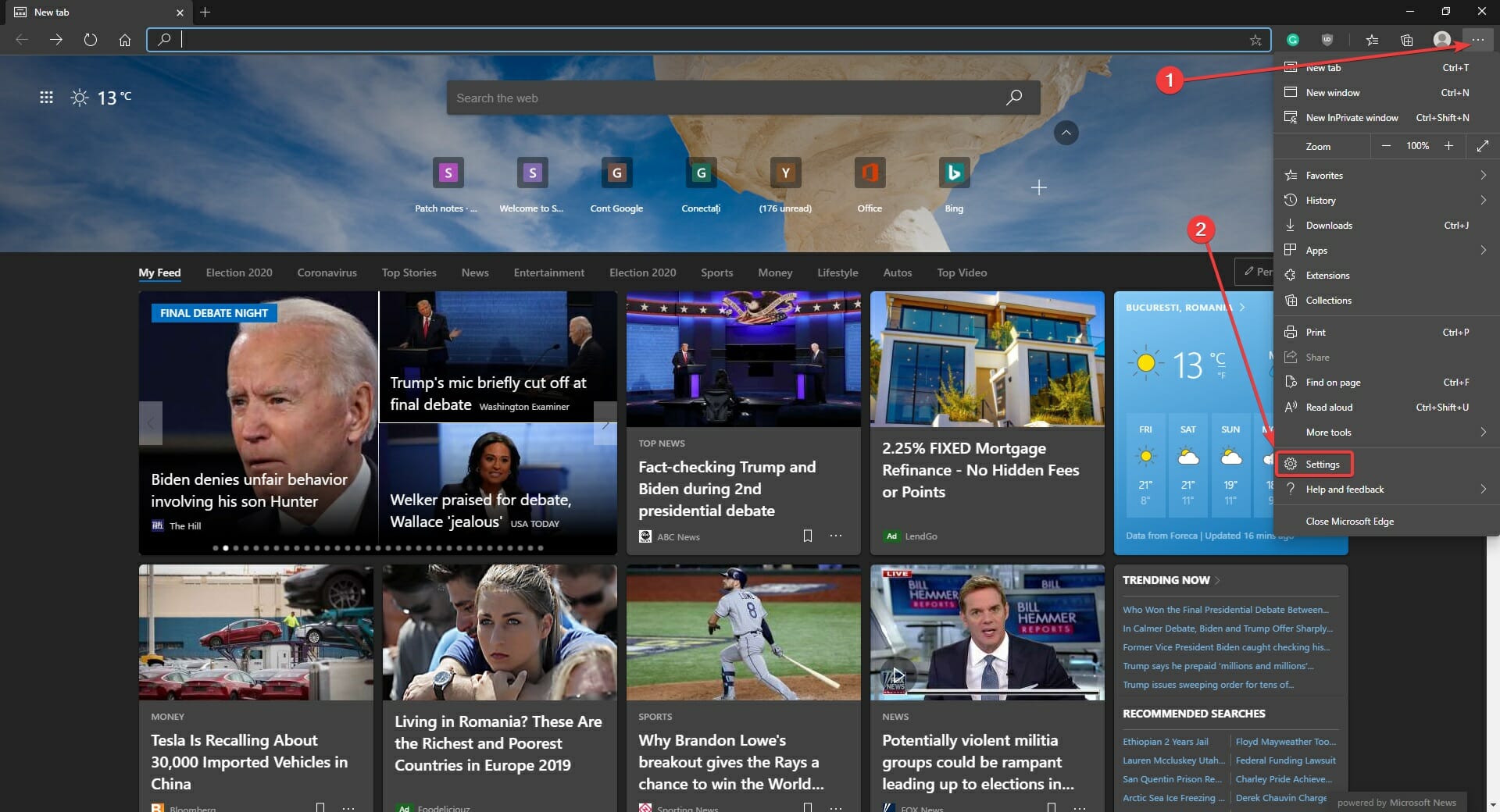
  2. Press the 3 dots on the top-right corner of the menu
  3. Go to the Settings page from the drop-down menu
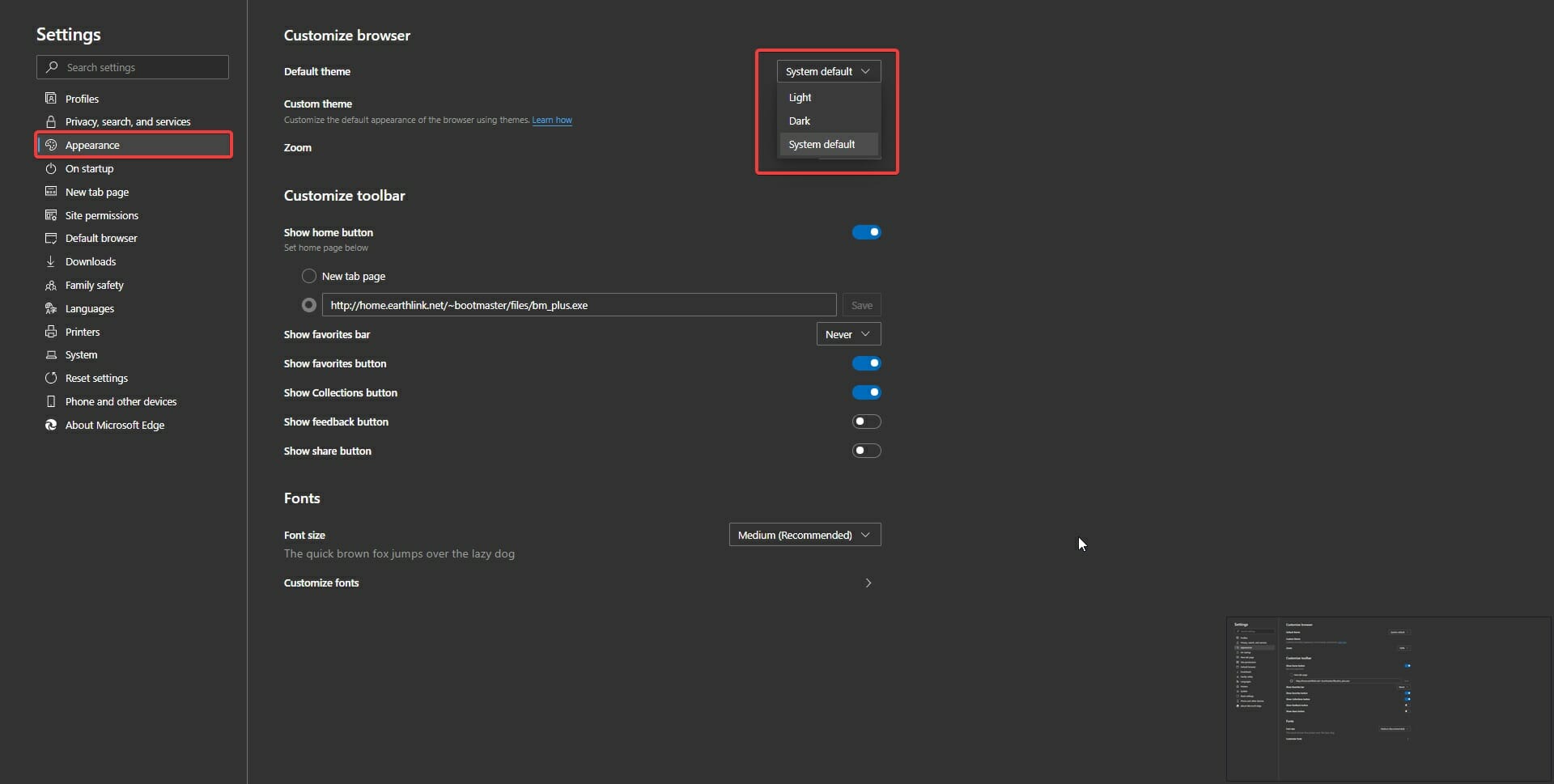
  4. Select Appearance from the settings menu
  5. In the dropdown menu next to Default theme, select Dark
  6. Restart Microsoft Edge

What is the most customizable web browser?


Opera GX is one of the most customizable browsers that you can install on your Windows 10 computer. The long list of available customization options and high browsing speed alongside advanced privacy options makes Opera our browser of choice.

Being built on the Chromium project base, Opera allows for the installation of all Chrome Web Store themes while keeping your privacy untouched.

If you like Microsoft Edge Dark Mode, we are happy to let you know that Opera also has a dark mode since it’s based on Chromium as well. And that’s only the tip of an iceberg when it comes to all the ways you can personalize Opera to your liking.

Besides your usual wallpapers, you can tweak almost everything including enabling sound effects for different actions you take inside the browser.

The browser also comes with a free VPN included, the ability to limit the CPU and RAM opera consumes, and a ton of other great features.

Opera GX

Try out the most customizable browser available today, plus exclusive features of Opera GX.

Full Fix: Microsoft Edge window position issues

Microsoft Edge was introduced in Windows 10 as a default browser, and even though this is a modern browser it has its share of issues. One problem that users reported is that Microsoft Edge doesn’t remember window position, so let’s see how to fix this problem.

Microsoft Edge is a completely new browser and it’s designed as a replacement for Internet Explorer. Even though Microsoft Edge fixed many of the shortcomings that Internet Explorer had, Edge has its own problems.

One of these problems is related to window position and users reported that Microsoft Edge doesn’t remember the position and size of the window once you close it. This isn’t a big problem, but it can certainly be irritating. Fortunately, there are a few potential workarounds available.

How to fix Microsoft Edge window position issues?

Microsoft Edge is a great browser, but some users encountered issues with window position in Edge. This is usually a minor problem, and speaking of Edge issues, here are some similar problems that users reported:

  • Microsoft Edge not retaining window position – Many users complained that Microsoft Edge won’t remember window position on their PC. This can be an annoying problem, but you should be able to fix it by installing the latest updates.
  • Microsoft Edge does not remember window size – This is another relatively common problem with Microsoft Edge, but you should be able to fix it using one of our solutions.
  • Microsoft Edge not filling screen – Sounds like a temporary problem that should clear itself. Otherwise, resetting to default should to the trick.

Solution 1 – Consider using a different browser

Opera browser video pop-out functionality

If window position problems in Microsoft Edge keep appearing, you might want to consider switching to a different browser. This is just a small but annoying problem, and if you can’t fix it, maybe this is the right time to switch to a different browser, such as Opera One.

In terms of features, Opera One is much better than Edge. The differences are so big that is quite strange to compare them.

Top features that Opera One offers:

  • built-in adblocker
  • integrated messengers in the sidebar
  • tab sync from one device to another
  • workspaces and tab islands
  • native AI and modular AI-ready design
  • free VPN

With a focus on privacy and features that are useful to users, Opera One is clearing in the lead here. If you like to learn more about it, see our Opera Review.

Opera One

Enjoy so many great functionalities as you make the switch from Edge to Opera One.
Free Download Visit website

Solution 2 – Use right-click to close Edge

This is a potential workaround and few users claim that it works. According to them, you can make Microsoft Edge remember window position after closing simply by clicking the X button with the right mouse button.

To do that, right-click the X button, keep it pressed and double-click the X button with the left mouse button. This is an unusual workaround, but few users claim that it works, so you might want to try it out.


Solution 3 – Install the latest update

This is a software problem with Microsoft Edge, and since Microsoft is aware of this issue, it should be fixed by downloading a specific update. This is just a minor and harmless issue, therefore it might not be fixed in the near future. Nevertheless, be sure to regularly use Windows Update and keep your Windows 10 up to date.

For the most part, Windows 10 installs the missing updates automatically, but sometimes you might miss a couple of updates due to certain issues on your system. However, you can always check for updates manually by doing the following:

  1. Press Windows Key + I to open the Settings app.
  2. Navigate to the Update & Security section.
    Microsoft Edge not retaining window position
  3. Now click Check for updates button.
    Microsoft Edge not retaining window position

If any updates are available, they will be downloaded automatically and installed as soon as you restart your PC. After the latest updates are installed, check if the problem is still there.


Solution 4 – Reset Microsoft Edge from Settings

Sometimes there might be a glitch with Microsoft Edge, and in order to fix it, you need to reset Microsoft Edge to the default. This is rather simple, and you can do it with just a couple of clicks. You can reset Edge by following these steps:

  1. Open the Settings app and go to the Apps section.
    Microsoft Edge does not remember window size
  2. Select Microsoft Edge from the list and click Advanced options.
    Microsoft Edge not retaining window position
  3. Scroll down to the Reset section and click the Reset button. Click the Reset button once again to confirm.
    Microsoft Edge does not remember window size

After doing that, Microsoft Edge will reset to the default and the problem should be completely resolved.

If this doesn’t work out for you, there’s another way to achieve this but it’s more complex. See our solution down below that uses PowerShell.


Solution 5 – Use the keyboard shortcut to close Edge

Microsoft Edge does not remember window size

According to users, in order to fix window position issues in Edge, you might want to close the application using the keyboard shortcut. This is a strange workaround, but it works according to users.

Simply press Alt + F4 while in Edge to close it. After the application closes, start it again and it will retain its position.

Bear in mind that this is just a workaround, so you’ll need to repeat it every time in order to prevent this issue from appearing again.


Solution 6 – Launch Microsoft Edge using a desktop shortcut

This is another workaround, but according to users, it might be helpful if you’re having problems with Edge and window position. It seems that Edge resets its window position and size if you start it using the Taskbar or Start Menu icon.

However, if you start the application using the desktop shortcut, the application will retain its size and position. This sounds like a strange workaround, but it works according to users, so you might want to try it out.


Solution 7 – Create a new user account

Sometimes this problem can occur due to a corrupted user account. Your account can get corrupted for various reasons, and if that happens, you might encounter window position issues in Microsoft Edge.

Since it’s quite hard to repair a corrupted account, it’s advised to create a new account and move your personal files to it. This is quite simple, and you can do it by following these steps:

  1. Open the Settings app and go to the Accounts section.
    Microsoft Edge does not remember window size
  2. In the left pane, navigate to the Family & other people section. In the right pane, go to Add someone else to this PC.
    Microsoft Edge not retaining window position
  3. Select I don’t have this person’s sign-in information.
    Microsoft Edge does not remember window size
  4. Now choose Add a user without a Microsoft account.
    Microsoft Edge not retaining window position
  5. Enter the desired user name and click Next.
    Microsoft Edge does not remember window size

After you create a new account, switch to it and check if the problem is still there. If the issue doesn’t appear, you’ll have to move all your personal files to the new account and start using it instead of your old one.


Solution 8 – Use PowerShell to reset Edge

According to users, if you’re having Microsoft Edge window position problems, you might be able to solve them simply by resetting Edge to the default.

This is a complex operation and you should first take a look at resetting Edge from settings first.

To continue with PowerShell in order to reset Edge, you need to remove a couple of files by doing the following:

  1. Press Windows Key + R and enter %localappdata%. Now press Enter or click OK.
    Microsoft Edge does not remember window size
  2. Navigate to PackagesMicrosoft.MicrosoftEdge_8wekyb3d8bbwe directory and delete all files from it.
    Microsoft Edge not retaining window position

Now you need to run a Powershell command to complete the process. To do that, follow these steps:

  1. Press Windows Key + S and enter powershell. Right-click Windows PowerShell from the list of results and choose Run as administrator.
    Microsoft Edge does not remember window size
  2. When PowerShell starts, run the following command: Get-AppXPackage -AllUsers -Name Microsoft.MicrosoftEdge | Foreach {Add-AppxPackage -DisableDevelopmentMode -Register “$($_.InstallLocation)AppXManifest.xml” -Verbose}
    Microsoft Edge not retaining window position

After doing that, the problem should be completely resolved and Microsoft Edge should start working again.

Solution 9 – Perform System Restore

If this problem started appearing recently, it’s possible to fix it using System Restore. In case you’re not familiar, System Restore is a great feature that allows you to restore your system to the previous version and fix various issues along the way.

To perform a System Restore, you just need to follow these steps:

  1. Press Windows Key + S and enter system restore. Choose Create a restore point option from the menu.
    Microsoft Edge not retaining window position
  2. System Properties window will now appear. Click System Restore.
    Microsoft Edge not retaining window position
  3. System Restore window will appear. Click Next to proceed.
    Microsoft Edge does not remember window size
  4. If available, check Show more restore points option. Now select the desired restore point and click Next. Follow the instructions on the screen to complete the restoration process.
    Microsoft Edge not retaining window position

Once your system is restored, check if the problem still appears. If not, it’s possible that a system update caused this issue to appear, so keep a close eye on updates.

Microsoft Edge window position issues can be a minor hindrance, but until an official fix is released, you might have to rely on workarounds and third-party solutions.

Windows 10 Insider build 20185 (Dev Channel) brings minor changes to DNS Settings and MDM policies

Microsoft has just released the Windows 10 Insider build 20185 for Insiders in the Dev Channel (previously Fast Ring). This new build is a minor update with a couple of improvements for DNS configuration in the Settings app, as well as new Mobile Device Management (MDM) policies for ADMX files to be configured with Intune Custom profile.

You can find all details about new features, bug fixes, and known issues in this build below:

What’s new in Build 20185

Improving DNS configuration in Settings

We’re making a few changes to the Network section in Settings:

  1. Making DNS settings more easily accessible: Editing your DNS server assignment is now a top-level option when you go into your network’s properties page.
  2. Encrypted DNS controls in the Settings app: Encrypted DNS (DNS over HTTPS, or DoH) can help increase privacy and security while browsing the web. You can now configure DoH directly in the Settings app to more easily take advantage of this feature:
    • For ethernet connections: Go to Settings > Network & Internet > Status. Click Properties, then select Edit IP assignment or Edit DNS server assignment and it will be available in the popup
    • For Wi-Fi connections: Go to Settings > Network & Internet > Wi-Fi. Click the adapter properties link, then select Edit IP assignment or Edit DNS server assignment and it will be available in the popup. Currently you will not see the encryption options if you go to the individual network’s property page

You can add any IP address listed here to unlock the DoH dropdown and choose to use encryption. Once encryption is enabled, you can confirm it’s working by looking at the applied DNS servers in the network properties and see them labeled as “(Encrypted)” servers. If you want to try a custom DoH server we don’t recognize yet, you can configure an IP address to be recognized as a DoH server by using the netsh command documented here at the end of the blog post.

The new Edit Network DNS settings popup in Settings.

As always, appreciate your feedback!

New ADMX Backed Policies for MDM

Starting with Windows 10 Insider Preview Build 20175, we have enabled 647 new MDM policies across 56 ADMX files to enable commercial customers to configure policies that are also supported through Group Policies. Contains ADMX based Policies such as App Compat, Event Forwarding, Servicing and Task Scheduler. These new policies can be configured using Intune custom profile. Intune UX is planned to be available later this year.

ADMX file name:

  • AddRemovePrograms.admx
  • AppCompat.admx
  • AuditSettings.admx
  • CipherSuiteOrder.admx
  • COM.admx
  • Cpls.admx
  • CtrlAltDel.admx
  • DigitalLocker.admx
  • DnsClient.admx
  • DWM.admx
  • EncryptFilesonMove.admx
  • EventForwarding.admx
  • FileServerVSSProvider.admx
  • FileSys.admx
  • FolderRedirection.admx
  • Help.admx
  • HelpAndSupport.admx
  • kdc.admx
  • LanmanServer.admx
  • LinkLayerTopologyDiscovery.admx
  • MMC.admx
  • MMCSnapins.admx
  • MSAPolicy.admx
  • nca.admx
  • NCSI.admx
  • Netlogon.admx
  • OfflineFiles.admx
  • PeerToPeerCaching.admx
  • PerformanceDiagnostics.admx
  • PreviousVersions.admx
  • QOS.admx
  • Reliability.admx
  • Scripts.admx
  • sdiageng.admx
  • Securitycenter.admx
  • Servicing.admx
  • Setup.admx
  • SharedFolders.admx
  • Sharing.admx
  • Shell-CommandPrompt-RegEditTools.admx
  • Smartcard.admx
  • Snmp.admx
  • TaskScheduler.admxtcpip.admx
  • Thumbnails.admx
  • TPM.admx
  • UserExperienceVirtualization.admx
  • W32Time.admx
  • WinCal.admx
  • WindowsAnytimeUpgrade.admx
  • WindowsConnectNow.admx
  • WindowsMediaDRM.admx
  • WindowsMediaPlayer.admx
  • WindowsMessenger.admx
  • WinInit.admx

Changes and Improvements

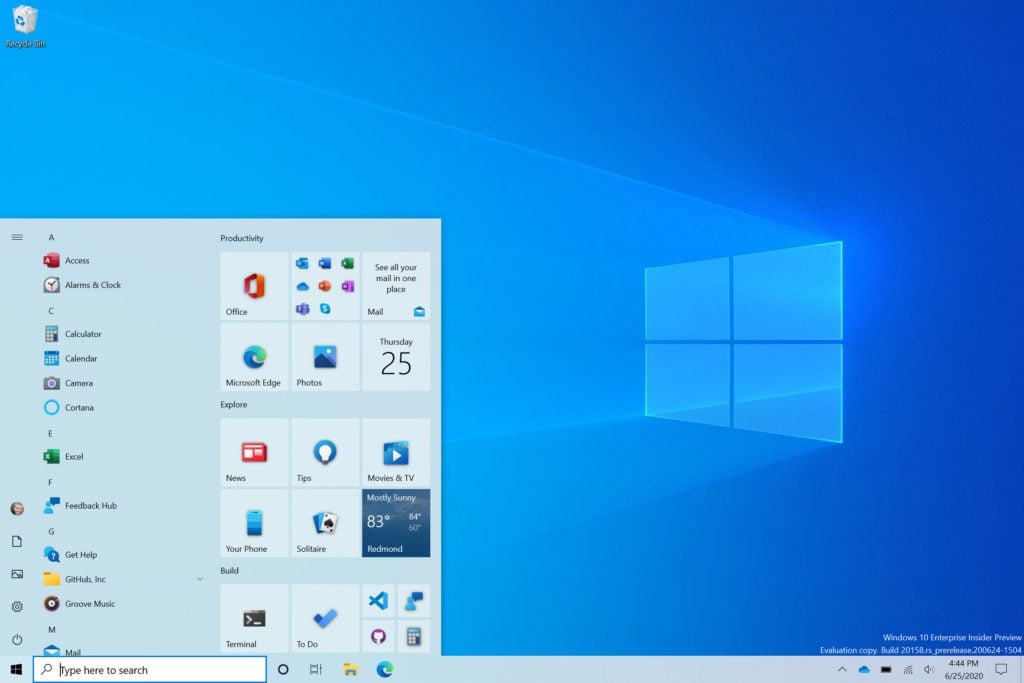
  • We’re moving the 3D Viewer app into the Windows Accessories folder in the Start menu all apps list.

Fixes

  • We fixed an issue where sometimes the “close all windows” action in the Taskbar wasn’t closing all of the open tabs for pinned sites.
  • We fixed an issue that could result in the network icon in the Taskbar saying there was no internet although there was an active connection.
  • We fixed an issue where dragging and dropping an app from Start’s all apps list over to the tile grid to pin it wasn’t working for certain apps.
  • We fixed an issue where the letter headers in the Start menu’s all apps list had unnecessary left padding when the all apps list was set to hidden.
  • In order to address an issue where the tiles were difficult to read against certain backgrounds when using full screen Start we’re adjusting the background to be slightly less transparent.
  • We fixed an issue where when using a Start menu layout applied by MDM, tile groups may disappear after a few days of uptime without rebooting.
  • We fixed an issue where if a notification included an inline image the app icon would be slightly out of line with it.
  • We fixed an issue where launching an app from its taskbar jumplist wasn’t working for certain desktop bridge apps and instead would result in the app disappearing from the taskbar.
  • We fixed an issue resulting in excessive network traffic when using the Open File dialog to navigate to shared network folders where previous versions where enabled.
  • We fixed an issue that could result in a blank icon displaying instead of a plus button on the main Default Apps page in Settings after uninstalling the app set as default.
  • We fixed an issue where opening Storage Settings then immediately going into one of the sub-pages and then back could result in the page not loading.
  • We fixed an issue resulting in the new Microsoft Edge not being listed in the App History section of Task Manager.
  • We fixed an issue resulting in
  • We fixed an issue impacting touch keyboard launch reliability.
  • We fixed an issue where TextInputHost.exe would enter an unresponsive state, leading to clipboard history, the Emoji Panel, and dictation not appearing when pressing their corresponding keyboard shortcuts.
  • We fixed an issue that could result in not being able to paste the first entry in clipboard history.
  • We fixed an issue that could result in ARM64 devices bug checking when resuming from hibernation.

Known issues

  • We’re working on a fix for an issue where some Microsoft Store games protected with Easy Anti-Cheat may fail to launch.
  • We’re looking into reports of the update process hanging for extended periods of time when attempting to install a new build.
  • We’re working on a fix for an issue where the min/max/close buttons are stuck in their original positions after resizing a UWP app. If you move the app window the position should update.
  • We’re investigating reports that the new taskbar experience for pinned sites isn’t working for some sites.
  • We’re working on a fix to enable live preview for pinned site tabs.
  • We’re working on enabling the new taskbar experience for existing pinned sites. In the meantime, you can unpin the site from the taskbar, remove it from the edge://apps page, and then re-pin the site.
  • We’re working on a fix for an issue where pinned sites don’t show all open tabs for a domain. In the meantime, you can fix this by pinning the site’s homepage rather than a specific page (e.g. pin microsoft.com rather than microsoft.com/windows).
  • We’re working on a fix for an issue where Alt + Tabbing to a browser tab sometimes moves the previously active browser tab to the front of the Alt + Tab list as well.
  • Opening a WSL 1 distribution can result in the error: ‘The I/O operation has been aborted because of either a thread exit or an application request’. Please check out this

In addition to the release of this new build in the Dev Channel, the Windows Insider team also announced today that the next webcast will air on Twitch on August 18 at 10AM PDT. That’s the consequence of Microsoft closing its Mixer live streaming platform last month, but the Windows Insider team will also keep publishing videos on the official YouTube channel as well.

We’ve been getting new Dev channel builds at a regular pace in the past couple of weeks, but these builds are still not labeled “21H1.” Microsoft now uses the Dev channel to test new features that may or may not end up in the next feature update for Windows 10, but recent improvements for the Start Menu, the Settings app, Notifications, and Tablet mode have recently landed in 20H2 builds for the Beta channel.

Samsung deepens its partnership with Microsoft with new Office, Your Phone, and Xbox integrations

If Microsoft is expected to launch its dual-screen Surface Duo phone later this summer, the company isn’t going to abandon its existing partnership with Samsung, one of the biggest smartphone makers in the world. Samsung has just unveiled this morning its latest mobile devices including the Galaxy Note 20 and the Galaxy Tab 7, and the company used this opportunity to unveil new integrations between Galaxy devices and Microsoft services.

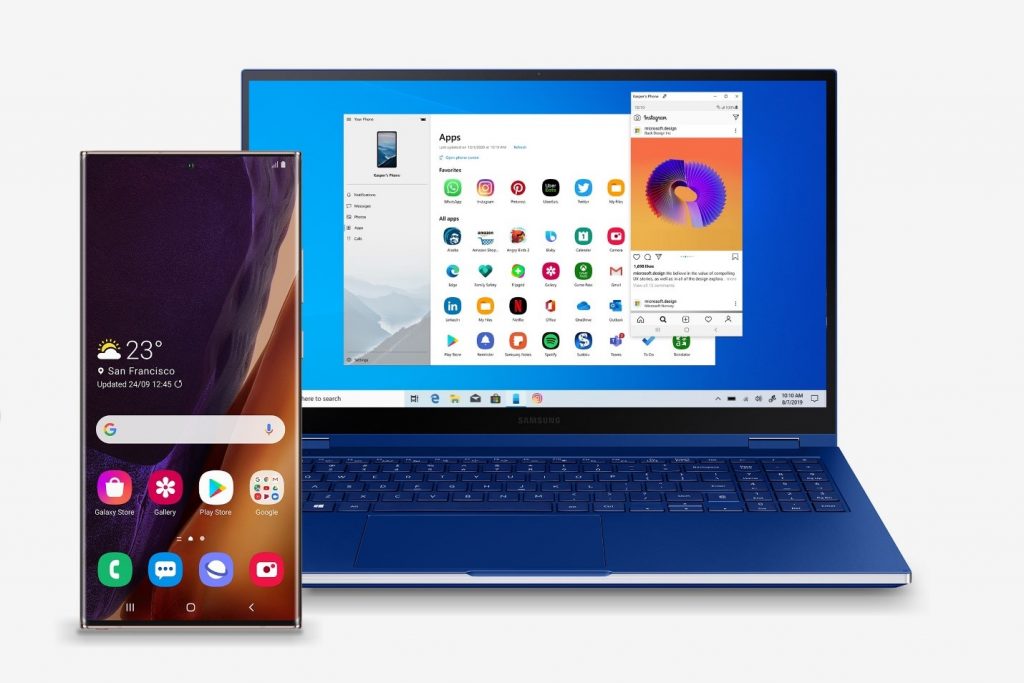
First of all, premium Samsung Galaxy smartphones have been enjoying a unique “Link to Windows” integration that provides a seamless way to take calls, check phone notifications, and more from a Windows 10 PC. The new Galaxy Note20 will push things even further with the ability to launch Android apps from your phone directly on your Windows 10 PC. This is different from the existing Your Phone “Phone Screen” feature that mirrors your smartphone screen on your Windows 10 PC.

“When you launch an app, it opens in a separate window, allowing you to multi-task and saving you the time and hassle of sign-in or set up. You can also pin your phone’s Android apps to your Windows 10 taskbar or Start menu for quick and easy access, making things like checking out your social feed or ordering your lunch while you wrap up a conference call even easier, without ever picking up your phone,” explained Yusuf Mehdi, CVP of Modern Life, Search & Devices at Microsoft.

GIF shows Your Phone app, showing mobile apps on PC screen

When it launches on August 21, the new Galaxy Note 20 will only be able to project a single Android app to a Windows 10 PC, but accessing multiple apps side by side will be available later this year, Microsoft said. In addition to providing seamless access to Android apps from a Windows 10 PC, the Galaxy Note20 will also better integrate with Microsoft 365 apps such as OneNote, Outlook Tasks, and Microsoft To Do, and Microsoft Teams.

“Coming soon, notes from Samsung Notes can automatically sync with your OneNote feed in Outlook on the web or OneNote as an image. You can quickly jot down your notes from a meeting or grocery list with your S Pen on Galaxy Note20 and have instant access to the content in your productivity apps like Outlook and OneNote. You will also be able to sync Samsung Reminders from your Galaxy Note20 to your Windows 10 PC across Microsoft To Do, Outlook and Microsoft Teams experiences, so you can view and edit from anywhere, keeping your reminders aligned across your phone, PC and apps,” explained Mehdi.

GIF shows M365 Samsung Notes, sharing a sketch of a bridge from a phone to an email on the PC laptop

Other Samsung devices will also benefit from this Microsoft partnership, with the new Samsung Galaxy Watch3 using Outlook as its native email client. Samsung also demoed its new Galaxy Tab7 being used as a second screen for Windows 10 PC, a capability that will be available later this year. This mirrors the “SideCar” feature that Apple implemented between Macs and iPads last year.

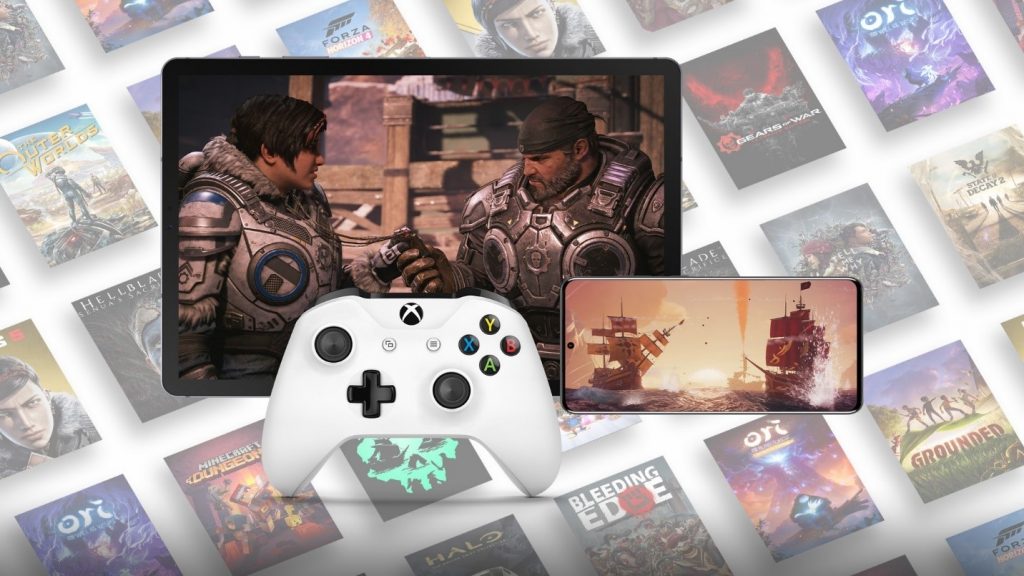
Last but not least, Samsung’s partnership with Microsoft extends to Xbox, with Samsung offering the Xbox Game Pass with cloud gaming on its Galaxy App Store. According to The Verge, this Xbox Game Pass app will be different from the regular app that will be available on the Google Play Store in September, with the exclusive ability to “redeem tokens and make in-app purchases like buying skins or DLC items in the Xbox Store.”

Samsung Galaxy Note20 Project xCloud

Samsung will also offer a Gaming Bundle for its new Galaxy Note20 that will include three months of Xbox Game Pass Ultimate (with Cloud gaming included starting September 15), and a new Power A MOGA XP5-X Plus Bluetooth Controller with an attachable phone clip. This should be a great way to bring Xbox Game Pass and Cloud Gaming to the masses, especially since the Galaxy Note20 will support the ultra-fast 5G networks are mobile carriers are currently developing across the world.

Overall, these new integrations between Samsung devices, Windows 10 PCs, and Microsoft services should be great news for Galaxy fans, but Microsoft’s partnership with Samsung also makes us wonder about the necessity of the Surface Duo. Keep in mind that Samsung was one of the first smartphone manufacturers to launch foldable devices, and the company is also working with Microsoft to optimize the company’s apps for its new Galaxy Z Fold 2.

As of today, Samsung Galaxy devices provide better synergies with Windows 10 PCs through Your Phone and Link to Windows, and it’s not clear if Surface Duo early enthusiasts will enjoy the same seamless experience. Microsoft has yet to really explain why anyone would want a Surface Duo, and this ongoing partnership with Samsung, while great for consumers and Samsung, could make Surface Duo marketing a bit harder.

Samsung Galaxy Z Fold2

More information and launch details for Galaxy Z Fold2 will be available in September, but Microsoft’s Surface Duo will likely need to be cheaper if the company wants it to be an attractive alternative to Samsung’s premium device. In the meantime, the Galaxy Note20 will start at $999.99 and the bigger Galaxy Note20 Ultra at $1,299.99, and both devices will be available in the US starting August 21. Microsoft will likely offer both of them on its online store, as it did for the Galaxy S20 earlier this year.

Microsoft Teams’ new Channel Info button makes it easy to see who’s online

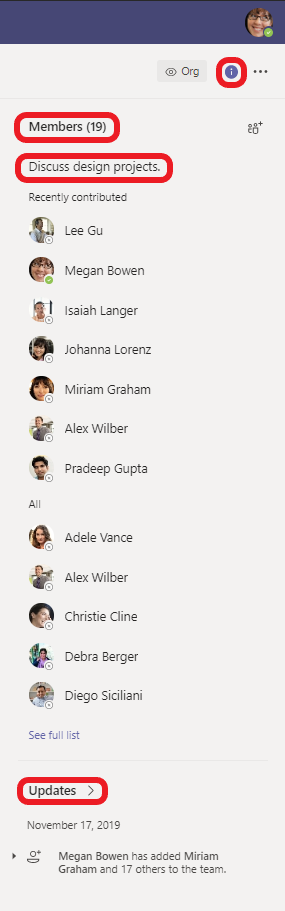
Earlier this year, Microsoft announced that new Channel information pane would come to Microsoft Teams, which should make it easier to find new and relevant information in Teams channels. The company has recently announced that the feature is now generally available in the Microsoft Teams desktop and web apps. The new Channel info pane is now accessible via a new small “Channel info” icon in the channel header. It lets you track key channel details at a glance including a description of a specific channel, system messages, the online presence of all users, as well as a list of recent contributors and members.

Members

First off, the “Members” section in the channel info pane provides a list of all members who have access to a given channel or recently contributed to it. Microsoft Teams users can click the “See full list” option at the bottom to see a complete member list.

Moreover, people who have actively posted or replied to the channel over the last couple of months are listed in the “recently contributed” section. The list could be quiet long for active channels with hundreds of members. There is also a new “Add members” Add people to team button button available in the upper-right corner of the information pane.

Instance of channel info pane featuring members and other info.

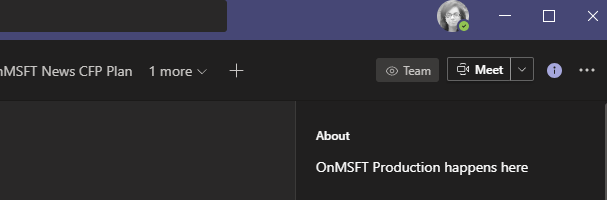
About

Additionally, channel owners can use the About section to provide a description of their channel (as shown in the screenshot below). Channel information such as “Discuss Microsoft 365 projects” makes it easier for Team members to post in relevant channels without losing track of their projects.

Microsoft Teams About Section

Updates/System messages

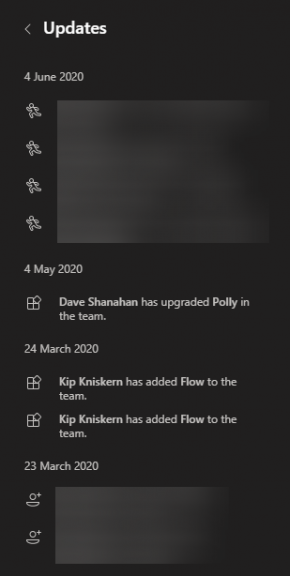
Finally, system messages including recent channel and team updates are listed at the bottom of the information pane. It helps to keep an eye on who has joined or left the team during the last 12 months. Users can also click on the drop-down arrow to see more updates from a specific contributor.

Microsoft Teams Sysem Messages

It should be kept in mind that Channel information pane functionality is a bit different for private Teams channels, and we invite you to check out the Microsoft support document for more details.

How to set up a Microsoft Teams meeting in Outlook

There often comes a time when you need to set up a Microsoft Teams meeting through Outlook. This can be for creating meetings for folks outside of a general channel in Teams, or for creating a meeting for an external user, who can join as a guest. So, here’s a look at how you can set up a Microsoft Teams Meeting in Outlook, without having to go directly into Microsoft Teams.

In Outlook on Windows 10

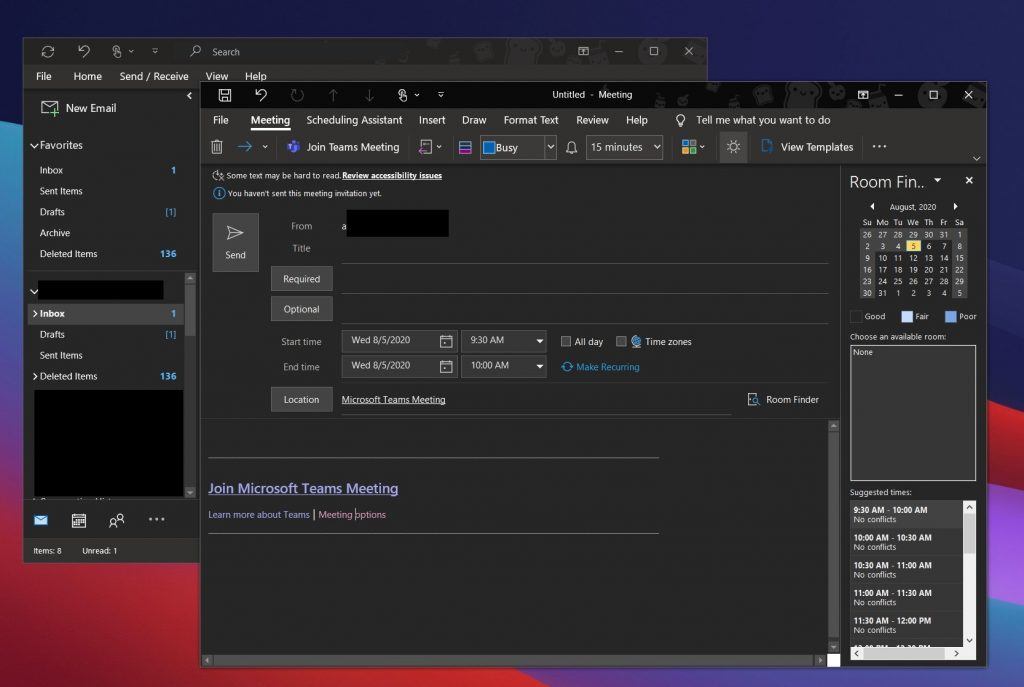
Teams Meetings Outlook

Setting up a meeting in Outlook on Windows 10 is really easy. To get started, open Outlook and switch to the account you want to start the meeting with. Then, head to the top tab in Outlook. After that, select the Home tab. When you see the down arrow next to New Email, click it. This will give you an option for Teams Meeting. Click it, and a new meeting window will pop out. You can fill out the information fields such as required, optional, the start time, end time, and more.

You also can press the CRTL button and then click the Meeting Options link to control some settings for the meeting. This includes who can bypass the lobby, announcements for when people join or leave, and more. When you finish with your changes, you can click the Save button. Then, when you’re ready to set up the meeting in Outlook, click the Send button.

In Outlook on the Web

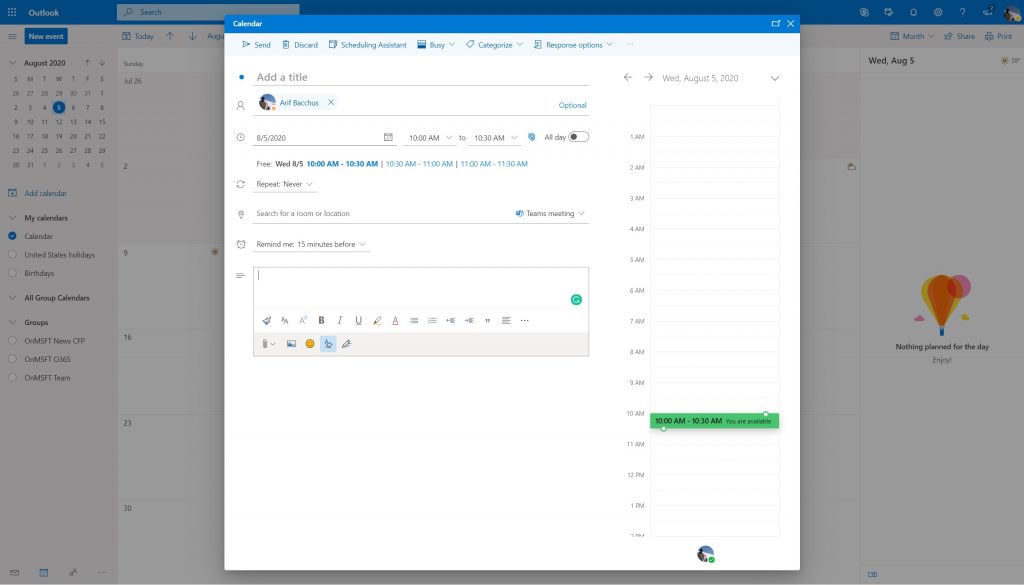
Teams Meetings Outlook Web App

Next, there’s Outlook on the Web. It wasn’t always possible to create Teams meetings from the Outlook Web app, but Microsoft added the feature in January of this year. Just like on Windows 10, the process is really easy, too.

To get started, switch to your Outlook Calendar from the Outlook Web app by clicking the Calendar icon. From there, click the New Event button. You can fill out the name and the fields, and invite attendees with their email addresses. Also, choose a time and day for the meeting. When ready to add the Teams meeting, click add online meeting and choose Teams meeting from the drop-down menu. Fill out the message, and then click the Send icon.

Our hub has more!

Creating Teams Meetings in Outlook is just the start of the Teams experience. Over the past few months, we’ve covered Teams extensively. Check out our tips and tricks, or picks for best apps and bots, and so much more. Our Teams hub has you covered, so feel free to check it out. And, as always, let us know if you have your own Teams tips and tricks by dropping us a comment below.

Final Fantasy VII, Darksiders: Genesis and more are coming to Xbox Game Pass in August

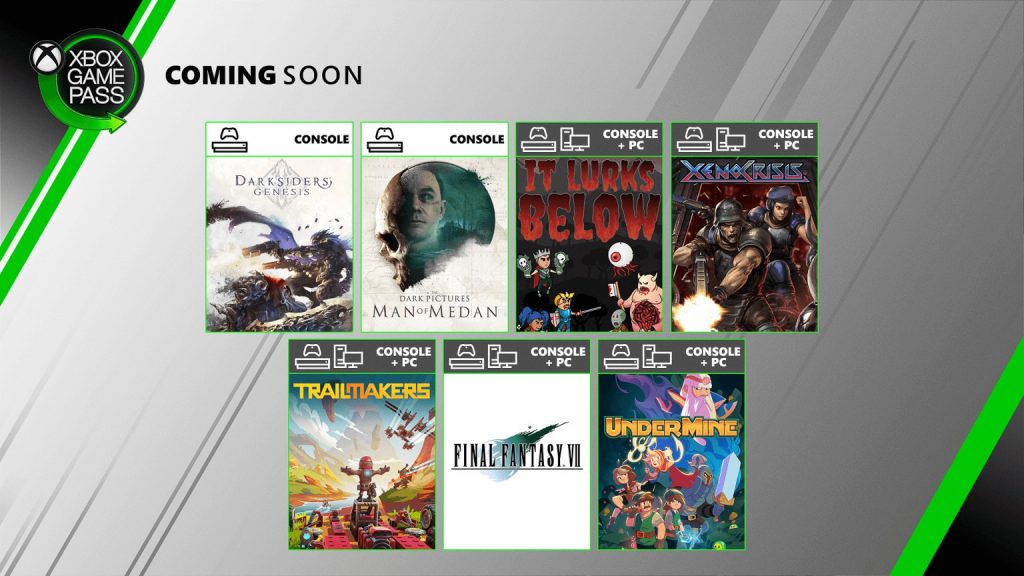
Microsoft has just revealed the latest games that will join Xbox Game Pass for Console and PC in August. No less than six games will be available starting tomorrow, starting with Darksiders: Genesis and The Dark Pictures Anthology: Man of Medan on Console. In addition, It Lurks Below, Trailmakers, UnderMine, and Xeno Crisis will all be available on both PC and Console tomorrow.

A last game will join the Console and PC catalogs next week on August 13, and it’s a true classic: Final Fantasy VII, one the best J-RPG of all times that got the remake treatment on PlayStation 4 earlier this year is coming to Xbox Game Pass, and it will join other episodes such as Final Fantasy IX and Final Fantasy XV. The Xbox One version of the game was released in March of last year, and it’s not clear yet if the PC version will support cloud saves and Xbox Play Anywhere, as Final Fantasy IX does.

Overall, this is a solid update for Xbox Game Pass in August, and if you haven’t played Final Fantasy VII yet, you should absolutely give it a try. If the PlayStation 4 remake received critical acclaim earlier this year, this game and recent Final Fantasy episodes have never really managed to recapture the magic of the original PlayStation game released back in 1997.

Back in November at X019, Microsoft announced that many other Final Fantasy and Square Enix titles would join Xbox Game Pass this year, and the list includes Final Fantasy VIII and the Final Fantasy XIII trilogy. Along with Bethesda, the publisher has become one of the biggest supporters of Xbox Game Pass in recent years, and that’s a great thing for Xbox gamers. If you have yet to try Xbox Game Pass, we remind you that you can still get your first month of Xbox Game Pass Ultimate for just $1.


[Updated] Microsoft’s updated Services agreement replaces Xbox Live with “Xbox online service”

It seems that Microsoft could soon announce some changes for its Xbox Live Gold subscription, which has been around since the launch of the original Xbox console. Microsoft recently removed the option to buy 12 months of Xbox Live Gold on its online store, and VentureBeat journalist Jeff Grubb recently claimed that Microsoft could soon drop the Xbox Live Gold requirement for playing multiplayer games on Xbox.

Microsoft has yet to officially announce any changes for Xbox Live Gold, but the company has now quietly updated its Services agreement to replace “Xbox Live” with Xbox online service.” Another notable change in the updated document is the use of “Xbox consoles” to refer to Xbox One and Xbox 360 consoles.

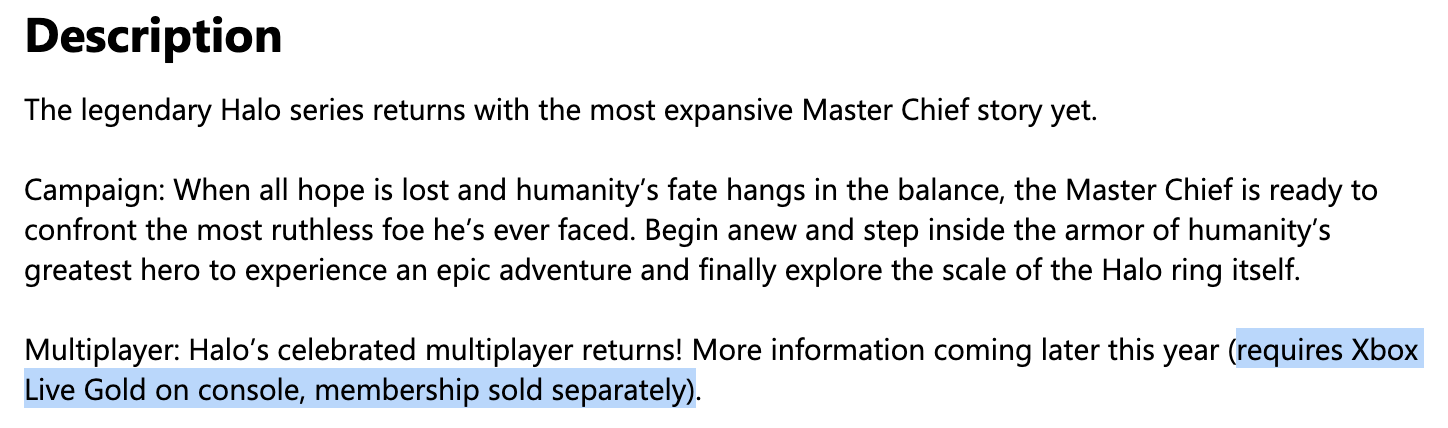
Even though the new Services agreement no longer mentions “Xbox Live” or Xbox Live Gold” specifically, the subscription service and the online multiplayer paywall for free to play games may not immediately go away. According to the store listing for Halo: Infinite, the game’s free-to-play multiplayer mode will still require Xbox Live Gold on Xbox One consoles.

Halo Infinite Store Listing Multiplayer Xbox Live Gold Required

It would be a bit surprising to see Microsoft get rid of Xbox Live Gold, which is one of the company’s oldest consumer subscription services and likely a good source of revenue. However, the company may well want to shake things up ahead of the launch of a new console generation, and free multiplayer may well convince PlayStation fans to give the Xbox ecosystem a second look.

Update 9:50AM PT: Xbox Live Gold isn’t going away according to a statement from a Microsoft spokesperson provided to Windows Central. The new “Xbox online service” wording has been apparently been introduced to differentiate features like cross-saves and friend requests from  Microsoft’s Xbox Live Gold subscription. You can find the full statement from the spokesperson below:

The update to ‘Xbox online service’ in the Microsoft Services Agreement refers to the underlying Xbox service that includes features like cross-saves and friend requests. This language update is intended to distinguish that underlying service, and the paid Xbox Live Gold subscription. There are no changes being made to the experience of the service or Xbox Live Gold.

How to use Picture in Picture mode in Chromium Edge

Most modern browsers support the Picture-in-Picture mode including the popular Google Chrome.

Picture in Picture enables users to view a video on top of other windows. PiP is already supported by Chromium-based Opera One and Vivaldi and the Chrome web browser itself.

Recently we have spotted a leaked version of the Chromium-based Microsoft Edge browser. Many users already started testing the build of the upcoming browser version.

Quick tip:

You can struggle with tweaking an unstable version of a browser, or you can switch to Opera One, a browser that already has the PIP function embedded in its stable version.

You can detach online videos from almost any video provider like YouTube, Netflix, or Twitch into their own window that you can adjust to your liking. Also this browser comes with a native AI.

Opera One

Pop-out your videos, move them, or resize them while still remaining in complete control.
Free Download Visit website

How can I use Picture in Picture mode in Chromium Edge?

  1. Launch a new Microsoft Edge browser on your system.
  2. Visit YouTube and play a video of your choice.
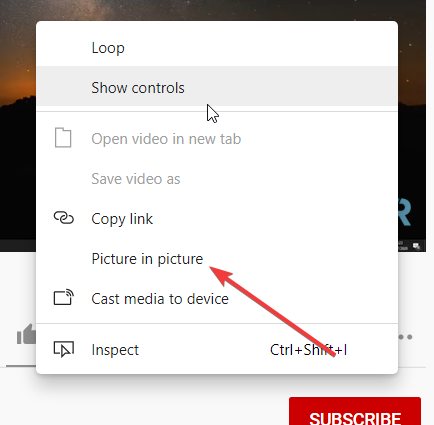
  3. Select Picture in Picture after right-clicking on the video twice.
  4. The video will start playing in PIP mode by using in new Edge browser’s back to tab option

Note: If you have issues enabling the Picture in Picture version in Edge browser, you need to enable two of the related tags including the use of SurfaceLayer objects for videos and Picture in Picture.

The Picture in Picture mode to the Firefox browser is currently in the development stages. Users can test the feature in Nightly version.

It is recommended to try the new build in a Virtual Machine so that you won’t have to bear the risks attached to the installation of software from an unknown source.

Other features for Chromium-based Edge

The dark mode fans must be pleased to see that the new Edge comes with an experimental dark mode. The company has hidden it behind a setting flag at the moment.

The other major features are going to provide a firm foundation for Chromium-based Edge’s adoption. For example, users will be able to directly install extensions from the Chrome Web Store.

In case you don’t want to use this feature, we have a great guide on how to disable picture in picture on Windows 11, so don’t miss it.

Are you planning to give Edge another chance once the new version is out? Let us know in the comments below.

Pre-orders for the new Razer Kishi Xbox cloud gaming controller are already selling out

After months of testing, Microsoft officially announced the launch date for their Xbox game streaming service yesterday and also revealed a number of third-party controllers and stands that would make playing Xbox video games on mobile devices easier and more fun to play.

One of these devices was the Razer Kishi (specifically the “Razer Kishi for Android (Xbox)”) which is essentially two controllers that can attach to each side of an Android smartphone to turn it into a kind of Xbox-branded Nintendo Switch portable gaming console. The Razer Kishi for Android (Xbox) was shown heavily in the trailer, which you can watch below, and it appears to have made an impression as it’s already sold out on the Microsoft Store online storefront. Thankfully, it appears to be still in stock on the Razer website.

The Steel Series Arctis 1 Wireless for Xbox headset, which was also featured during yesterday’s announcement, has also sold out. This is rather surprising as it’s not technically needed to play Xbox games on a smartphone or tablet. Technically, a controller isn’t needed either as touch controls will be supported but it’s hard to imagine many gamers using that option.

Razer Kishi for Android (Xbox)

Microsoft’s Xbox cloud streaming service is launching on September 15th in select regions. It will support over 100 games at launch and will require an active Xbox Game Pass Ultimate subscription and an Android smartphone or tablet.

Have you purchased any gaming accessories in preparation for Xbox gaming streaming? Let us know what you bought in the comments below and then follow us on Pinterest and Twitter for more Xbox news.

Windows 10 Storage Spaces bug fixed, safeguard hold remains

Do you remember the Storage Spaces bug that came up after some users updated to Windows 10 version 2004?

There wasn’t anything most of the affected users could do about the issue. Even Microsoft cautioned against using the chkdsk command to address it.

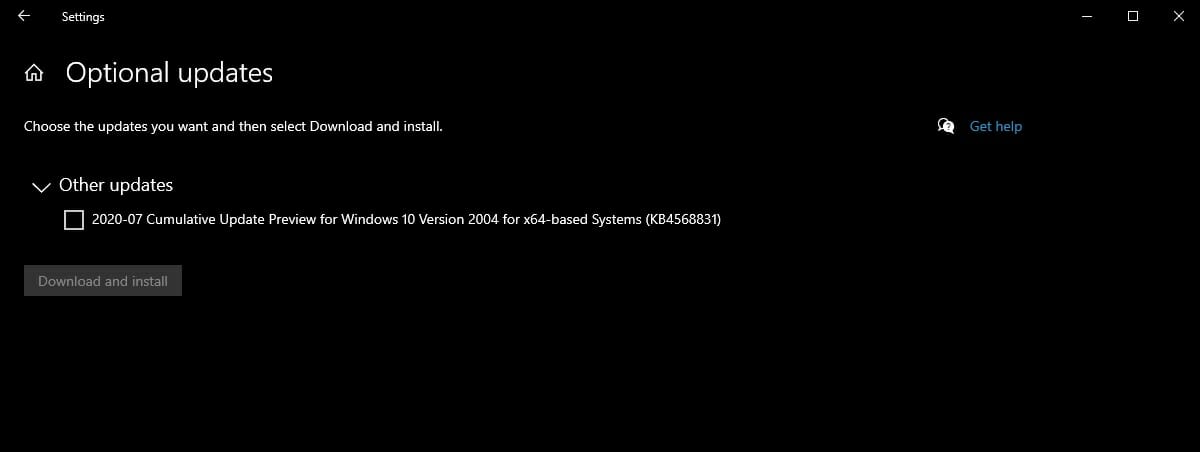
Well, the Redmond tech giant announced that it fixed the bug with the recently released cumulative update KB4568831.

Windows 10 Storage Spaces problem

Parity Storage Spaces serves as a drive backup feature that comes to the rescue when one of your storage devices fails. But this option became unavailable or began to malfunction after some PCs updated to the latest version of Windows 10 over a month ago.

Then, Microsoft pointed out that, with certain configurations, Disk Manager would display Parity Storage Spaces partitions as Raw.

You should be able to get rid of the problem now by installing CU KB4568831. Microsoft isn’t automatically pushing this update though, so you need to download and manually install it.

It’s understandable that many affected users may have expected to be able to upgrade to the May 2020 Update right away, now that what prevented them from doing so is gone.

But they can’t do that just yet, according to Microsoft.

When the tech giant acknowledged the Parity Storage Spaces issue, it also put affected devices on a compatibility hold.

To safeguard your update experience, we have applied a compatibility hold on these devices from installing or being offered Windows 10, version 2004.

Apparently, the update block remains in force until mid-August, and to make matters worse, it has no workaround for now. This means that DIY alternatives like installing the OS with the Microsoft Media Creation tool would most probably fail.

In the meantime, Microsoft is automatically delivering the new OS to more Windows PCs that are approaching end of service.

As always, you can share your great or not-so-great Windows 10 experiences in the comments section below.

[wl_navigator]

Can a VPN IP address be traced? How to prevent it?

One of the most pressing matters for the regular VPN user is whether or not can a VPN IP address be traced. We’ve already debunked a lot of myths and misconceptions, including:

However, this is a whole new perspective that we need to apply to our knowledge. We already know that you can be traced through a VPN, although it’s not exactly very likely that you will.

Furthermore, we’re also in the know regarding whether can a VPN hide your IP address.

However, things are a bit more complicated than they appear, and we’re not entirely ready to give you a straight answer just yet.

So let’s find out if a VPN IP address can be traced.

What makes an efficient VPN?

One of the biggest concerns of casual VPN users is related to the efficiency of the service they chose.

But what makes a VPN efficient, to begin with? Well, for starters, a service that really delivers what it advertises should suffice.

For instance, you’ve maybe seen certain VPN services claim that you’ll be 100% anonymous while using their product.

However, there’s no such thing as 100% anonymousness. Not as long as your device is connected to the Internet, that is.

A VPN service, even a great one, can protect you to a certain degree. After that, the way you manage your online privacy and personal data is entirely your responsibility.

You could use proxychains, Tor, and a VPN back-to-back and it would all be worthless if you go post personal info for everyone else to see, visit shady websites, perform risky downloads and allow malware on your system.

That’s why we believe that a good, no, a great VPN should have the following perks:

  • Zero-logging policy
  • No data leaks while connected to the VPN (it should also include a killswitch)
  • Top-notch security (VPN protocols, encryption keys, and algorithms)
  • A large network of secure servers

Can my real IP address be tracked while using VPN?

1. Not being careful with your private data

Considering a VPN that has the traits described above, can someone track your real IP address while using that specific service? Well, we’ve said it before and we’ll say it again.

It all depends on your online habits. So, the answer is a cold, disheartening yes. Anyone with half a mind could track your real IP address, even while you’re using a VPN if you allow it to happen.

Normally, such a thing should be impossible, since you’re routing your entire traffic through a secure, encrypted tunnel.

Thus, for someone to be able to track your real IP address, they should be somewhere in the middle, between you and the destination service you’re trying to access.

2. Using a free VPN

Although it’s a bit unfair to just throw it out there, this is a well-known fact. Most free VPNs have sketchy privacy policies and don’t need to be asked twice before they hand out private logs about their customers.

Thus, if you’re using such an unfortunate free VPN, your online activity might be recorded. So all someone needs to do in order to trace your real IP is just getting their hands on that VPN‘s logs.

Note the logs have more than just your real IP address. Everything, including what websites you’ve visited, how much time you spent on each page, and what files you downloaded can be parts of those logs.

It’s worth mentioning that not all free VPN services have these poor customer data handling manners. There are also free VPNs you can trust, ones that wouldn’t compromise just to cash an extra few bucks.

3. Using a VPN that leaks data

This is one of the most important traits that separate amateurs from pros in the VPN industry. Truth be told, you’d be better off without a VPN than using one that leaks your private data every now and then.

We also can’t stress enough the importance of kill switches. Data leaks happen so quickly that they’re quite hard to spot as a client.

However, for someone listening to your connection 24/7, even a minor slip can reveal your true IP address.

Private Internet Access

Private Internet Access

Looking for a leak-free VPN? PIA has got your back.
$2.85/mo. Buy it now

What a kill switch basically does is block your computer’s ability to revert to its default, insecure connection, in case the VPN connection is interrupted.

Thus, as long as you’re not connected to your VPN, your computer can’t connect to the Internet, unless you disable the kill switch.

The bad news is that certain VPNs might leak data even when the secure connection is active.

On the bright side, there are several ways to spot a leaky VPN connection. One of the most popular ways is using online third-party tools, such as:

Make sure to test if your VPN leaks private data before engaging in any activity that would jeopardize your privacy.

Your real IP address can be traced through VPN

All things considered, it’s safe to say that nothing is impossible nowadays, not even your real IP address being traced while using a VPN.

All it takes is a minor slip-up and someone who’s really determined to invade your privacy.

However, a few precautions at the right time might stop anyone who would attempt such a gig dead in their tracks.

Always be careful not to post personally identifiable information while behind a VPN, avoid sketchy websites, and don’t download shady content.

More so, make sure you choose trustworthy VPN services, ones that won’t log your data, and leak private information while you’re connected to their servers.

[wl_navigator]

Office 2019 and 2016 to lose Office 365 services support

As you may already know, Office 2019 and 2016 are still popular today despite the allure and convenience of Office 365 alternatives.

Nonetheless, users have always been able to plug the older versions of the standalone productivity software into Office 365 services. This option won’t be available to them for much longer though, especially after Microsoft stops supporting the standalone suite for connecting to Microsoft 365 services.

Microsoft to stop supporting older Office versions for Office 365 integration

As from October 13, 2020, older versions of Microsoft Office, including v2019 and 2016 won’t be getting support for plugging into Office 365.

Such Office clients are available as a one-time purchase, and if you still have one of those on your PC, you may need to upgrade to a subscription version of the product. Otherwise, you’ll miss out on the feature and security improvements that Microsoft keeps adding to its cloud-based services.

As Microsoft explains, the no-longer-supported Office clients may have performance bugs that the company won’t be fixing. In addition, connecting to Office 365 without support may also introduce software security risks and data compliance issues.

 After October 13, 2020, ongoing investments to our cloud services will not take into account older Office clients. Over time, these Office clients may encounter performance or reliability issues. Organizations that use these older clients will almost certainly face an increased security risk and may find themselves out of compliance depending upon specific regional or industry requirements.

However, the announcement doesn’t mean that affected Office clients are becoming obsolete soon. Neither does it imply that these older applications won’t be able to connect to Office 365.

The only thing that Microsoft is withdrawing here is support for the standalone packages as far as connecting to the company’s cloud services is concerned.

Recently, Microsoft reminded Office 365 enterprise users to upgrade to TLS 1.2 or a later version by October 15, 2020.

Do you use any version of the standalone Microsoft Office software suite? Kindly leave your response in the comments section below.

[wl_navigator]

FIX: Ubersuggest not opening in browser

Ubersuggest is a keyword tool with which users can generate keywords for their website pages. Thus, it’s a handy search engine optimization utility.

However, some users might encounter issues when trying to open Ubersuggest in browsers. Some users might not be able to access it even when their network connection is fine.

This article also covers the following 5 issues:

  • Ubersuggest not working
  • Ubersuggest chrome extension not working
  • Ubersuggest chrome extension
  • Ubersuggest.io not working
  • Ubersuggest chrome

What can I do when Ubersuggest doesn’t open?

1. Try opening Ubersuggest in another browser

First, try opening the Ubersuggest website in an alternative browser and if it opens OK, then it’s probably an issue that pertains to the browser the website that doesn’t open it.

Opera One is the perfect choice to try this website as it’s less prone to errors and incompatibilities. Moreover, it’s faster than other browsers, and that’s a big plus for such a website.

Although it’s a light browser, it comes with a lot of useful built-in features so you won’t need to look for extensions or add-ons.

And one of the most important bundle features is the free VPN that you can use without any time limit.

You can also say goodbye to ads as the built-in Ad Blocker clears all distractions while stopping cryptocurrency mining at the same time. Plus, it brings it’s own built-in AI.

Opera One

If you want to change your browser, Opera One should be the top alternative. It’s safe and it protects your privacy with the integrated VPN.
Free Download Visit website

2. Is Ubersuggest down?

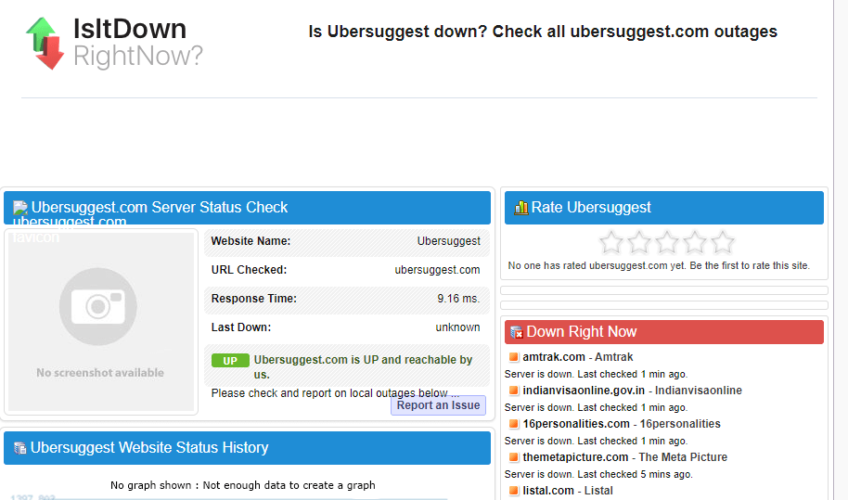
Ubersuggest might be temporarily down. To check, open the IsItDownRightNow website. Enter Ubersuggest.com in the text box, and click the OK button.

Then the server status check will tell users if the site is down or not.

IsItDown RightNow website ubersuggest not working

3. Reset the Browser

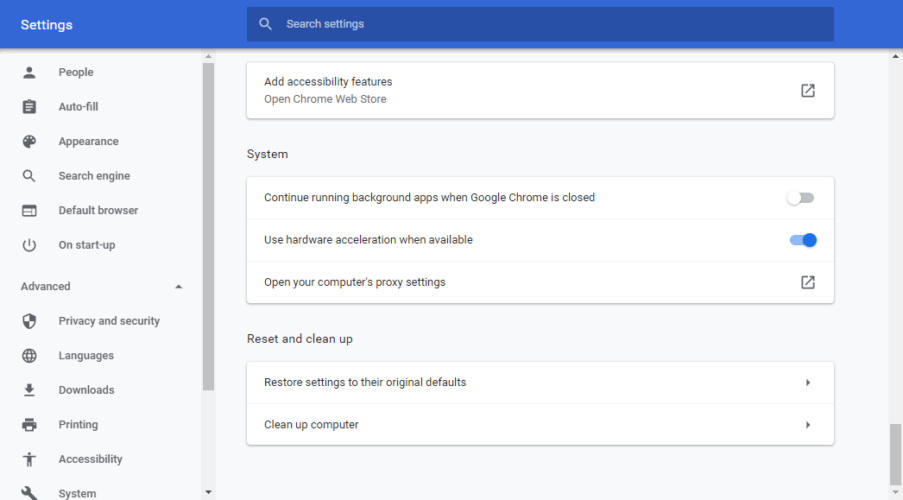
  1. Try resetting the browser to clear its data, turn off its extensions, and restore its settings to default. Google Chrome users can do that by clicking the Customize and control Google Chrome button.
  2. Select Settings on the menu to open that tab.
  3. Scroll down the Settings tab, and click the Advanced button.
  4. Then click the Restore settings to their original defaults button at the bottom of Settings.Restore settings to their default option ubersuggest not working
  5. Click Reset settings to confirm.

4. Turn on JavaScript

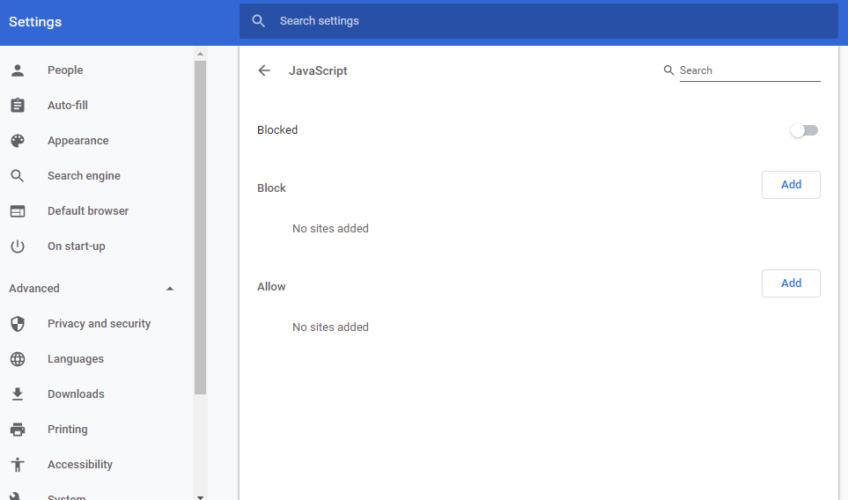
    needs to be enabled in Google Chrome to open some websites without any issues. Type the following line into the URL bar and press Enter: chrome://settings/
  1. Then click the Advanced button in Settings.
  2. Click Site settings and JavaScript to open the options shown directly below.JavaScript settings ubersuggest not working
  3. If JavaScript is blocked, click the Blocked option to turn it on.

5. Turn off firewalls

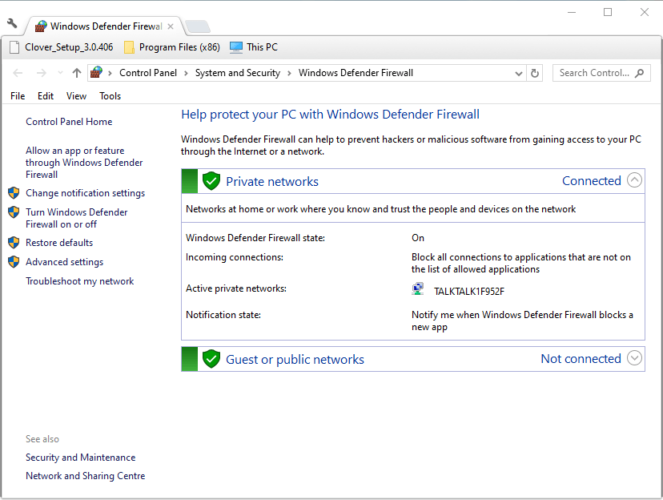
  1. The Windows Defender Firewall, or other third-party firewalls, might be blocking Ubersuggest. To turn off WDF, click the Type here to search button in Windows 10.
  2. Click Windows Defender Firewall to open the Control Panel applet for it.The Windows Defender Firewall Control Panel applet ubersuggest not working
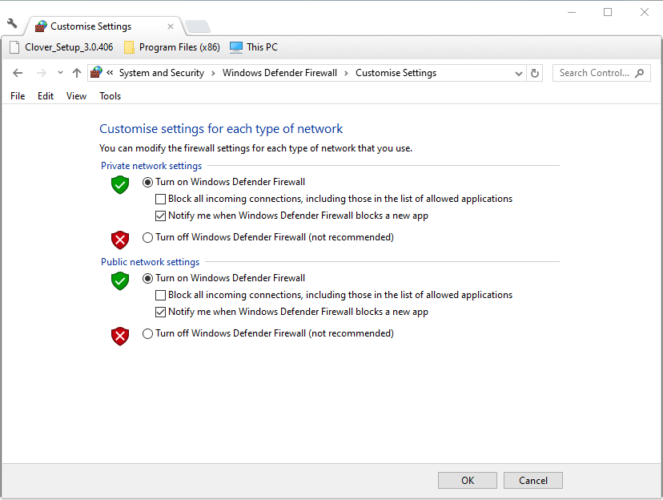
  3. Then click on Turn Windows Defender Firewall on or off, which will open the options shown directly below.WDF options ubersuggest not working
  4. Select the Turn off Windows Defender Firewall options, and press the OK button.

To turn off third-party firewalls, users will need to disable the antivirus utilities that include them.

Users can usually do that by right-clicking the system tray icons for antivirus software and selecting the disable or turn off setting.

Check out the antivirus software support sites for further guidelines on how to disable an antivirus utility.

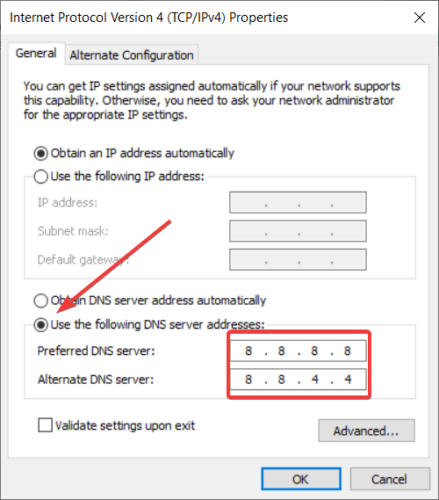
6. Switch to Google DNS

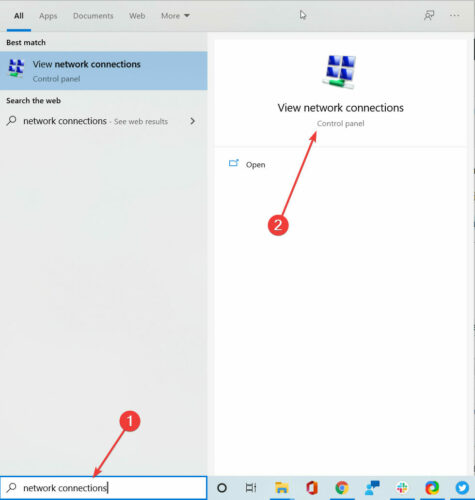
  1. Some users might need to change their DNS servers to fix the Ubersuggest issue. Users can switch to Google DNS by accessing the Network Connections.
  2. Type network connections in Windows Search and click on View Network Connections from the results.
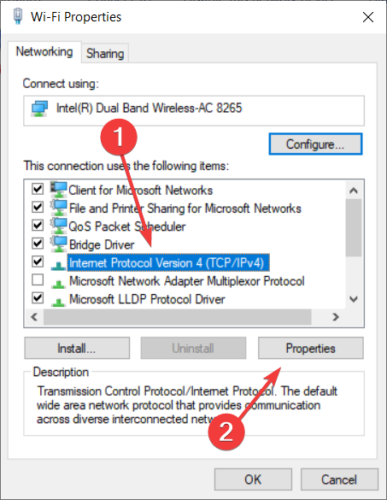
  3. Right-click on the right connection and select Proprieties.
  4. Select Internet Protocol Version 4 (TCP/IPv4), and then press the Properties button.
  5. Input 8.8.8.8 in the Preferred DNS server box.
  6. Next, enter 8.8.4.4 in the Alternative DNS server box.
  7. Click the OK and Close buttons.

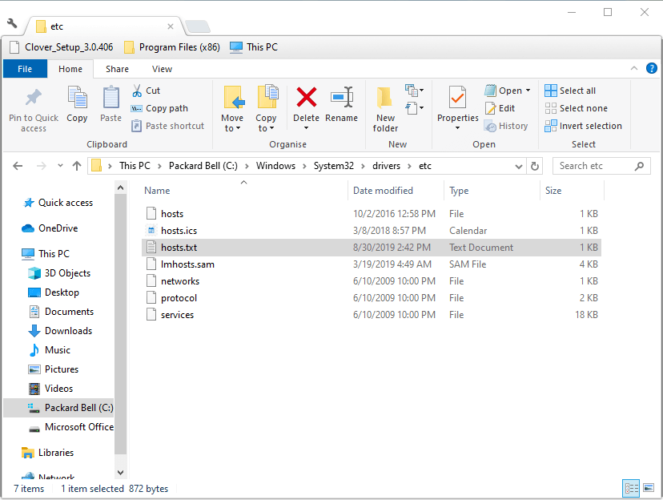
7. Check the Hosts file

  1. The Hosts file might be blocking Ubersuggest. To check the Hosts file, click the File Explorer button on Windows 10’s taskbar.
  2. Then enter the following path in the folder address bar and press Enter: C:Windowssystem32driversetcThe hosts folder ubersuggest not working
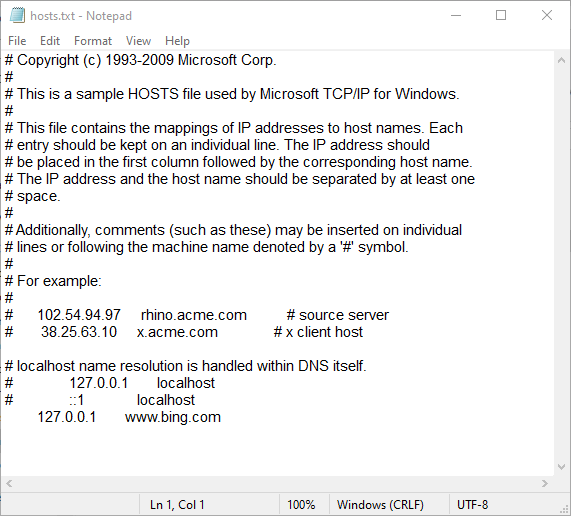
  3. Click on hosts.txt to open the text file below.The hosts.txt document ubersuggest not working
  4. Delete the Ubersuggest URL if the Hosts file includes it.
  5. Then click File and Save.

So, there are various ways users can feasibly fix Ubersuggest when it doesn’t open in browsers. The resolutions above might also fix other websites that don’t open.

Microsoft Teams will get all your organization in a meeting

Assuming your organization has 20.000 employees or less, Microsoft announced that it’s scaling Teams meetings to that many participants.

That is part of a bigger plan of the company to infuse Microsoft Teams with Advanced Communications.

We saw that coming since not long ago they announced an effort to improve communication in Teams by handling A/V redirect locally.

How do I add the Advanced Communications features in Teams?

As we mentioned above, it’s possible to have 20.000 participants in a meeting. However, only the first 1.000 will get to interact. After the limit will be reached, the others will be switched to a view only mode.

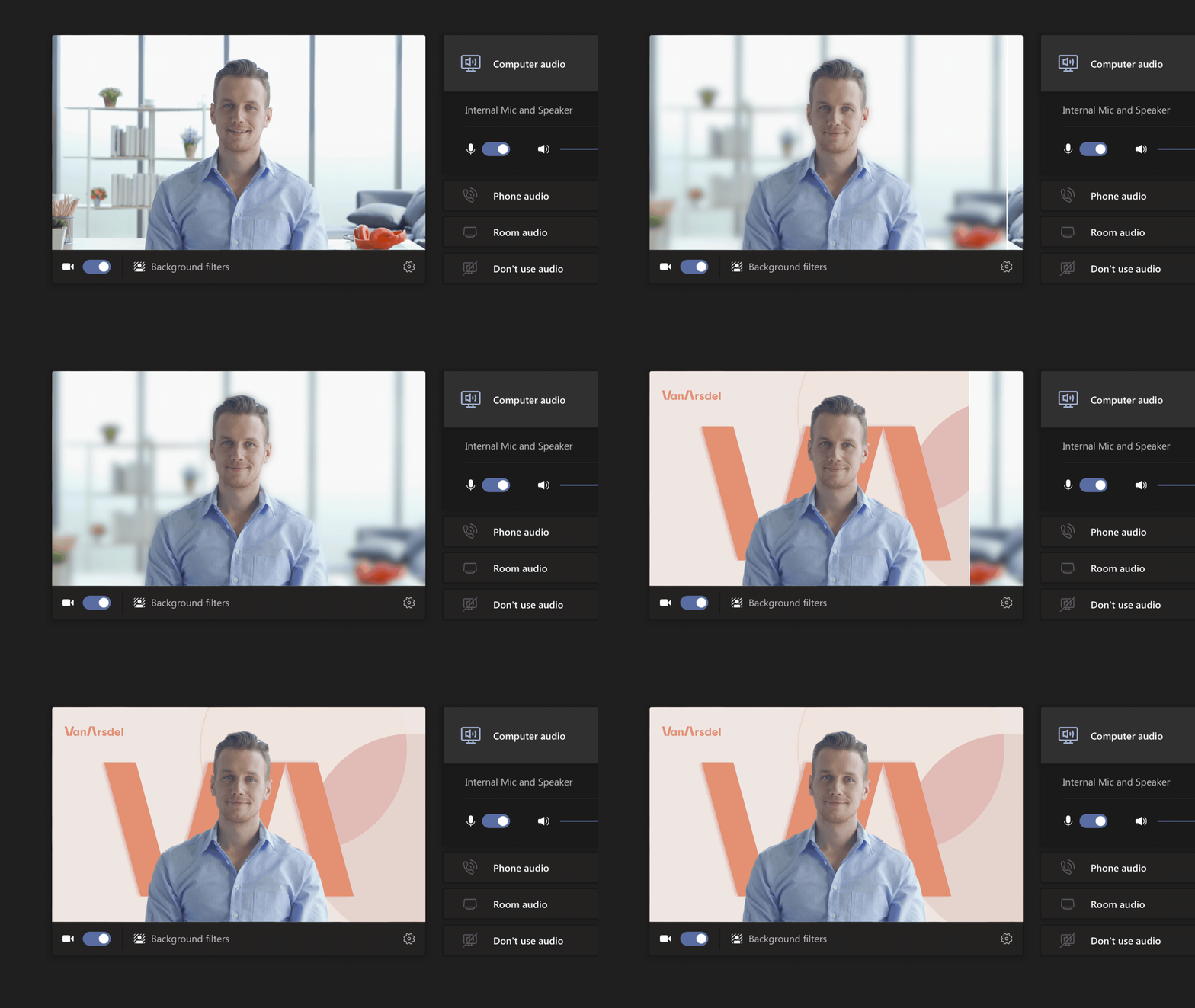
Another improvement is the enhanced admin control. The organizer gets to structure the meeting and add the company branding in the background.

An animated image of the Custom branded background.

Microsoft also promises to add a branded meeting lobby for a more professional look. A more important feature is setting up a compliance recording policy to keep that meeting private.

All the new capabilities will be available beginning this week and can be enabled based on an Advanced Communications plan which you can add to a Microsoft 365 or Office 365 paid subscription.

There is also a 60-day free trial through the Teams Admin Center starting now. You will also be able to contract it from the Microsoft Teams website but you will have to wait until mid-August.

A license will cost $12 per user per month.

Other Microsoft announcements

Good news for some organizations! Microsoft decided to extend the support for Skype for Business (3PIP) phones beyond 2023, so you will be able to use the phones while you organization moves to Teams.

According to Microsoft’s announcement, the list of accepted devices will be expanded:

Additionally, we will be supporting core calling features on SIP phones from Cisco, Yealink, Polycom, and others with Teams. Support for SIP phones will be available in the first half of 2021.

We are bringing a new line of Microsoft Teams phones with physical buttons, high-quality audio, and core calling features at an affordable price.

These phones are designed for common areas and basic information worker scenarios, with options available from AudioCodes, Poly, Yealink starting early 2021.

What do you think about the new Microsoft Teams features? Tell us all about it in the Comments section below.

[wl_navigator]

Chrome waiting for available sockets? Here’s how to fix that

Google Chrome or any other Chromium-based browser, by default, allows up to 6 simultaneous open connections at any time.

The problem occurs if the user streams multiple media files simultaneously from more than six media and audio tags, which may lead to an error.

When the user utilizes more than six connections, the 7th connection will just sit idle until one of the sockets opens up. This can result in a Waiting for available sockets error in Chrome.

Is Google Chrome hanging when streaming media as the Waiting for available sockets error appears? The best way to fix it is immediately going for third-party audio tools.

They don’t have limitations when applying effects. Alternatively, you can try Opera One browser. You can also force open sockets.

Read in detail about the solutions below.

How can I fix socket errors in Chrome?

  1. Try third-party Audio Tools
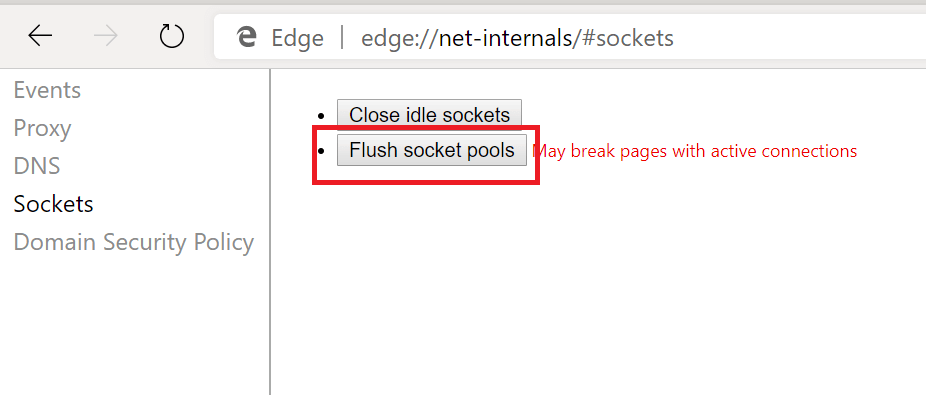
  2. Force Open Sockets
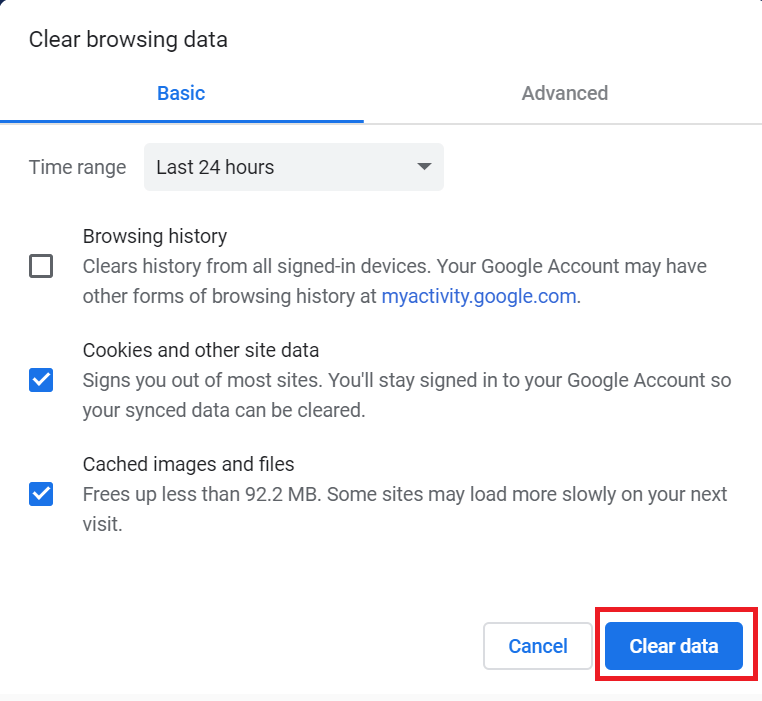
  3. Clear Browser Cache and Cookies
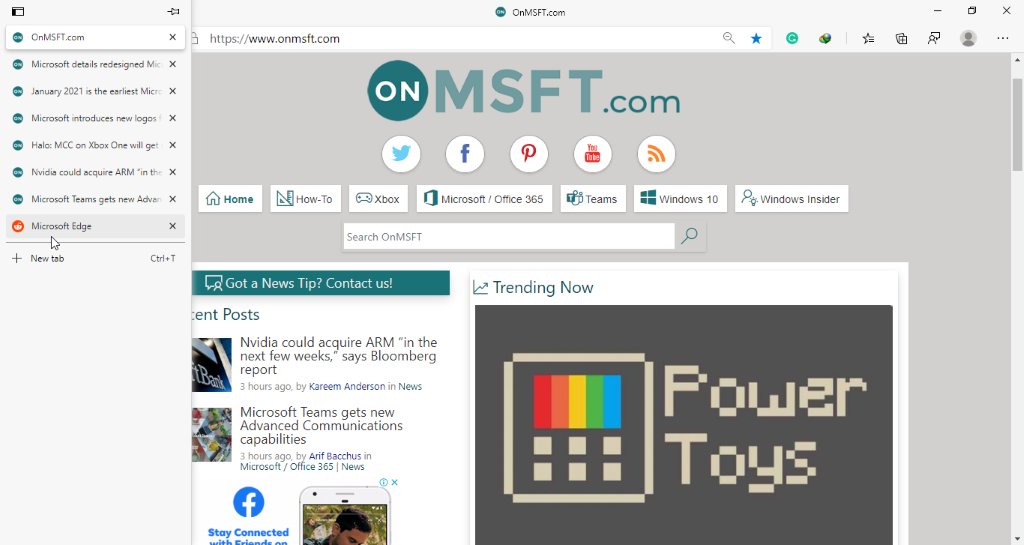
  4. Switch to Opera One

1. Try third-party Audio Tools

If you are trying to upload or play a large number of audio effects and music tracks, try to use third-party tools like Web Audio API and SoundJS.

  • Web Audio API – This is a Mozilla project and provides a powerful and versatile system for controlling music on the web. The developers can choose to add audio effects, audio sources, spatial effects as well as create audio visualization.
  • SoundJS – This is a popular  JavaScript library that provides a simple API. Combined with powerful features, SoundJS makes working with audio on the web a breeze. It allows the developers to add cross-browser sounds to the games and other projects.

2. Force open sockets

  1. Open Chrome and type the following command in the address bar and hit enter.
    Chrome://net-internal 
    Edge://net-internals (if you are using Edge)
  2. From the left pane, click on the Sockets tab.
    Flush Socket Pools
  3. Now click on the Flush Socket Pools button.

Close Google Chrome and relaunch it. Check if the error is resolved.

3. Clear browser cache and cookies

  1. Launch Google Chrome. Click on the Menu icon and select Settings.
  2. Scroll down to the Privacy and Security section.
  3. Click on Clear browsing data.
  4. Select a time range, and then check Cookies and other site data and Cached images and files option.
  5. Click on the Clear data button to clear the changes.
    Clear Browsing data - Chrome
  6. Wait for Chrome to clear the data. Exit and relaunch Chrome and check for any improvement.

4. Switch to Opera One

If you’re not accustomed to using third-party tools for this, you can try switching to an alternative browser that takes fewer resources than Chrome.

Opera One is a privacy-oriented browser that is both snappy and feature-rich. Especially when it comes to media streaming, where this Chromium-based browser really shines.

The reason for which Opera One has such leverage in this particular area is mainly due to its in-built VPN tool that allows you to stream content from any location by cleverly bypassing geo-restrictions.

Needless to say that using a VPN comes with extra perks such as increased privacy and identity protection.

Having undertaken a complete overhaul, Opera One already surpasses all major browsers with its distinguishable design, safety, and privacy.

Let’s quickly look at its key features:

  • Social media and messaging integrated in the sidebar
  • Turbo mode and battery saver
  • Integrated Ad blocker and VPN
  • Workspaces and Tab Islands
  • Built-in AI

Opera One

Reimagine streaming with the most powerful browser: faster, better, 100% private, and ad-free.
Free Download Visit website

This isn’t the only socket issue you can encounter, and many users reported ERR_SOCKET_NOT_CONNECTED error, but we covered that one in a separate guide.

There you go, we hope that our solutions helped you fix the Waiting for available sockets error in Chrome.

Latest Microsoft Edge Canary update brings vertical tabs for some users

Microsoft has rolled out a new vertical tabs feature to Edge Insiders on the Canary channel that makes it easier for users to manage multiple active tabs simultaneously. Spotted by Aggiornamenti Lumia, the feature is rolling out to select Insiders running Microsoft Edge Canary Build 86.0.597.0, and it brings an option to stack browser tabs vertically.

Microsoft Edge Canary Insiders running the latest version should be able to see the new vertical tabs experience by default. To use this feature, open multiple tabs in your browser, and then click the “switch to vertical tabs” option (shown in the screenshot below). A new vertical panel will now pop-up on the screen, and it will allow you to reorder, manage, and open a new tab. The new panel makes better use of the extra vertical space in Microsoft Edge, and it comes with a “Pin pane” icon.

Vertical Tabs Microsoft Edge

The new vertical tabs feature has been designed to make browsing with a bunch of active tabs more convenient and helps to identify tabs at a glance. As of this writing, the functionality is only available in the Canary channel of Microsoft Edge, and it’s now just a matter of time until Microsoft rolls it out in the Dev channel too.

Microsoft is committed to “zero waste” goal by 2030

In a post on the Official Microsoft Blog, Microsoft President Brad Smith goes into detail on how the Redmond company aims to become “zero waste in Microsoft’s direct operations, products and packaging by 2030.” More than 11 billion tons of waste is produced every year and of that, electronic waste accounts for 70% of all hazardous waste dumped in landfills.

Microsoft hopes to reduce as much of 90% waste the company generates while reusing, repurposing, and recycling ” their solid, compost, electronics, construction and demolition, and hazardous wastes.” One way that Microsoft will do this is through the new Microsoft Circular Centers that will be available onsite at all 160 of their datacenters worldwide.

Here is a video on how Microsoft looks to process its electronic waste through their new Microsoft Circular Centers.

“Microsoft will reduce nearly as much waste as we generate while reusing, repurposing or recycling our solid, compost, electronics, construction and demolition, and hazardous wastes. We’ll do this by building first-of-their-kind Microsoft Circular Centers to reuse and repurpose servers and hardware in our datacenters. We’ll also eliminate single-use plastics in our packaging and use technology to improve our waste accounting.

By 2030, we will divert at least 90 percent of the solid waste headed to landfills and incineration from our campuses and datacenters, manufacture 100 percent recyclable Surface devices, use 100 percent recyclable packaging (in Organization for Economic Cooperation and Development, OECD, countries), and achieve, at a minimum, 75 percent diversion of construction and demolition waste for all projects.”

In January 2020, Microsoft announced that it will remove more greenhouse gases from the Earth’s atmosphere than it produces by 2030 and will aim to remove all the carbon dioxide emissions Microsoft has ever released (since its creation in 1975) by 2050.

Project xCloud is launching on Android on September 15 as part of Xbox Game Pass Ultimate

It’s official, Microsoft’s Project xCloud game streaming service will launch on September 15 in 22 markets. The service, which Microsoft will apparently market as “cloud gaming” instead of Project xCloud, will launch in beta for Xbox Game Pass Ultimate members, and only Android phones and tablets will be supported at launch. These mobile devices will be able to play over 100 Xbox Game Pass games, but Microsoft will share more details about the full catalog of games closer to launch.

“When cloud gaming launches as part of Xbox Game Pass Ultimate, players will have access to more than 100 high-quality games playable from the cloud, including Minecraft Dungeons, Destiny 2, Tell Me Why, Gears 5, Yakuza Kiwami 2, and more. And as we’ve committed to providing day-one access to new titles from Xbox Game Studios as part of Xbox Game Pass, it’s our intent to make those same games available in the cloud from the day they release,” explained Kareem Choudhry, CVP of Project xCloud.

The launch markets for cloud gaming in Xbox Game Pass Ultimate include Austria, Belgium, Canada, Czech Republic, Denmark, Finland, France, Germany, Hungary, Ireland, Italy, Netherlands, Norway, Poland, Portugal, Slovakia, Spain, South Korea, Sweden, Switzerland, the United Kingdom, and the United States. To use cloud gaming on September 15, Xbox Game Pass Ultimate members will need to download the Xbox Game Pass mobile app from the Google Play Store, the Samsung Galaxy Store, or the ONE Store.

During the public preview, Microsoft required beta testers to use an Xbox wireless controller with Bluetooth or a PlayStation 4 controller. Both controllers will continue to be supported, but Razer, PowerA, 8BitDo, and Nacon are also creating new accessories specifically designed for Project xCloud. The list includes the 8BitDo SN30 Pro controller for Android devices, which is much smaller than Microsoft’s Xbox Wireless controller. The Razer Kishi Universal Mobile Gaming Controller for Android is another interesting alternative that can turn your smartphone into a Nintendo Switch-like gaming device.

Project xCloud Accessories

Microsoft is still working on touch controls for Project xCloud games, and the Game Stack team did a livestream yesterday to demo them on games like Gears 5 (via The Verge). Developers will be able to create custom layouts with buttons that are quite different from the familiar Xbox Wireless controller, but these adaptable touch controls likely won’t be better than using a dedicated mobile controller. Anyway, Project xCloud beta testers can already test touch controls on Hellblade: Senua’s Sacrifice, and Microsoft plans to add touch controls to more games later.

“More than 10 million Xbox Game Pass members are already discovering and playing great games on console and PC – and with the addition of cloud gaming, members can discover and try out new games on Android phones and tablets,” Kareem Choudhry said today. We still don’t know when Microsoft will make its cloud gaming technology available on other devices including Windows 10 PCs and iOS devices, but the upcoming Android launch will be an important milestone in the creation of a true Netflix-like streaming service for video games.

Digital pre-orders open for Project Cars 3 video game on Microsoft’s Xbox One consoles

Pre-orders are now live for the upcoming Project Cars 3 video game on Microsoft’s family of Xbox One consoles ahead of its August 28th release date.

Project Cars 3 is available in both a regular edition and a Deluxe Edition which comes with the main game, the season pass for future downloadable content, and three days of early access.

Here’s the official game description:

Own it all with Project CARS 3. Live every thrill of your journey from weekend warrior to racing legend as you race to earn, own & upgrade hundreds of precise handling, elite-brand cars. Individually tailored settings for every skill level, personalization options for every driver, customization for every car in your garage & every race condition the way you want in YOUR Ultimate Driver Journey.

Are you a fan of the Project Cars series and will you be buying Project Cars 3 for Xbox One? Let us know in the comments below and then follow us on Pinterest for more Xbox gaming content.


Xbox One and PC gamers won’t be able to play as Spider-Man in upcoming Marvel Avengers video game

Less than a week after the upcoming Marvel Avengers video game finally started garnering some positive buzz with the announcement of its betas and the reveal of Hawkeye, opinion on the title has once again soured dramatically among many gamers and critics after Sony confirmed that one of Marvel’s most-popular characters, Spider-Man, would be playable on PlayStation consoles only.

This means that, while Marvel Avengers will release on Microsoft’s family of Xbox One consoles and on PC via a variety of online stores, only those that own a PlayStation 4 console will gain access to Spider-Man. This doesn’t appear to be a timed exclusive deal either. Xbox and PC players will never get to play Spider-Man in their version of the game.

While Sony does maintain a lot of the rights when it comes to Spider-Man’s usage in a variety of media platforms, the character has frequently appeared in various video games on and PC and other consoles such as LEGO Marvel Superheroes, Marvel Ultimate Alliance 3, Disney Infinity, and Marvel vs Capcom: Infinite. Restricting Spider-Man to the PS4 version of Marvel’s Avengers is clearly a decision Sony made to help promote its PlayStation consoles, in particular its upcoming PS5 which launches later this year and will be competing directly with Microsoft’s Xbox Series X.

Console exclusive video game content isn’t a new marketing strategy and it’s often met with frustration by gamers who simply want all of the available content on their version of the game. Soulcalibur II is one of the more famous examples of a multi-platform games with platform exclusive characters. It included Zelda’s Link on the GameCube version, Spawn on the Xbox version, and Tekken’s Heihachi on the PlayStation 2 version. Thankfully, this practice was phased out over subsequent entries in the Soulcalibur franchise.

Another example would be Boba Fett in Disney Infinity 3.0 whose figure was sold with the PlayStation version months ahead of its individual release meaning that players on Xbox One and other platforms couldn’t play as the fan favorite bounty hunter at launch.

It’s unclear how this decision will affect sales. Those who own both an Xbox One and a PlayStation 4 will likely just buy the PlayStation version but the lack of Spider-Man on other platforms could frustrate gamers so much that they might skip the title completely.

Marvel Avengers is due out on September 4th with its closed and open beta periods set to run later this month.

Has the exclusivity of Spider-Man affected your decision to play Marvel Avengers? Has it convinced you to buy the PS4 version or even purchase a PS4 console? Share your thoughts with the community in the comments below and then follow us on Pinterest and Twitter for more Xbox gaming news.

Marvel's Avengers
Marvel's Avengers
Developer:
Crystal Dynamics
Price:
Free


Drivable cars are coming to Fortnite Battle Royale this week on Xbox One and other platforms

Drivable vehicles have been a feature that was promised since the initial trailer for Fortnite’s current season (Chapter 2 Season 3) but little had been said of them until today when a sudden promotion for what looks like a new car appearing in-game and on the official Fortnite social media channels.

The promotion features a drawing of a car called Whiplash which will apparently be added to the game in a new update rolling out sometime tomorrow across all supported platforms. The update is being labelled the Fortnite Joyride Update which, along with the car reveal, pretty much confirms that this is the drivable car update many had been waiting for.

Fortnite has introduced a variety of transportation mechanics over its numerous seasons ranging from hoverboards and mechs to helicopters and speedboats. They’re often a necessary part of surviving a match of Fortnite Battle Royale as they provide a convenient way to travel quickly from one part of the map to another when evading opponents and the growing storm.

While most players have unlocked all of Chapter 2 Season 3’s Battle Pass content by now, Fortnite is keeping players engaged over the remaining weeks with the sudden appearance of an Ancient Astronaut on the map, the reveal of a sunken city, and the lowering of water levels to add more solid ground to fight on.

It’s unclear what the end of the season will contain but many are expecting some sort of addition to Fortnite’s lore with more references to the astronaut and the rifts.

Do you play Fortnite and are you excited for the addition of drivable cars? Let us know in the comments below and then follow us on Pinterest and Twitter for more Xbox gaming news.

Fortnite
Fortnite
Developer:
Epic Games Inc.
Price:
Free


Fortnite - 1,000 V-Bucks

Can VPN hide MAC address? Is sharing your MAC dangerous?

We’re perfectly aware that VPNs can help you evade a lot of monitoring by cloaking your IP address, but can VPN hide your MAC address? Note that we’re talking about MAC, as in Media Access Control address, not the device.

If you already know what MAC is and how it can affect your online privacy, you can use the table of content controls on the left to skip the boring, technical stuff.

However, we promise to be short and deliver concise, down-to-earth details about this topic.

What is a MAC address?

A MAC address is similar to an IP address, because both are crucial when it comes to identification, but only to a certain degree. IP address is a more loose concept, where different devices can have the same IP address at some point in history.

MAC addresses, on the other hand, are device-bound and, as a result, unique. A MAC consists of six pairs of hexadecimal digits, which are either separated by colons or hyphens, or they’re not separated at all.

As opposed to MAC addresses, IPs (IPv4, that is) consist of four groups of digits, each group containing up to three digits. These groups are separated by a simple dot.

Compared to the uniqueness of MAC addresses, IPs come from finite number pools. To clarify things even more, there are exactly 4,294,967,296 IPv4 addresses.

However, it’s worth mentioning that even MAC addresses are finite. It’s only that their number is far higher than the amount of possible IPv4 addresses.

Since they’re 48-bit addresses, you can determine the amount of possible MAC addresses by solving 2 power 48. We’ll spoil the result for you. It’s 281,474,976,710,656. Yes, that’s almost 281 trillion and a half.

Can VPN hide MAC addresses?

To put it shortly, VPNs can’t spoof your MAC address, and doing so would be pointless. Masking your MAC address would only make sense if you want to protect yourself from other users on the same network.

More so, Windows has (or used to have) a built-in MAC address randomizer that would spoof your real MAC address in settings.

Alternatively, you could use one of the various MAC spoofing tools on the Internet, or look up a tutorial on how to change your MAC quickly and without messing everything up.

So we say it again: a VPN can’t hide your MAC address. Why? Because it would be pointless.

But, if you want to have an extra-layer of protection and benefit of other cool features of a VPN, we strongly recommend you to use a truly private VPN. Here are the benefits of using a VPN:

  • Advanced privacy protection
  • Secured applications, not just your web browser
  • Block unwanted connections
  • High grade encryption

⇒ Get Private Internet Access

Is giving out your MAC address dangerous?

Usually, someone else knowing your MAC address shouldn’t be much of a security threat. It’s far less dangerous than someone knowing your public IP address, for instance.

If someone were to have your public IP address, you could be targeted by a wide variety of attacks. The most common attack would be a DDOS since it doesn’t take much to achieve.

Or, if you’re unfortunate enough, you could be targeted by a more severe attack, which could escalate in the perpetrator gaining full remote access to your device and handle it in a broad variety of ways.

However, an attacker can’t do much by simply knowing your MAC address. Let’s say that it has the same level of threat as someone knowing your real name online.

If you still have doubts about the dangers of someone else knowing your MAC, let’s tell you what’s the worst that could happen.

1. Forcing a deauth attack

If you’re connected to a wireless network and the attacker is well aware of your MAC address, they could force you to deauthenticate from your network. And maybe even prevent you from reconnecting by using the same MAC address.

However, note that this can only work if the attacker is either physically near your WiFi network or on the same network as you. Thus, someone random on the Internet can’t do much by simply being aware of your MAC address.

2. Match your MAC with a vendor

Alright, that’s not exactly dangerous, but if you want to keep what kind of device you use on the hush, it’s best not to make your MAC address public.

There are a lot of tools and tables that you can use to identify the device type that’s using a certain MAC address. These tools are mostly used by confused users who don’t exactly know who made the components inside their system.

However, a MAC identification tool can also be used by an attacker that wants to target only specific devices on the network by matching their MAC address to a known database of devices.

3. Impersonating your router

If the attacker were in your proximity, they could replicate the MAC address of your router. This, in turn, could help facilitate a man-in-the-middle (MITM) attack.

In this type of attack, the attacker could make your current device believe it’s connected to your safe, regular router.

In fact, your PC could be connected to another device that the attacker cleverly disguised as your router by merely cloning the MAC address.

All your traffic would then pass through the attacker’s device and you’d have no idea. This is by far the most dangerous type of MAC-type attack.

However, as you’d expect, the attacker needs to be really close to your router or be relatively close and use a signal booster or some different signal amplification device.

Furthermore, your device might pick up two different access points, and one of them is likely to be insecure (without a password). Thus, it would be quite obvious that someone was trying to trick you.

4. Gaining MAC-based clearance on various systems

This one is a bit of a stretch, but it could happen just like any other attack. If you’re using some software that uses MAC-based identification to grant you access, someone else cloning your MAC address could be a real threat.

For instance, if you’re on a MAC-restricted network that uses no other type of identification. If someone were to replicate your MAC address, the network would give that user clearance.

And that’s about it. Although it seems like a lot of attacks, the fact that the perpetrator needs to be nearby is quite offputting and makes it both harder to achieve and a lot more obvious to the one that’s being attacked.

A VPN can’t hide your MAC address

To wrap things up nice and tidy, VPNs are generally not capable of hiding your MAC address. We say generally because we haven’t yet heard of one that can do that. We’re pretty confident they don’t exist, but we can’t take any chances.

However, even if a VPN lacks MAC spoofing capabilities, it’s not a big deal. Changing your MAC address could only protect you from users that are on the same network as you, or awfully close (physically) to your router.

For these situations, we strongly advise you to avoid public WiFi networks, use strong passwords for your personal home router, and try to avoid letting people settle too close to your router for obvious reasons.

Parallels Desktop to let you run Windows apps on Chromebooks

Windows is still the most popular desktop operating system to date, which is why developers have built tens of millions of applications for the OS.

Now, according to a plan that Chrome OS product manager Cyrus Mistry recently revealed to the Verge, you’ll soon be able to run your mission-critical Windows 10 apps on a Chromebook,

Windows 10 apps to run on Chromebooks, thanks to Parallels Desktop

Non-Windows PC systems are gaining popularity day by day despite the long-standing dominance of the personal computer OS from Microsoft. On top of that, enterprise and individual users are increasingly exploring alternative experiences on platforms like Chromebooks.

But there’s a major issue here. Just like other third-party applications, Windows apps don’t currently have native support in Chromebooks.

It’s why many of these users may hesitate to move to the lean, web-facing laptops from Google. There’s good news though—Windows apps are coming to Chromebooks, thanks to the Parallels Desktop virtual machine.

Mistry explains:

We want to make sure you have that option [for Windows apps] as well… so that every once in a while you’ll be able to get that when you need it, but we don’t want that to be the world you’re living in.

If you’re wondering how Google will pull that off, be assured that the Parallels VM will be safely loading the full copy of Windows along with Chrome OS and Android applications. As a result, you should be able to deploy your favorite Windows software on the platform without any complications.

Mistry also talked about Coherence, a feature that may let you deploy just the app you need instead of the entire Windows desktop.

In the future we’ll have other types of things where you don’t even have to run the whole Windows desktop, you’ll just run the app you need.

Have you ever needed to virtually deploy Windows 10 on a Chromebook? Let us know in the comments box below.

[wl_navigator]

Can VPN hide torrenting? Is it safe to torrent with a VPN?

One of the most pressing matters that burden the minds of VPN users is whether can VPN hide torrenting or not. Although torrenting is many times deemed as unlawful behavior, things are actually way different.

VPNs are amazing tools that can help you hide all sorts of traffic, including the one you generate while torrenting. However, there are a few things you must take into consideration before engaging in such activities.

What is torrenting?

Usually, downloading a file from the Internet happens as you’d guess. You make the request to the remote server, which generates a response and sends you the file if all conditions are met. Piece of cake.

However, with torrenting, things are a bit different. Instead of relying on a single remote server as standard downloads do, torrenting relies on other users who engage in this type of activity.

Torrenting makes use of P2P (peer-to-peer) and clients to allow you to participate. You fire up the client, load the torrent details either manually or using a torrent file, then wait for the download to complete.

Instead of receiving a single, larger file from a single server, torrenting lets you retrieve several parts of the file from various users, then the client reconstructs the original file by using the bits.

The reason behind this practice is that it takes a lot less time to download several smaller file chunks from multiple users than downloading a single, large file from a single server.

Once the downloads come to a stop, you begin seeding the files you downloaded. This means that other users will be able to fetch the files from you, as you did from them.

Is it legal to torrent?

From a legal standpoint, torrenting is somewhere in the gray area. Mostly because it’s been associated with piracy, due to the vast amount of tracker websites where pirated content was (and still is) shared via torrent.

However, generally speaking, torrenting is not illegal just because it’s a popular and efficient file-sharing technology. It’s like marking the Internet illegal just because a lot of shady stuff happens online.

For instance, many open-source (and not only) services facilitate torrent download links for their products. Downloading these, for instance, is perfectly legal.

Why hide torrenting traffic?

Well, for once, torrenting traffic is one of the easiest to spot types of traffic. An ISP could take one brief look at your log and determine that you’ve engaged in downloading/uploading files via torrent.

And even though there might be nothing to hide in the first place, it’s still quite unsettling that someone could have that level of clearance on your private online data.

Not to mention if your torrenting habits are a bit sketchy, or let’s say somewhere in a gray area.

So it would make perfect sense to take a shot at hiding your torrent data from your ISP (and others who might take an interest). As you’d expect, a VPN excels at hiding torrenting data. Much like any other type of traffic you pass.

Can VPN hide torrenting traffic?

Assuming that we’re on the same page concerning privacy protection with VPNs, let’s see if and how a VPN could hide your torrenting traffic from various third-parties.

What a VPN does is retrieve all of your traffic and routes it through a secure, encrypted tunnel. That way, everything coming from your PC can’t be seen by your ISP. This, of course, includes torrenting traffic.

However, you should take a few precautions before choosing a VPN that’s fit for torrenting.

1. Make sure the VPN has a kill switch

If you download something via torrent and you’re behind a VPN, that’s wonderful. However, know that a VPN connection might fail at any time, regardless of your activities.

Thus, it might decide to interrupt the connection while you’re streaming video, or reading your emails.

Private Internet Access

Private Internet Access

Looking for a torrent-friendly VPN? Check out PIA.
$2.85/mo. Buy it now

In the meantime, your PC will reconnect to your default, insecure connection. Thus, if you’re downloading files with a torrenting client, your identity and activity will be exposed.

What a kill switch does is prevent your PC from connecting to the Internet if no VPN is detected. That way, even if your connection drops while using a torrent, no traffic will leak.

If you want to try a kill switch-enabled VPN and don’t know where to look, you should check out Private Internet Access.

2. Check if the VPN allows torrenting

Many VPNs have no issue with you downloading files through torrent clients.

However, some of them are quite specific with their anti-torrenting policies, so you’ll need to make sure whether your VPN allows torrenting before purchasing a subscription.

Most of the time you’ll be able to find it casually mentioned in the Terms of Service documentation. Another strong indicator that your VPN is pro-torrenting is the availability of dedicated torrenting servers.

So, keep your eyes peeled and try not to upset your VPN provider if it doesn’t support torrenting usage. If you don’t know where to start, check out our best VPNs for torrenting recommendations.

VPN is able to hide torrenting traffic

All things considered, VPNs are quite reliable tools when it comes to hiding all kinds of traffic, including the type you generate by downloading and uploading via torrent clients.

However, you should still be cautious about what you do online. Even though a VPN can hide your activity from your ISP, the VPN provider has access to your torrenting traffic and might suspend your account if anything goes wrong.

Last, but not least, you should check if your VPN supports torrenting and if it has a kill switch. A kill switch can help you bypass torrent traffic leaks and you won’t get in trouble for torrenting on a non-supportive service.

[wl_navigator]

The new KB4568831 optional update hides 20H2 features

Microsoft announced a new cumulative update KB4568831 to Windows 10 version 2004 that is coming with a lot of fixes but also some hidden gems.

The guys from ghacks.net noticed that this optional preview update carries over some new features from Windows 10 2009 but they are hidden and dormant until you activate them.

We already created a guide for you on how to install the new 20H2 featured on your Windows 10 version 2004 so you can easily enjoy the new beautiful Start Menu and more.

What is new about the cumulative update KB4568831?

Windows 10 KB4568831 update

First of all, Microsoft disabled the RemotFX vGPU feature due to a security vulnerability related to  CVE-2020-1036 and KB4570006.

If you install this update and want to start a virtual machine with RemoteFX vGPU enabled, it will fail and you will receive an error message:

  • The virtual machine cannot be started because all the RemoteFX-capable GPUs are disabled in Hyper-V Manager.
  • The virtual machine cannot be started because the server has insufficient GPU resources.

And if you want to enable the RemoteFX vGPU again, you will receive a message saying that the adapter is not supported anymore.

The conclusion is either you stop using this adapter or you install this update and it will block it. Otherwise you will be vulnerable to attacks exploiting the CVE-2020-1036 vulnerability.

Other changes coming with cumulative update KB4568831

Other improvements coming with the new update range from fixing issues with the Magnifier stopping to work in Internet Explorer to issues preventing family safety features.

Another notable fix is for an issue with 4K high dynamic range (HDR) content being displayed darker when you configure certain non-HDR systems for HDR Streaming.

KB4568831 also fixes and an issue when using sharing functionality in Microsoft Office when you enable Conditional Access.

Read more about all the new fixes from the Microsoft’s announcement.

Are you going to enable the new Start Menu in Windows 10? Tell us if you encounter any problems is the COmments section below.

[wl_navigator]

Download Windows 10 KB4503286 to fix PC startup issues

It’s Patch Tuesday time and Microsoft released Windows 10 cumulative update KB4503286 to Windows 10 v1803 users. This update bumps the OS version to build 17134.829. 

Update KB4503286 brings important security updates and fixes some issues affecting various Windows components.

However, Microsoft mentioned that this patch brings a few issues of its own as well.

What improvements and fixes does KB4503286 bring?

1. IE11 bug fix

Microsoft fixed an important issue that was introduced with the previous releases. The bug occurred due to issues with the Default Search Provider and prevented Windows 10 users from opening Internet Explorer 11.

Speaking of browser issues, if you’re tired of such limitations, you can switch to a new, better, faster and overall more efficient browsing solution such as Opera One.

This privacy-focused browser can be the right choice for you. Having undertaken a complete overhaul, Opera One comes out looking crisp, neat, and elegant, delivering an intuitive and user-friendly interface with countless customization options.

You can, for instance, change its appearance from modes to themes, displayed sections, and more – until it perfectly reflects your style and matches your browsing needs down to the very last detail.

But it’s not all about looks. This is a feature-rich browser with the utmost concern for your privacy which delivers competitive functionalities aimed to facilitate users’ experience as much as possible.

By running Opera One, you will enjoy a full-scale in-built VPN tool to protect your online identity and unblock otherwise geo-restricted content and websites, uninterrupted and fast loading webpages browsing thanks to the integrated adblocker and many more.

Let’s quickly look at its key features:

  • Built-in VPN and Ad blocker
  • Battery saver mode and turbo mode
  • Native AI and modular AI-ready design
  • Workspaces and tab islands

Opera One

Bug-free browsing? You bet! Get a taste of faster, better, 100% private, and ad-free browsing with Opera One!
Free Download Visit website

2. Device startup issues fixed

KB4503286 resolves device startup issues in Windows 10. According to user reports, the bug-affected devices from Windows Deployment Services (WDS) server that used Variable Window Extension.

Microsoft says that the issue could lead to premature termination of a connection to the WDS server.

3. Bluetooth connection issues fixed

Thankfully, Microsoft addressed the security flaw in Windows 10 that blocked suspicious connections between Bluetooth devices and Windows 10.

4. General security updates

Microsoft released various security updates to fix issues affecting many Windows Components. T

he tech giant patched some vulnerabilities in the following components: Internet Explorer, Windows App Platform and Frameworks, Windows App Platform and Frameworks, Windows Authentication, Windows Virtualization, Windows Shell, Microsoft Edge, and more.

5. KB4503286 known issues

Thankfully, KB4503286 brings a single known issue to the table. Microsoft warns users their PCs may fail to perform some specific operations on folders and files.

The issue affects those folders and files that are stored on Cluster Shared Volume (CSV). You may encounter the following error code: STATUS_BAD_IMPERSONATION_LEVEL (0xC00000A5). 

Microsoft says that they are working to resolve the issue. However, the company suggested a temporary workaround as well. You can perform one of the following operations:

  • Perform the operation from a process that has administrator privilege.
  • Perform the operation from a node that doesn’t have CSV ownership.

You need to wait for the upcoming release to permanently fix this issue.

Did you encounter other KB4503286 issues? Let us know in the comments below.

How to install the new Start Menu on Windows 10 version 2004

The advantage of being a Windows Insider is that you get to experience features that will be implemented a lot later in a stable version.

The bad side is that the Insider builds come with potential bugs, actually, the whole point behind this being to fix them in time for a stable release.

Well, you can bypass the issues and go straight to the good stuff because we will tell you how to install some Windows 10 version 2009 (aka 20H2) on your Windows 10 version 2004.

How can I enable the new Start Menu in Windows 10 v2004?

The most important features from Windows 10 20H2 are the new beautiful Start Menu and the fact that you can use ALT + Tab in Microsoft Edge to switch between tabs.

Actually, the secret behind this transformation is that in fact, some of the features that are going to become permanent in Windows 10 2009 are already installed in Windows 10 version 2004.

First, you need to install the preview updates launched this week because the new features are part of that update.

How do I enable the new Windows 10 20H2 features?

  1. Open Registry editor by typing regedit in Windows Search and clicking on the result.Open registry editor
  2. Look for [HKEY_LOCAL_MACHINE\SYSTEM\CurrentControlSet\Control\FeatureManagement\Overrides\0\2093230218]
  3. Change EnabledState=dword:00000002
  4. Change EnabledStateOptions=dword:00000000

The experts from ghacks.net even created a file that you can use to make the necessary modifications without editing the Registry yourself.

You need to restart your computer for the changes to take effect. After the restart, you will see the nice new Start Menu.

[wl_navigator]

Fix: Browser Does Not Recognize any of the Video Formats

Your browser does not currently recognize any of the video formats available is a frequent YouTube error message.

Numerous Chrome, Vivaldi, and Firefox users have stated on forums that, the error message appears when they try to play YouTube videos.

It’s a little surprising that the above browsers don’t always play YouTube videos for some users as those are browsers that support most HTML5 video codecs.

If your browser is having a hard time playing YouTube videos due to video formats not being recognized?

Start by turning off the Switch to Flash Player feature and disabling any YouTube HTML5 Player extensions. That should resolve the problem in most cases, but if it doesn’t, you will need to reset your browser to default values or switch to a more reliable browser.

Learn more about how to follow through with these solutions below.

What can I do if my browser won’t recognize video formats?

  1. Use another browser
  2. Turn off the switch to flash player
  3. Reset the Browser
  4. Check the media.mediasource.enabled setting

1. Use another browser

How about a browser that doesn’t have issues with YouTube streaming? Opera One is a worthy alternative to all mainstream browsers for a variety of reasons.

Based on the Chromium project, Opera One has great privacy-oriented features and it takes fewer system resources than Google’s flagship browser and protects your online identity at all times.

Even though it supports Google Web Store extensions, those are not a necessity. The built-in Add-blocker and VPN are all you need in order to prevent trackers and cookies from grabbing your information.

In regards to video streaming, it works seamlessly on all platforms you can think of, starting with YouTube and Twitch.

But, don’t take our word for it, check it out and see for yourself. Plus, it comes with built-in AI, VPN and Ad blocker.

Opera One

Watch high-resolution YouTube videos with less connection issues.
Free Download Visit website

2. Turn off the switch to Flash Player

  1. Open Chrome’s primary menu.
  2. Click More tools and select Extensions.
  3. Next, enter Switch to Flash Player in the search box.
  4. Toggle the Switch to Flash Player extension off.
  5. Enter Disable YouTube HTML5 Player in the search box to locate that extension.
  6. Toggle that extension off, or click its Remove button.
  7. Restart Chrome.

3. Reset the Browser

  1. Enter Chrome://settings in the browser’s URL bar.
  2. Press the Enter key.
  3. Scroll down the Settings tab to click Advanced.Chrome Settings
  4. Scroll down to the Restore settings to their original defaults option.Reset Chrome to default settings
  5. Click the Restore settings to their original defaults option.
  6. Select the Reset settings option.

4. Check the media.mediasource.enabled setting

  1. Enter about:config in the <span id="urn:enhancement-64d17675-03f1-dc12-c88c-bd759c57f0f3" class="textannotation”>URL bar.
  2. <span id="urn:enhancement-64d17675-03f1-dc12-c88c-bd759c57f0f3" class="textannotation”>Press the Enter.
  3. Enter media.mediasource.enabled in the about:config’s pages search box.media.mediasource.enabled firefox flag
  4. Double-click media.mediasource.enabled to set to True.
  5. Restart the browser after enabling Media Source Extensions.

That’s how users can resolve the Your browser does not currently recognize any of the video formats available YouTube error.

As the error is usually appearing due to extensions, turning off all browsers extensions and add-ons is the most probable fix.

Bing is Microsoft’s next overhaul to change your office

You might think that Google Search is unbeatable and impossible to overthrow but Microsoft is not giving up the fight that easy.

Last month’s announcement with Bing Site Scan tool letting you set crawling speed raised some eyebrows but that’s merely a drop in the ocean, right?

Now, the giant from Redmond announced that they are implementing Microsoft Search in Bing and Microsoft 365 Apps for the enterprise.

That’s a big move because it brings Bing in the center of today’s virtual workplace, in the middle of Microsoft 365 users.

How will Bing and Microsoft Search influence work?

Microsoft explains in their announcement exactly what Microsoft Search in Bing is all about:

Microsoft Search in Bing enables your users to use the familiar browser address bar and search box to find workplace information more easily.

For example, documents, internal sites and business tools, people and org charts, and other relevant information from within your organization.

Microsoft Search in Bing searches across files, SharePoint sites, OneDrive content, Teams and Yammer conversations, and other shared data sources in your organization, as well as the web.

So, if you’re at work, using Bing, not only that you will roam the Internet but also the resources from your workplace through Microsoft Search.

Moreover, they are working on an optional Google Chrome extension to set Bing as the default search engine for Google Chrome and provide easier access to Microsoft Search.

After you install it, you will have an On/Off switch just in case you want to stop using Bing as the default search engine.
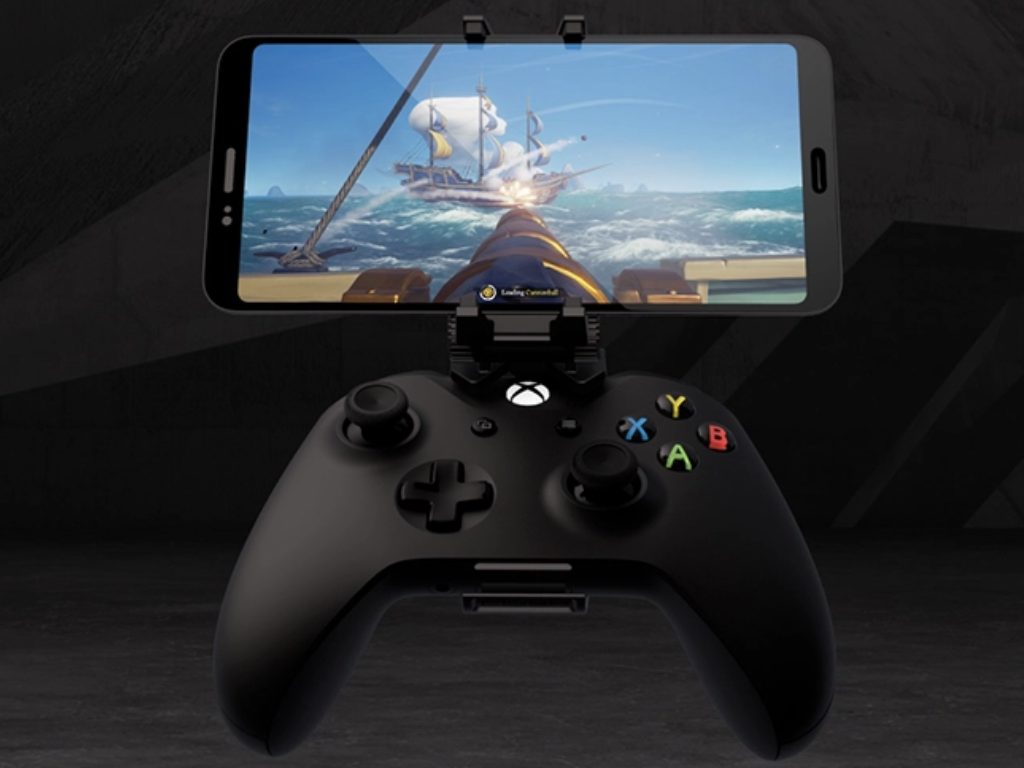
The extension will be limited to organizations that opt-in for it by electing a specific setting in the Microsoft Search section of the Microsoft 365 admin center.

Microsoft is rebranding Bing and changes its logo

After this announcement, several users, including the notorious @ALumia spotted a different name and icon for the Bing search service.

Some users see the name Microsoft Bing instead of just Bing and the icon has been changed from the stylized letter B to the Microsoft icon.

Microsoft Bing rebranding


After the Microsoft Search in Bing announcement, a Bing rebranding makes the best sense in the world and it’s a part of a big effort by the giant to create a strong Microsoft 365 virtual office.

What do you think about the latest Microsoft moves with Bing? Tell us all about it in the Comments section below.

[wl_navigator]

Microsoft Teams gets new Advanced Communications capabilities

Microsoft has just announced some new Advanced Communication Capabilities for Microsoft Teams. The new capabilities cover a wide range, all of which are designed to help companies take their communications “to the next level.”

The first set of these capabilities include the ability to scale Teams meetings to up to 20,000 participants. This will allow businesses to reach larger audiences during interactive meetings. However, they’ve also limited the size of interactive meetings to 1,000 participants, with a new shift to a “view only” mode after the limit is met.  Also included is a branded meeting lobby, and the ability to set up a compliance recording policy.

Microsoft says these new capabilities will be enabled with a new Advanced Communications Plan for Teams, that can be added to any Microsoft 365 or Office 365 paid subscription. A 60-day free trial is also available via the Teams Admin Center or the Microsoft Teams Website in mid-August. Licenses come in at $12 per user per month.

In addition, Microsoft detailed that they will extend support for Skype for Business (3PIP) phones beyond 2023, so businesses can continue to use these devices as they move to Teams. The company also plans on supporting core calling features on SIP phones from Cisco, Yealink, Polycom, and others with Teams. Support for SIP phones will be available in the first half of 2021.

Wrapping up the list of announcements is the introduction of a new line of Microsoft Teams phones with physical buttons, high-quality audio, and core calling features at affordable prices. These phones will come from AudioCodes, Poly, Yealink starting early 2021. Microsoft is also planning on introducing new USB peripherals and Teams phones that have dial pads and a “modern Teams user interface.”

How to block driver updates in Windows 10 [Quick Guide]

Everybody is talking about how you should update all your drivers right after you upgrade your system to Windows 10.

But, this doesn’t have to be the truth always, because some drivers just aren’t compatible with Windows 10.

In other words, certain software updates could prevent a certain piece of hardware from working.

In this article, I’m going to show you how to block further driver updates in Windows 10.

How can I stop automatic driver updates on Windows 10?

1. Use the Show or hide updates tool

  1. Access Microsoft’s website and download the troubleshooting tool.
  2. Run it and choose Hide updates, under Show or hide updates.
  3. Now check your driver to prevent any further automatic updates.

There was a lot of fuss when Microsoft decided to not let you control automatic updates in Windows 10 Home version.

Probably because a lot of people complained, Microsoft decided to release a troubleshooter which allows you to block automatic updates for Windows 10.

That troubleshooter still works in the full version of Windows 10, and it could be used to block automatic updates of drivers, as well.

By applying the above steps, this troubleshooter will make sure that your desired driver will stay at the current version forever.

So, if you use some older piece or hardware on a Windows 10 computer, you don’t have to worry that it will lose its functionality sometime in the future, because of the incompatible driver.

As I said, this tool doesn’t have to be used only for blocking driver updates, as it can block all other unwanted updates in Windows 10.

2. Use professional driver updater software

Using a professional tool that updates your drivers is a straightforward option. This type of program will update your drivers automatically, only when needed, and you can customize the settings to suit your needs.

3. Disable the update service

  1. Go to Start > type services.msc > hit Enter.
  2. Go to Windows Update service > double click on the service.stop windows update service
  3. Click on the General tab > go to Startup Type> select Disabled as shown in the screenshot below.disable windows update service
  4. Reboot your computer to stop any updates.

This method allows you to disable any updates. This includes OS updates, driver updates, software updates, and more.

4. Roll back drivers

  1. Go to Device Manager > right-click the problematic device > go to Properties.
  2. Select the Driver tab > select Roll Back Driver.
roll back display driver windows 10

If your computer already installed new driver updates, you can quickly uninstall them by rolling back drivers. Use this solution if the latest driver versions broke your machine.

And this is how you can disable automatic driver installation in Windows 10.

How do you feel about Microsoft’s decision to prevent you from controlling updates in Windows 10? Tell us your opinion in the comments.