How to Use BrandCrowd’s AI Logo Generator

Creating a polished logo should not require a design degree or expensive software. With BrandCrowd’s AI logo generator, you can turn your brand name into professional logo concepts, refine them with intuitive tools, and export formats that work across websites, social media, and print. This beginner‑friendly guide breaks down the complete workflow so you can produce strong visual branding in minutes.

Step 1: Open BrandCrowd and Enter Your Brand Information

Start With the Right Inputs

Begin by navigating to BrandCrowd’s main site and selecting the logo creation area. The first prompt will ask for your brand name. Enter the exact spelling you want reflected in your logo. You may also include an optional tagline if you have one.

BrandCrowd’s logo generator uses this information to suggest logo concepts that align with your text and perceived industry category. It draws from a large library of professionally created templates to propose designs that are structurally sound and visually relevant to your brand.

At this point, the goal is to begin building your identity with suggestions that feel intentional rather than random.

Step 2: Review Initial Logo Suggestions

What to Look For

After submitting your brand name, you will see a range of logo concepts. 
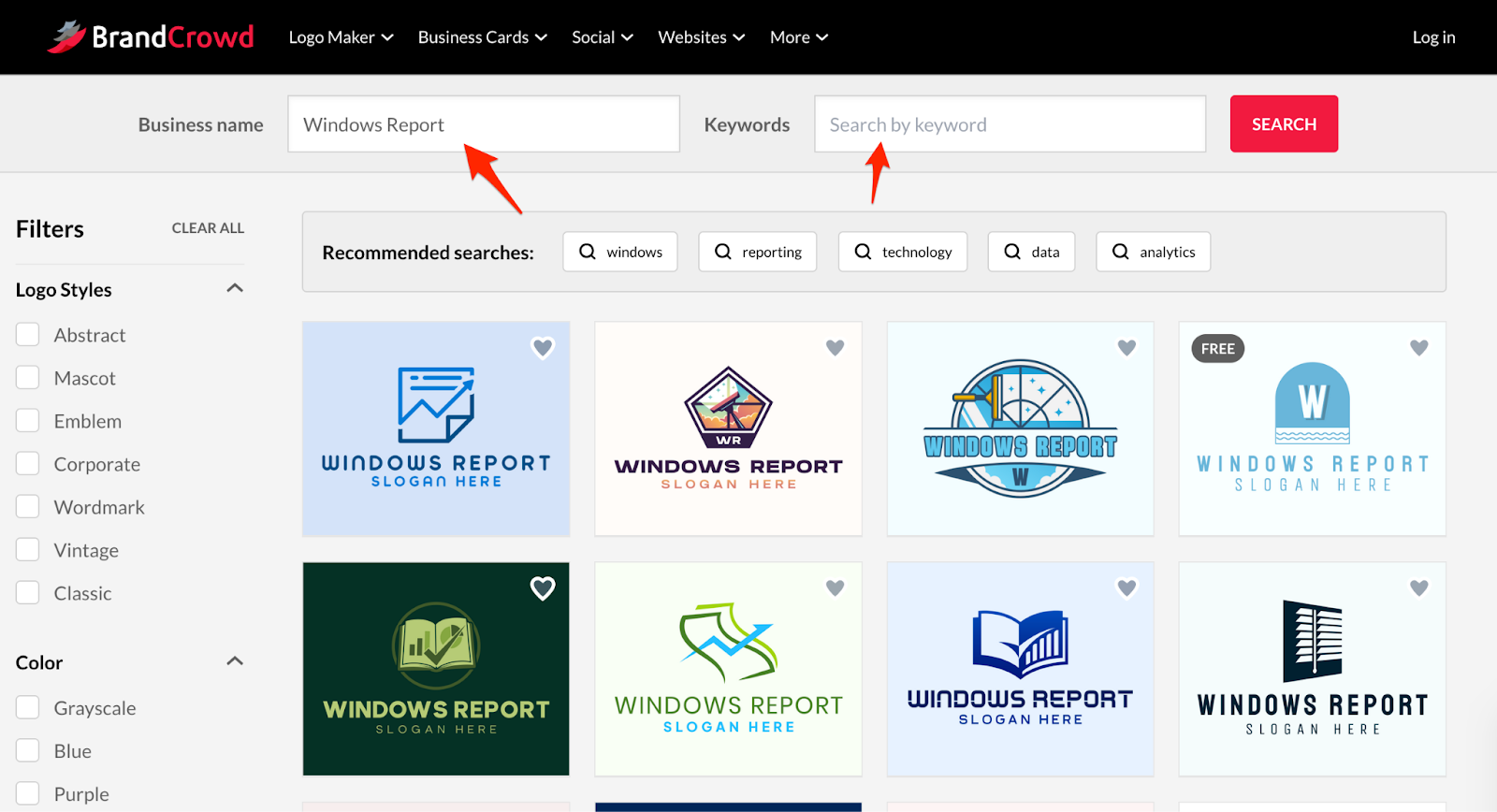
AI logo brand name

Scan through the first batch and pay attention to:

  • How well the typography reads
  • Whether the layout feels balanced
  • If the style matches your brand personality (modern, classic, minimalist, playful, etc.)

Your first impressions matter. If a design struggles to read clearly at this stage, it could cause issues once you deploy the logo on business cards or as a social profile image.

Step 3: Narrow Options With Style and Color Filters

Refine Quickly With Filters

BrandCrowd offers filtering tools that help narrow down the initial results by design direction. 
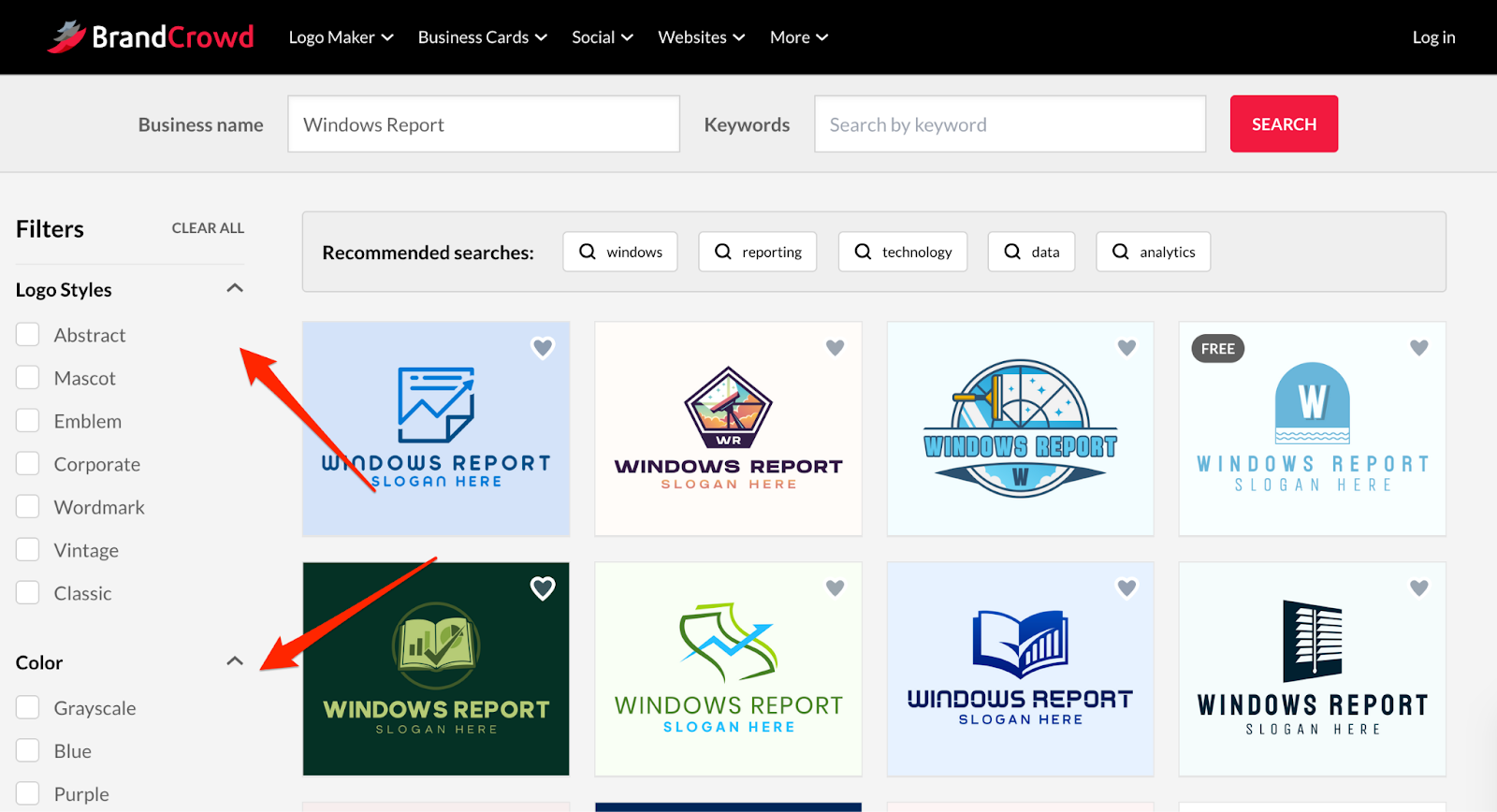
Filter AI logo results

Filters include:

  • Logo style (for example wordmark, emblem, classic, modern, minimalist)
  • Color palette categories

Applying these filters helps you remove irrelevant directions and focus on concepts that match real usage scenarios. For instance, simple wordmark styles often perform better on letterheads and email signatures, while emblem or badge styles may read better on product packaging.

Using both style and color filters can quickly reduce the list to a handful of designs worth exploring in depth.

Step 4: Open the Logo in the BrandCrowd Logo Maker

Start Customizing

Once you find a concept that feels close to your goal, click it to open in BrandCrowd’s logo maker editor.
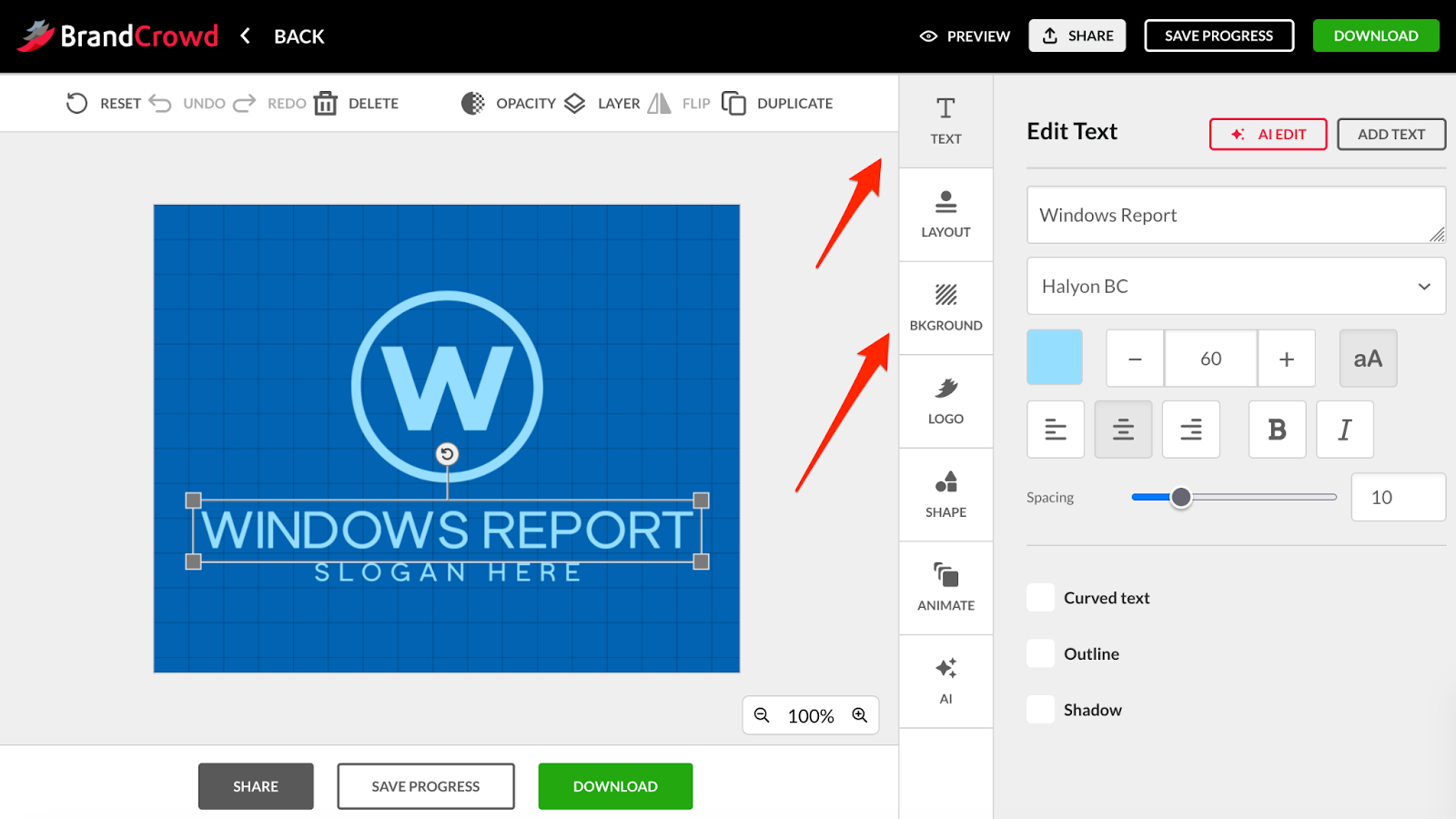
BrandCrowd AI logo editor

 Here, you can:

  • Update the brand name or tagline
  • Swap between curated color palettes
  • Adjust layout options (text above, beside, or integrated with the icon)

The editor keeps everything harmonized so that edits maintain balanced spacing and alignment. This approach makes it easy to explore variations without fear of breaking the design.

Step 5: Use the Advanced Tools for Fine‑Tuning

Go Deeper If You Want

For additional control, BrandCrowd provides more detailed editing options. These allow you to:

  • Resize icons independently of text
  • Experiment with alternative icons
  • Adjust color tones more precisely
  • Test multiple layouts side by side

This level of customization sits somewhere between template editing and full‑blown design software. It gives you more visual control without requiring Illustrator‑level expertise.

Step 6: Preview in Real‑World Contexts

Check How It Performs in Use

Before finalizing, it’s important to see how your logo looks in different placements. BrandCrowd will generate previews of your logo on:

  • Business cards
  • Social media graphics
  • Website headers
  • Letterheads

These previews show whether your logo maintains clarity and impact across different sizes and formats. Having this perspective prevents surprises after exporting.

Step 7: Choose a Pricing Plan and Export Your Logo

Understand the Costs

BrandCrowd offers logo downloads through affordable subscription tiers. 

Windows 11 Beta Update KB5077201 Brings Emoji 16.0 and Camera Improvements

Microsoft continues to iterate on Windows 11, following recent Beta Channel updates like KB5074177 and KB5074169. Today, the company rolled out a new Insider build with a handful of refinements and feature tweaks aimed at improving day-to-day usability.

What’s new in KB5077201 in the Beta Channel?

Microsoft has released Windows 11 Insider Preview Build 26220.7755 (KB5077201) to the Beta Channel. As usual, the changes roll out gradually and only reach Insiders who have enabled the toggle to receive the latest updates as soon as they are available.

Emoji 16.0 returns to Windows Insiders

One of the more visible changes in this build is the return of Emoji 16.0, which is now being rolled back out to Windows Insiders.

Emoji 16.0 introduces a small, curated set of new emojis, with one addition representing each major emoji category. Newly added emojis include:

  • Face with Bags Under Eyes
  • Fingerprint
  • Root Vegetable
  • Leafless Tree
  • Harp
  • Shovel
  • Splatter

Users can access these new emojis through the standard emoji panel, just like existing emoji sets.

Source: Microsoft

New camera pan and tilt controls

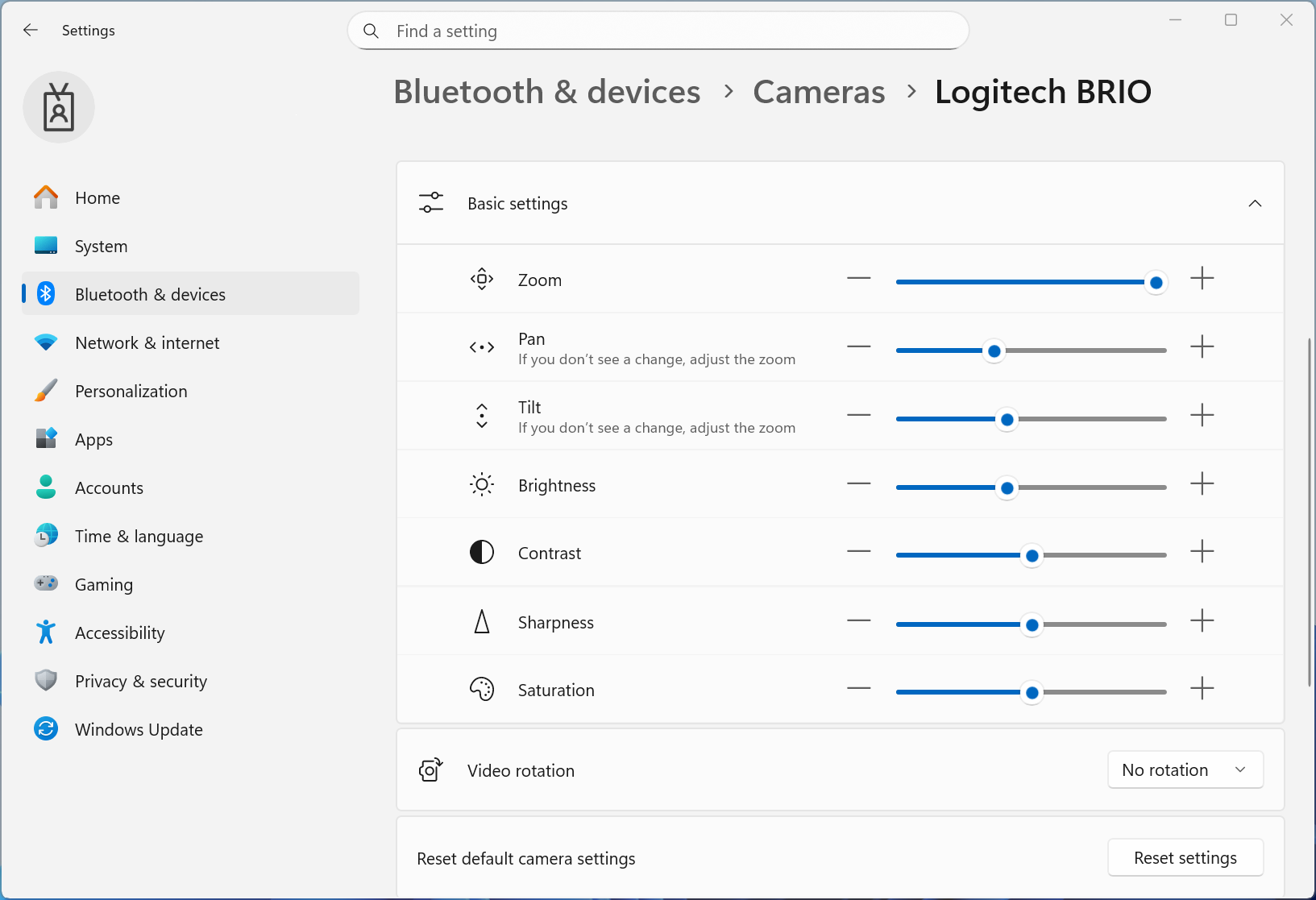
Windows 11 now adds direct pan and tilt controls for supported cameras. These controls appear in Settings > Devices & drivers > Cameras, inside the selected camera’s basic settings.

This change should make it easier for users to fine-tune camera positioning without relying on third-party software, provided the camera hardware supports these features.

Source: Microsoft

General improvements

Microsoft also included several under-the-hood improvements in this build. These changes focus on stability, performance, and visual polish across the system:

  • Improved visual experience and performance in several system scenarios
  • Better taskbar auto-hide behavior at the bottom of the screen
  • Reduced desktop icon flashing and related performance slowdowns
  • Improved performance when Windows Security credential pop-ups appear

While Build 26220.7755 is a relatively minor update, many Insiders will hope it avoids the kind of issues seen in previous releases that required emergency patches shortly after launch.

Microsoft Edge tests “Help me write” AI writing assistant in Settings

Microsoft Edge Canary now uses Help me write and Help me rewrite labels instead of Copilot-branded rewrite wording. The browser also includes an unfinished AI rewrite panel that is still under development.

The change is visible in both Settings and context menus. You can find it in Settings > Languages, under Writing Assistance, where Edge now shows “Use ‘Help me write’ writing assistant.”

Image Credit: Venkat | WindowsReport.

The description explains that the feature can use your input, selected text, and page content to generate contextual suggestions and drafts. This information is processed by AI to provide more relevant results. The wording replaces the earlier “Use Copilot for writing on the web” label. The context menu also replaces “Rewrite with Copilot” with the new task-focused wording, removing direct Copilot branding.

The right-click menu in Edge Canary now displays “Help me rewrite” instead of the previous Rewrite with Copilot option. Image Credit: Venkat | WindowsReport.

Using plain action-based labels places the focus on writing inside the browser rather than on a separate assistant name. This keeps the feature easier to understand and consistent with other built-in browser controls.

The rewrite panel opens and shows controls to replace or adjust text. Text generation does not work in the current build. The feature is still controlled by testing or a server-side switch.

Google Chrome also uses the “Help me write” name for its AI writing feature. Other modern browsers use similar plain-language labels.

These changes are limited to Edge Canary and may change before release. Even so, the consistent rename across Settings and context menus keeps AI writing presented as a built-in Edge feature rather than a Copilot-named tool.

Riot Games Announces Layoffs From the 2XKO Team; Here’s Why

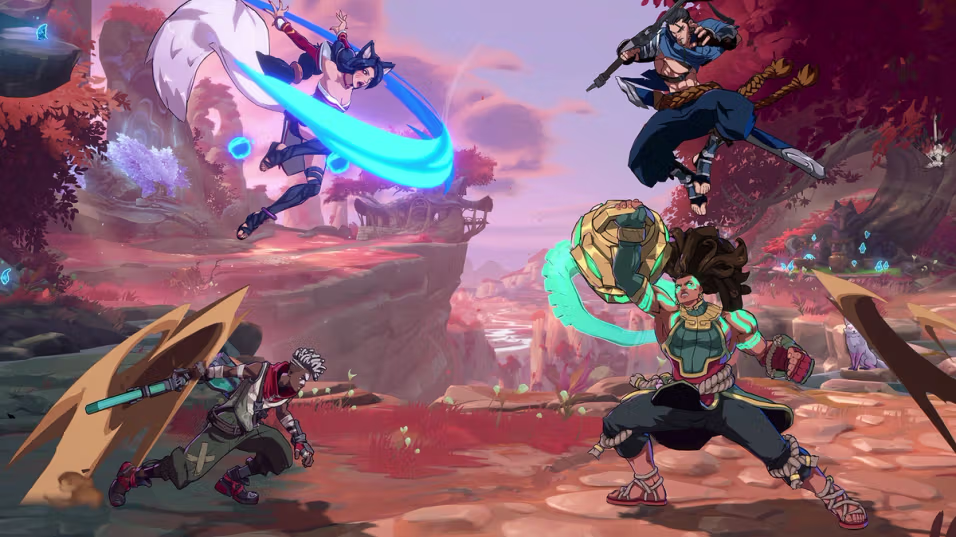
Riot Games has announced a reduction in the size of the team working on its fighting game 2XKO, citing the need for a more sustainable approach as the title continues to evolve. In a statement shared with the community, Riot emphasized that the decision was not made lightly and reflects wider trends in player engagement.

Nearly 80 employees have reportedly been laid off from the team

Although the number hasn’t been mentioned in the official announcement, GameDeveloper reports that the fresh layoffs have reportedly hit nearly 80 developers from the 2XKO team. According to Riot, 2XKO has found a passionate core audience, but overall momentum has not reached the level necessary to support the existing team structure.

By downsizing, the company aims to focus on making key improvements to the game, including features and updates players have been requesting. Specific plans for upcoming changes are expected to be shared in the near future.

Despite the restructuring, Riot confirmed that its 2026 Competitive Series plans remain unchanged. The company reaffirmed its commitment to partnering with tournament organizers and supporting the events that drive the fighting game community.

Riot Games commits support the affected employees

Riot also highlighted its dedication to supporting team members affected by the reduction, offering six months of notice pay and severance where applicable, while assisting employees in exploring other opportunities within the company.

Tom Cannon, addressing the community directly, stressed that the move is a shift in operations, not a reflection on the talent or contributions of the 2XKO team. “The people who helped ship 2XKO poured years of creativity, care, and belief into this game,” Cannon said.

Article feature image source: Riot Games

World’s End Club Quietly Releases on Xbox Series X|S & Xbox One

Fans of Kotaro Uchikoshi, the visionary behind the Zero Escape series, have something unexpected to celebrate this week. A game connected to his creative legacy, World’s End Club, has quietly launched on Xbox Series X|S and Xbox One (via TheXboxHub)

World’s End Club finally gets Xbox ports

World’s End Club is a 2D side‑scrolling action‑adventure from developer IzanagiGames, with writing contributions from scenario designers like Uchikoshi. The game was first released on other platforms, but skipped Xbox entirely until now, a rare move for Japanese titles with Western console releases. That has changed as of this week, with World’s End Club now available on Xbox.

The Xbox release is notable because Uchikoshi’s Zero Escape series, including classics like 999: Nine Hours, Nine Persons, Nine Doors (released in 2009) and its sequels, didn’t originally launch on Xbox hardware.

Meanwhile, the third entry in the franchise, Zero Time Dilemma, only came to Xbox years after its initial release on handhelds and later platforms. As far as World’s End Club is concerned, it brings narrative twists, charm, and mystery with side‑scrolling gameplay.

Players follow a group of twelve characters on a bizarre journey across Japan, blending storytelling with action‑puzzle sequences. Its narrative pedigree, bolstered by Uchikoshi’s involvement and ties to creators of Danganronpa, gives it crossover appeal for fans of story‑driven games.

Microsoft Is Phasing Out Legacy Printer Driver Support in Windows 11

Microsoft is taking a major step to modernize printing on Windows 11. Starting with the January 15 non-security update, the company has officially ended support for legacy V3 and V4 printer drivers, which were first marked as deprecated in September 2023 (via Tom’s Hardware).

The change means users relying on older printer drivers may find their printers failing to install or stop working entirely. Existing drivers can still receive updates on a case-by-case basis, but new submissions of V3 and V4 drivers are now blocked by default. Any exceptions require a manual review with explicit justification from the printer manufacturer.

According to Microsoft, most users won’t notice any disruption since modern printers already use supported driver architectures. Those affected are advised to contact their printer maker for an updated driver or consider upgrading to a newer printing solution.

This shift is part of a wider push to secure and simplify the Windows print ecosystem. Microsoft cites issues such as the notorious PrintNightmare vulnerability and the complexities of maintaining thousands of vendor-specific drivers as key reasons for the change. By limiting what can be distributed through Windows Update, the company is shifting responsibility for legacy hardware support back to manufacturers.

Looking ahead, Windows will prefer its built-in IPP class driver starting July 1, 2026, when multiple driver options are present. By July 1, 2027, third-party printer driver updates via Windows Update will be restricted to security fixes only. The move also aligns with Microsoft’s Protected Print Mode, an optional feature that removes third-party drivers entirely, hinting at the future of printing on Windows.
Users planning to print on older hardware should check their drivers now to avoid disruptions as Microsoft phases out legacy support.
Intel Core Ultra 5 250K Plus’ Geekbench Benchmark Results Might Disappoint You

Intel’s upcoming Core Ultra 5 250K Plus desktop CPU has just popped up on Geekbench, giving us one of the first real looks at performance from the Arrow Lake Refresh processors ahead of their expected March 2026 launch.

Intel Core Ultra 5 250K Plus spotted on Geekbench with modest performance bump

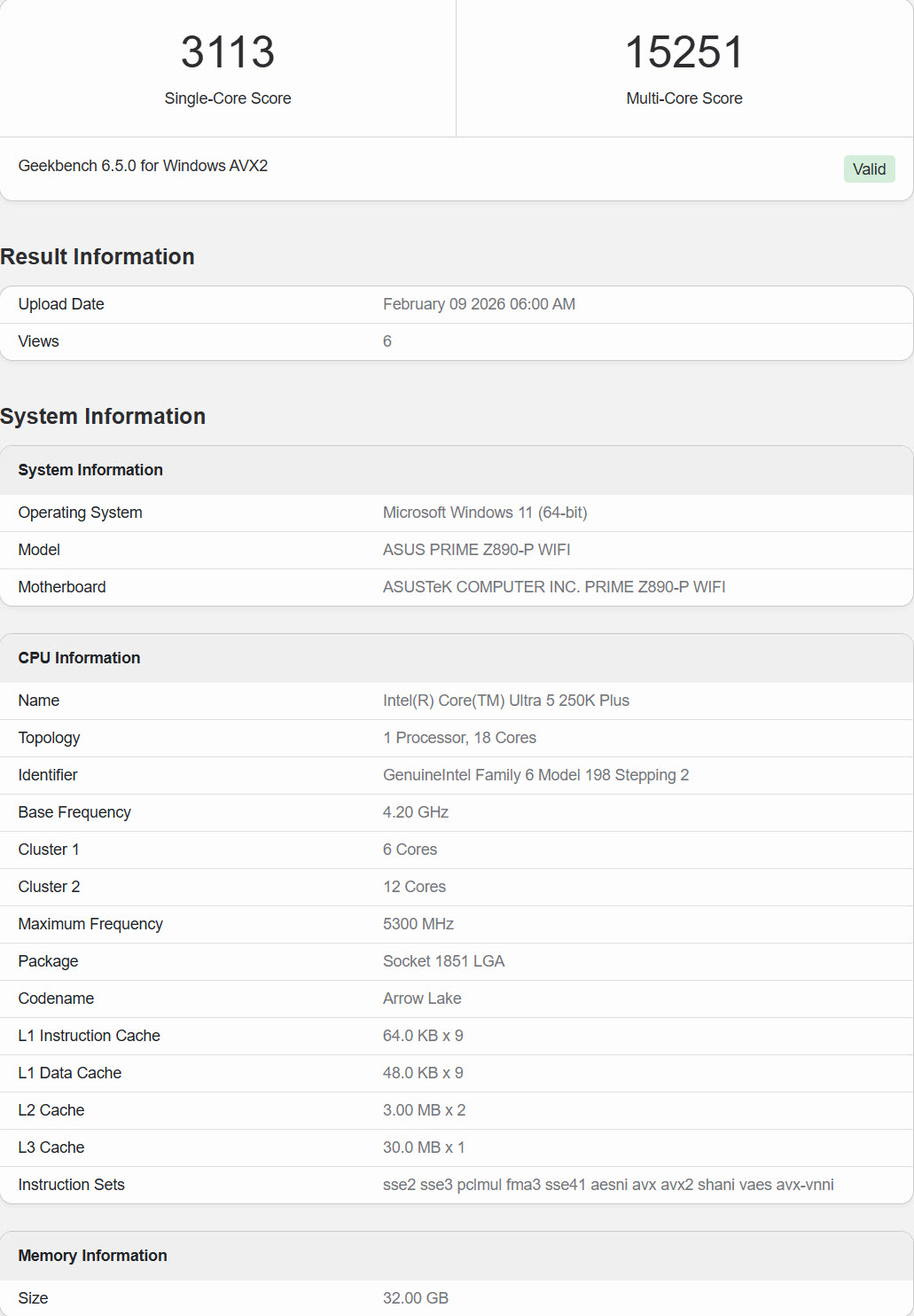
The leaked Geekbench results show the Core Ultra 5 250K Plus running on an ASUS PRIME Z890‑P WiFi system with 32GB of DDR5 memory. The CPU scores about 3,113 points in single‑core and 15,251 in multi‑core tests. Those numbers are in line with what you’d expect from a mid‑tier refresh, but it’s not groundbreaking.

It’s worth noting that single‑core performance appears slightly improved compared with the current Core Ultra 5 245K, though multi‑core performance is modest. Under the hood, this new SKU bumps up the core count to 18 total cores (6 performance + 12 efficiency cores), up from 14 cores on its predecessor, and pushes boost clocks up to around 5.3 GHz. It also retains the same 125W base power and 159W maximum turbo power as the current model, and is expected to support DDR5‑7200 memory natively.

Image credit: Geekbench 6

Price rumored to be under $300

Pricing leaks from retail listings suggest Intel could position the Intel Core Ultra 5 250K Plus under the $300 mark, making it a competitive choice for mainstream desktops ahead of the transition to Intel’s next‑gen Nova Lake platform later this year.

As always with early Geekbench leaks, these numbers aren’t definitive. BIOS updates, driver optimizations, and final silicon tweaks could bump performance when independent reviews emerge after the expected late‑March embargo. However, this leak gives a solid early look at what Intel’s Arrow Lake Refresh might bring to the mid‑range CPU market.

Monster Hunter Stories 3: Twisted Reflection Gets Free Trial Ahead of March 13 Release

If you’ve been wondering whether Capcom will give you the chance to try Monster Hunter Stories 3: Twisted Reflection, there’s some good news. A free trial of Monster Hunter Stories 3: Twisted Reflection is now available, which lets you jump into the game before its official release on March 13, 2026.

Capcom releases free trial of Monster Hunter Stories 3: Twisted Reflection on Switch 2, PS5, Xbox Series X|S, and PC

As part of the trial, you’ll get to start the story, customize your character, explore the battle system, and start collecting equipment and Monsties, just like in the full game. The best part of the trial is that your progress can be carried over once you buy the full version.

The trial has some limits, though: only one save slot, a level cap of 10, and capped Trade Points and Monsties. You can keep playing past level 10, but experience points will stop accumulating. To transfer your progress, make sure to use the same account and keep the save data on your PC.

The trial is available now on Nintendo Switch 2, PlayStation 5, Xbox Series X|S, and PC (via Steam). Jump in, test the waters, and be ready to continue your adventure when the full game launches. If you like the free trial, you can pre-order Monster Hunter Stories 3: Twisted Reflection today.

Are you interested in Monster Hunter Stories 3: Twisted Reflection? Have you tried the trial yet? If yes, let us know your thoughts in the comments below.

Lenovo Reportedly Warns Gamers to Upgrade Hardware Now Before Price Increases Amid Memory Crunch

If you are into gaming, this year and possibly the next one are likely going to be a bumpy ride, thanks to shortages in key components, from DRAM and NAND to GPUs, across PCs and consoles. The internal components shortage and skyrocketing prices amid the memory crunch are reportedly also the reasons behind the delayed PS6 launch and rumors around increasing PS Plus prices. The next-gen Xbox console isn’t immune, either. That’s not all; Nintendo is also taking the hit, as Switch 2’s production cost has reportedly spiked.

Lenovo urges gamers to upgrade now amid soaring prices and shrinking hardware supply

Given the industry-wide situation, Lenovo’s North America President, Ryan McCurdy, has warned customers, saying that if you’re thinking of upgrading your PC or gaming setup, now is the time. Speaking to CRN, McCurdy highlighted the current “pricing sensitivity” as part of the massive AI infrastructure buildout (via Wccftech). Here’s the statement:

If the infrastructure is critical in the next three, six, 12 months, and the pricing sensitivity is high, then we get into a scenario where we’re acting quickly because essentially the current stock that is at our distributors and at our partners [has] some of the most attractive product pricing that will exist for the next six to 12 months.

The report also references an anonymous U.S. system integrator, who noted that hardware is disappearing from channels faster than ever before. Per the integrator, long-term availability will likely become a bigger issue than cost. In short, the waiting game could cost you extra money.

With Lenovo explicitly urging buyers to make purchases “as soon as possible,” it’s clear the market is under tremendous pressure. For those in the middle of the usual upgrade cycle, the question becomes one of timing versus risk. With prices likely rising and availability thinning, locking in your hardware now may be the smartest move for serious gamers.

OpenAI to Reportedly Begin Ads Testing in ChatGPT Today; “Updated Chat Model” Also Coming This Week

There was a time when we used to complain about Google for injecting sponsored results, aka ads, in search results. In fact, that trend hasn’t stopped. That, too, alongside the headache of AI Overviews, has been killing traffic for websites. Now that we are living in the AI era, most of you may have thought that ads would get off our backs. But sadly, that’s not happening either.

OpenAI reportedly starts ad rollout in ChatGPT from today

In the past few months, there have been multiple rumors around OpenAI testing ads inside ChatGPT. Turns out, the rumors were true. OpenAI, when it launched the ChatGPT Go plan in the U.S., confirmed that it will start rolling out ads inside ChatGPT. At the time, the company didn’t mention exactly when, nor did it provide any timeline. It only said that ads would roll out to ChatGPT in the coming weeks.

Now, it seems that the week is finally here. That’s according to a report by CNBC, which reports that OpenAI plans to start testing ads inside ChatGPT starting today, February 9 (via The Verge). A source familiar with the matter told the news outlet that OpenAI “expects ads to make up less than half of its revenue long term.”

In a reply to a Super Bowl ad by Anthropic that takes a dig at OpenAI’s plans for ChatGPT ads, Altman tweeted, calling the campaign “clearly dishonest.” That’s not all; he also added that ads in ChatGPT will only be visible to logged-in users on the free or Go plan. The report also adds that “OpenAI expects ads to make up less than half of its revenue long term.”

OpenAI also plans an “updated Chat model”

As far as company news is concerned, OpenAI is also reportedly planning to launch an “updated Chat model” this week. If the report is accurate, that would mean two model-related moves within the span of just a week. In case you missed it, late last week, OpenAI released GPT-5.3-Codex, moments after Anthropic dropped Claude Opus 4.6.

What’s your take on ads in ChatGPT? Let us know in the comments below.

Intel Foundry Back in Spotlight as MediaTek Tipped to Tap 14A Process for Dimensity Chips

Intel, which is well-known for manufacturing custom silicon for Microsoft hardware, has now been linked to MediaTek. The same MediaTek that sits right next to Qualcomm when we talk of mobile chips.

Intel may have roped in MediaTek as a foundry customer

That’s according to a new rumor, which suggests that Intel may be lining up MediaTek as a potential foundry customer. If true, future Dimensity chips could come to Intel’s upcoming 14A process.

Wccftech, which covered the rumor, reports that MediaTek is exploring Intel’s most advanced manufacturing node for future smartphone SoCs. There’s no official confirmation from either side. However, the idea has sparked discussion around Intel’s push to grow its foundry business and compete at the very top end of chip manufacturing.

Not to mention, landing a high-volume client like MediaTek would be a big win for Intel. Mobile chips ship in massive numbers, and a deal like this would hint at growing confidence in Intel Foundry’s roadmap.

Concerns around Backside Power Delivery (BPD)

That said, the rumor also raises some real questions. One of the biggest concerns reportedly revolves around Intel’s aggressive shift to Backside Power Delivery (BPD) on its advanced nodes. In theory, BSPD improves power routing and frees up space on the front of the chip. In practice, reported performance gains appear modest. More importantly, the design can increase self-heating, which is a serious issue for smartphone chips operating under tight thermal limits.

That makes Intel’s 14A process a tricky fit for mobile SoCs like Dimensity. Intel could address these challenges through new layouts or thermal optimizations, but nothing has been confirmed so far. If the rumor turns out to be accurate, MediaTek would give Intel Foundry a much-needed credibility boost and could help attract more customers to its advanced nodes. As always, take this rumor with a grain of salt.

ASRock Issues Comprehensive AM5 BIOS Update Following Ryzen No-POST Problems

Last week proved hectic for ASRock, as user reports piled up around no-POST and no-boot issues affecting AM5 systems, including setups running newer Ryzen processors. After days of growing concern, the company has now officially responded and rolled out what it calls a comprehensive fix.

ASRock has published a statement on BIOS update for its AMD AM5 motherboards, aimed squarely at improving system stability and addressing unexplained boot failures. The update arrives as a beta release and focuses on both compatibility improvements and resolving scenarios where systems fail to start, even after previously operating normally.

New beta BIOS integrates updated AMD AGESA

The newly released Beta BIOS version 4.07.AS01 integrates AMD AGESA ComboAM5 PI 1.3.0.0a, a firmware update designed to improve platform behavior at a low level. According to ASRock, the BIOS delivers three core changes: AGESA 1.3.0.0a integration, optimized memory compatibility, and fixes for boot failures on certain CPUs.

The new ASRock BIOS beta began appearing on ASRock’s official website over the weekend, without any statement from the manufacturer. It’s worth noting that ASRock has not published a detailed list of affected processors, reproduction conditions, or chipset segmentation beyond the general AM5 platform.

Ryzen 9000 is not explicitly mentioned this time

Notably, the new announcement avoids directly naming the Ryzen 9000 series, despite earlier reports linking no-POST issues to those CPUs. An ASRock update issued on February 5 explicitly referenced Ryzen 9000 problems, making the omission in this latest statement stand out.

Even so, the wording suggests that the BIOS targets broader no-boot cases, including systems that suddenly stop posting after normal operation, which is a symptom widely reported by users over the past week.

Users experiencing unexplained boot failures on ASRock AM5 motherboards may see improvements after installing the new beta BIOS. As with any beta firmware, caution is advised, but affected users are encouraged to test the update if their systems suffer from stability or POST issues.

The update underscores ongoing firmware fine-tuning across the AM5 platform as board partners and AMD continue refining support for newer CPUs and memory configurations.

Via VideoCardz

RTX 3080 Ti 20GB Prototype Reveals NVIDIA’s Abandoned High-VRAM Design

As NVIDIA is rumored to release the RTX 5090 Ti, attention has shifted back to unreleased graphics cards from the company’s past. A newly tested prototype suggests that some long-standing RTX 30-series rumors were closer to reality than NVIDIA ever admitted.

According to VideoCardz, YouTuber ChintzyPC has tested a pre-release RTX 3080 Ti 20GB graphics card that never reached official retail. The card appears to use the GA102-250 GPU, offering a rare look at an abandoned NVIDIA design.

Unreleased RTX 3080 Ti 20GB hardware surfaces

The tested card features a 20-chip GDDR6X memory configuration paired with a 320-bit memory bus. This setup differs significantly from the retail RTX 3080 Ti, which uses a 384-bit bus. The reduced bus width suggests only ten active memory controllers, limiting overall memory bandwidth despite the higher VRAM capacity.

A teardown revealed a non-standard PCB design that does not match any retail RTX 3080 Ti boards. Instead, the layout resembles a cut-down RTX 3090, with memory modules placed on both the front and back of the PCB. Unlike the RTX 3090, the board lacks NVLink support.

Performance closer to RTX 3080 than RTX 3080 Ti

To function correctly, the card required an unofficial driver patch sourced from the “NVIDIA-patcher” GitHub project. Standard GeForce drivers failed to fully enable normal 3D acceleration and gaming behavior. Once patched, the driver explicitly identified the GPU as “RTX 3080 Ti 20 GB.”

Gaming benchmarks placed performance closer to the RTX 3080 rather than a full retail RTX 3080 Ti. The combination of a 320-bit bus and a 350W power limit appears to be the primary bottleneck, preventing the extra VRAM from translating into higher frame rates.

The reported benchmark results state the following:

BenchmarkStock ScoreOverclocked Score
Speed Way50425403
Steel Nomad48635155
Port Royal1310513947

Stability issues limit real-world usefulness

Heavier compute and rendering workloads exposed major stability problems. Test systems reportedly crashed within seconds under sustained load, sharply limiting the usefulness of the additional 20GB of VRAM for professional or memory-intensive tasks. These issues suggest the card never reached a finalized validation stage.

Rumors that quietly proved accurate

Leaks from shipping manifests and certification databases previously hinted that NVIDIA was developing 20GB variants of the RTX 3080 and RTX 3080 Ti. While NVIDIA never officially acknowledged such models, custom RTX 3080 Ti 20GB cards were later spotted in Russia, reportedly ready for sale but distributed unofficially.

This prototype now serves as clear evidence that the rumored SKU existed internally, even if it never launched globally.

In related news, NVIDIA has reportedly delayed the RTX 50 SUPER series, and separate reports claim the company may cut RTX 50 GPU supply to China by up to 40%. Together with renewed interest around a possible RTX 5090 Ti, the resurfacing of this unreleased RTX 3080 Ti highlights how many high-end designs never make it to market, despite being far closer to completion than previously assumed.

Sony’s 2026 State of Play Kicks Off This Week: Date, Time, How to Watch & What to Expect

Sony is back with another State of Play, and it’s going to be a big showcase. The company has confirmed that a new presentation is scheduled for later this week, promising over an hour of updates, announcements, and gameplay reveals. If you’ve been waiting for fresh PS5 news, this is one to circle on your calendar.

When Is the Next PlayStation State of Play & Where to Watch?

State of Play broadcasts will go live on February 12 at 2 pm PT / 5 pm ET / 11 pm CEST, and February 13 at 7 am JST. Sony has confirmed that the event will broadcast in English with Japanese subtitles also available. Notably, the broadcast will run for more than 60 minutes, which makes it one of the longer State of Play events. You can watch the livestream on PlayStation’s YouTube and Twitchh channel. We have also embedded the YouTube stream below.

What Games Could Feature at Sony’s 2026 State of Play?

According to PlayStation, the event will feature news, gameplay updates, and announcements from studios around the world. That includes a mix of third-party and indie titles coming to PS5, alongside the latest updates from PlayStation Studios. In short, expect variety rather than a single game deep dive.

Sony already has a packed 2026 slate, including Saros, Marathon, MLB The Show 26, and Marvel’s Wolverine. On the third-party side, upcoming PS5 titles include Pragmata, Phantom Blade Zero, 007 First Light, Monster Hunter Stories 3, and GTA 6.

Whether we see new trailers, release dates, or surprises remains to be seen, but with an hour on the clock, expectations are naturally high. Just a reminder, we’ll be watching closely and will break down the biggest announcements once the show wraps.

NVIDIA Rumored to Prepare RTX 5090 Ti or TITAN-Class Blackwell GPU for 2026

NVIDIA may have delayed its RTX 50 SUPER lineup due to hardware shortages, but new reports suggest the company is preparing something far more ambitious at the very top end of its next-generation graphics stack.

According to TweakTown, NVIDIA is rumored to be developing an ultra-high-end RTX 50 series graphics card that would sit above the existing RTX 5090. The move comes despite earlier reports suggesting the RTX 50 generation would lean heavily toward midrange products.

A new Blackwell flagship might release during Q3

New claims point to a potential Q3 2026 launch window, timed around the Back to School period. The GPU could arrive as a GeForce RTX 5090 Ti or as a TITAN-class Blackwell card, signaling NVIDIA’s intent to reassert dominance at the extreme high end.

Overclocking.com reports that the GPU already sits in active development, with manufacturing preparation and board-level design work underway. Sources say the project has no direct connection to the RTX 50 SUPER series, which no longer appears on NVIDIA’s 2026 roadmap.

Positioned above RTX 5090

If the rumors hold, the new card would become the flagship Blackwell-based GPU, positioned clearly above the RTX 5090. Rather than serving as a refresh, it would stand as a separate halo product designed to push performance limits.

While gamers would inevitably take interest, expectations point toward a strong focus on AI, rendering, and compute-heavy workloads. A consumer-oriented RTX 5090 Ti could offer higher memory capacity and performance at a lower price than a full TITAN-class model.

NVIDIA has not confirmed the existence or specifications of this GPU. However, ongoing GPU supply constraints suggest availability could remain tight when the card eventually launches. That combination of scarcity and flagship positioning means buyers should expect extremely high prices.

If NVIDIA follows through, the rumored Blackwell flagship would show that even amid shortages and delays, the company still plans to push the absolute top end of consumer and prosumer GPU performance.

Intel 900-Series Chipsets Leak: Z990, Z970, W980, Q970, and B960 Detailed

Intel’s upcoming 900-series chipset lineup for Nova Lake-S desktop CPUs has reportedly leaked, expanding on earlier reports that first spotted the Z990 and Z970 chipsets. The new details now outline specifications across enthusiast, workstation, business, and mainstream platforms.

According to Wccftech, the leaked lineup includes Z990, Z970, W980, Q970, and B960 chipsets, all designed for next-generation LGA 1954 motherboards. This platform will replace Intel’s current 800-series chipsets used with Arrow Lake and Arrow Lake Refresh processors.

Intel 900-series chipsets target Nova Lake-S desktops

The 900-series chipsets will pair with Intel’s upcoming Nova Lake-S desktop CPUs, which are expected to launch in late 2026. Motherboards based on the new LGA 1954 socket will cover a wide range of market segments, from overclocking-focused enthusiast boards to business and entry-level workstation systems.

Z990 leads with PCIe 5.0 and full overclocking

The flagship Z990 chipset targets high-end desktop systems and enthusiasts. Reports suggest it will deliver up to 48 PCIe lanes, including 12 PCIe 5.0 and 12 PCIe 4.0 lanes.

Z990 is also expected to include:

  • Two USB4 / Thunderbolt 4 ports
  • Up to five USB 3.2 Gen 2×2 (20 Gbps) ports
  • Eight SATA III ports

Intel reportedly plans full overclocking support on Z990, including CPU IA, BCLK, and memory overclocking.

Z970 trims features but keeps CPU overclocking

Z970 sits just below Z990 in the lineup. It reportedly offers 34 PCIe lanes, all capped at PCIe 4.0 speeds, with no PCIe 5.0 lanes provided by the chipset itself.

Other expected Z970 features include:

  • One USB4 / Thunderbolt 4 port
  • Up to two USB 3.2 20 Gbps ports
  • Four SATA III ports

Z970 should support CPU IA and memory overclocking, but Intel appears to disable BCLK overclocking on this chipset.

W980 and Q970 focus on workstations and business

The W980 chipset targets entry-level workstation systems. It reportedly matches Z990 in overall I/O capabilities but disables CPU overclocking. Memory overclocking should remain available on W980 boards.

Q970 aims at the business segment. While it offers strong PCIe and USB connectivity, it reportedly removes all forms of overclocking, including CPU, BCLK, and memory tuning.

B960 serves the mainstream market

B960 is positioned as the mainstream option and closely mirrors Z970 in baseline I/O. However, Intel is expected to disable CPU and BCLK overclocking on B960, while still allowing memory overclocking.

Notably, the leak suggests Intel has no plans for entry-level H-series chipsets in the 900-series lineup.

Intel is expected to announce 900-series motherboards alongside Nova Lake-S CPUs, with a launch window later in 2026. Early teasers may appear at major industry events such as Computex 2026.

In related news, Intel has reportedly canceled the Core Ultra 9 290K Plus, while Intel Core G3 processors are expected to use LPDDR5X-8533 memory, signaling further shifts in the company’s upcoming desktop and mobile strategies.

Exchange Online Incident Flags Valid Emails as Phishing, Microsoft Confirms

Microsoft has confirmed it is investigating an ongoing Exchange Online incident that incorrectly flags legitimate emails as phishing and places them in quarantine.

The company posted a service alert explaining that some customers may be unable to send or receive email messages due to false-positive phishing detections. The issue began on February 5 and remains unresolved.

New Exchange URL rule labels email as phishing

Microsoft says the problem stems from URLs inside emails being incorrectly identified as malicious. Over the weekend, the company confirmed that a newly introduced URL detection rule caused the misclassification.

The rule was designed to catch more advanced spam and phishing techniques, but it ended up quarantining legitimate messages instead. Microsoft has classified the situation as an incident, which signals noticeable user impact.

Quarantined emails are slowly released

Engineers are actively reviewing quarantined messages and unblocking confirmed legitimate URLs. Microsoft says it is also working to release the affected emails back to users.

Some customers may already notice previously quarantined messages arriving in their inboxes. However, Microsoft has not shared an estimated timeline for a full fix, nor has it disclosed how many customers or regions are affected.

The incident comes shortly after Microsoft confirmed the shutdown of Exchange Web Services for Exchange Online. The company has also warned administrators about using local Exchange Online mailbox moves and recently began blocking email access through Microsoft Intune on non-compliant devices.

Microsoft has not indicated whether the current email misclassification issue relates to these broader changes.

Via Bleeping Computer

WhatsApp Faces EU Antitrust Probe Over AI Chatbot Restrictions

WhatsApp is facing fresh regulatory pressure in Europe, following an earlier antitrust probe in Brazil tied to restrictions on AI chatbots. As CNBC writes, European regulators now argue that similar policies introduced by Meta could harm competition across the EU.

EU raises concerns over WhatsApp AI access rules

In October, Meta announced updated WhatsApp Business Solution Terms that effectively banned third-party, general-purpose AI assistants from accessing WhatsApp. The new rules came into force in January and quickly drew scrutiny from the European Commission.

The Commission has informed Meta of its preliminary view that these changes may breach EU antitrust rules. Regulators say the policy could unfairly exclude competing AI assistants from WhatsApp, where Meta already holds a dominant market position.

Interim measures could force Meta to reverse changes

The Commission has told Meta it plans to consider interim measures designed to prevent potential damage to competition while the investigation continues. These measures would aim to preserve third-party AI assistants’ access to WhatsApp under the same conditions that existed before the policy update.

According to a Commission spokesperson, interim measures would require Meta to maintain access for third-party AI tools during the probe, ensuring competition does not suffer irreversible harm before a final decision is reached.

EU targets potential abuse of market power

EU Commissioner for Competition Teresa Ribera said the objective is to stop dominant tech firms from leveraging their market power to gain unfair advantages in adjacent markets, including AI services.

The investigation remains ongoing, and any enforcement action will depend on Meta’s response and its rights of defense under EU law.

Meta pushes back against EU intervention

Meta argues there is no justification for regulatory intervention, claiming the WhatsApp Business API should not be treated as a critical distribution channel for AI chatbots. The company says users already access AI assistants through app stores, operating systems, devices, websites, and commercial partnerships.

Meta also maintains that limiting third-party AI access within WhatsApp does not prevent competition in the broader AI market.

This case adds to a growing list of clashes between major tech firms and EU regulators. Recently, the EU brought charges against TikTok over concerns tied to addictive design features and their potential negative impact on mental health.

Separately, Meta has confirmed plans to expand paid subscription options across Instagram, Facebook, and WhatsApp, signaling broader changes to how its platforms operate amid rising regulatory pressure.

As the EU probe unfolds, Meta now faces the prospect of being forced to roll back its WhatsApp AI restrictions while regulators assess whether the policy undermines competition in Europe.

Sony May Raise PS Plus Prices Instead of PS5 Amid Rising Production Costs

Rising DRAM prices and ongoing memory supply constraints should affect services more than hardware, according to a recent earnings transcript from Sony.

Sony confirmed it has secured the minimum memory supply required to support PlayStation 5 production through 2026, lowering the risk of manufacturing disruptions.

While this move stabilizes output, higher component costs still pressure hardware margins. Sony acknowledged that supply security does not fully offset the financial impact of rising memory prices.

Sony avoids a direct PS5 price increase due to production costs

Sony appears intent on avoiding a direct PS5 price hike despite elevated production costs. The console sits later in its lifecycle, and Sony projects sales exceeding 15 million units in 2026. Executives believe raising prices now could disrupt demand and slow momentum.

Instead, Sony seems focused on protecting unit sales while absorbing margin pressure through other parts of the business.

Regional pricing diverges across markets

The report points to uneven regional PS5 pricing trends since August 2025. In Europe and the United States, PS5 prices reportedly sit around 15 percent above the original suggested retail level. Japan stands out as an exception, with pricing closer to the recommended baseline.

This regional divergence suggests Sony may prefer subtle channel adjustments, promotions, or bundles rather than a unified global price increase.

Lower-priced PS5 model under consideration

Sony indicated it may introduce a more affordable, entry-level PS5 model to help preserve demand. A lower-priced SKU would keep the platform accessible while component costs remain elevated.

This approach follows the traditional console strategy of expanding the install base first, then monetizing users through games, digital content, and services over time.

Rising costs may shift to subscriptions

Sony also signaled that it may shift some rising platform costs into services such as PlayStation Plus. Adjusting subscription pricing spreads financial pressure across an existing user base rather than new console buyers.

Service pricing also offers greater flexibility across regions and provides more predictable, recurring revenue compared to hardware sales.

GTA 6 timing influences Sony’s strategy

With GTA 6 confirmed for a November launch, Sony appears motivated not to undermine a potential sales surge tied to one of the industry’s biggest releases. Avoiding console price increases ahead of that window could help maximize hardware and software momentum.

Instead, Sony may prioritize margin recovery through digital sales and subscriptions, a strategy that contrasts with more aggressive hardware price increases seen from other console manufacturers.

In other news, early reports suggest the PlayStation 6 could ship with 30GB of DDR7 memory, pointing to another significant leap in console hardware capabilities.

Via Guru3D

Next-gen Xbox Could Become a Windows-Based Gaming Platform

Reports about a next-generation Xbox launching in 2027 continue to build, and new claims now shed light on how the console could work under the hood. Recent reporting suggests that Microsoft plans to base its next Xbox platform directly on Windows, signaling a major shift in console strategy.

Next Xbox reportedly built on Windows with a console-like interface

According to Windows Central, Microsoft is developing the next Xbox as a Windows-based platform with a console-style interface layered on top. The system reportedly resembles a Windows 11 gaming PC designed for a TV-first experience, complete with a dedicated Xbox full-screen interface.

This approach lines up with earlier reports that Microsoft wants a unified ecosystem where Xbox hardware, Windows gaming, and PC storefronts share more of the same foundation. Even with this shift, the next Xbox should still support the full existing Xbox game library, including Xbox One titles and older legacy games through backward compatibility.

The 2027 launch window seems like a possibility

Microsoft has not confirmed a release year, but multiple reports now point to 2027 as the likely launch window. The strategy reportedly supports Microsoft’s broader push toward a more premium next-generation Xbox ecosystem, rather than a traditional closed console design.

Some industry observers compare the idea to a modern take on the Steam Machine concept, but with far deeper integration into Microsoft’s own software stack.

Epic Games Store could arrive on Xbox

One of the more notable claims involves Epic Games. Epic has publicly stated that it wants to bring the Epic Games Store to Xbox hardware if Microsoft allows third-party storefronts.

Reporting suggests Epic aims to have its store ready at launch, assuming Microsoft opens the platform and finalizes its software requirements. If this happens, the next Xbox could blur the line between console and PC gaming more than any previous generation.

Microsoft is not alone in planning its next move. Sony is also reportedly working on a new console, with PlayStation 6 rumors pointing to advanced hardware, including 30GB of GDDR7 memory. If accurate, Microsoft will likely aim to match or exceed that performance to stay competitive.

Via VideoCardz

New Cyberpunk Game D1AL-ogue Goes Free on Steam, Feels Like a Paid Title

After Cyberpunk 2077 crossed the 35-million-copies-sold milestone and pushed cyberpunk into the mainstream, the genre continues to gain momentum. Now, PC players have a new cyberpunk experience to try, and it costs nothing.

A brand-new indie title called D1AL-ogue has launched for free on Steam, giving fans of dystopian worlds and cybernetics another reason to explore the genre. Keep in mind that the game isn’t related to Cyberpunk 2077; it just belongs to a similar genre.

D1AL-ogue is a new cyberpunk visual novel game with puzzles

According to ComicBook, D1AL-ogue was developed by Cherry Picker and Jungle Game Lab, and it was released on February 5. The game also runs on Steam Deck, making it accessible to handheld PC players as well.

Players step into the role of an android repair technician working in an unnamed cyberpunk city where the sun never rises. Instead of combat-heavy action, the game focuses on narrative-driven interactions, asking players to repair androids both physically and emotionally through dialogue choices.

The repair process introduces light puzzle mechanics, combining match-3 gameplay with visual novel storytelling. This mix creates a slower, more reflective cyberpunk experience that emphasizes atmosphere and character development over spectacle.

Strong user reviews despite short length

Early reception on Steam looks extremely positive. User reviews praise the game’s art style, moody atmosphere, and character-focused writing. Many players highlight how polished the experience feels, with several reviewers stating it could easily pass as a paid title.

The most common criticism centers on length. Most players report finishing the game in just a few hours, noting that it ends sooner than expected. Even so, the short runtime has not hurt its overall reception.

At the time of writing, D1AL-ogue holds a 95 percent approval rating based on 468 user reviews, a strong result for a newly released indie game.

The developers have not shared an official explanation for releasing D1AL-ogue at no cost. Some players speculate the game may serve as a proof of concept, designed to attract future funding, publishing deals, or interest in expanding the universe.

Its release also fits into a broader trend. A growing number of free cyberpunk titles suggest rising interest in the genre among indie developers, especially those experimenting with narrative-driven formats.

For fans looking for more cyberpunk content, the future of Cyberpunk 2077 remains a hot topic. The game’s director has recently shared hints about what lies ahead, while PC enthusiasts continue to push performance boundaries, even managing to triple FPS on Intel Arc A380 GPUs using a XeSS 3 workaround.

Microsoft Drops Send to Kindle in Word, Points Users to Amazon’s Send to Kindle Website

Microsoft has started retiring the Send to Kindle feature in Word, ending a short-lived integration that launched only three years ago. The phase-out begins today and will complete for all users by March 9, according to reporting from Neowin.

Microsoft removes Send to Kindle from Word

The Send to Kindle option will stop working across Word on Windows, Word on macOS, and Word for the web. Microsoft decided to remove the feature because it duplicated functionality already offered by Amazon through its own Kindle services, offering little long-term value inside Microsoft Word.

Depending on rollout timing, some users may still see the feature working temporarily, but Microsoft plans a full shutdown by March 9. The company does not require any action from organizations or IT administrators during this transition.

Amazon’s Send to Kindle service remains available

Even after removal from Microsoft Word, users can continue sending documents through Amazon’s Send to Kindle website. The browser-based tool lets users upload files via drag and drop while signed into an Amazon account and supports a wide range of document formats.

Microsoft recommends that organizations notify users about the change and update any internal guides or workflows that reference Send to Kindle inside Word.

The retirement follows other recent product changes across Microsoft’s ecosystem. The company recently pulled Microsoft Lens from app stores, while also rolling out accessibility improvements such as smarter arrow-key navigation for screen reader users in Word.

AMD FSR 4 Stays Locked to RDNA 4 as INT8 Leak Teases Older GPU Support

AMD recently reported strong financial results and unveiled Kintex UltraScale+ Gen 2 FPGAs, reinforcing momentum across enterprise and embedded markets. New details now clarify where AMD draws the line for gamers.

FSR 4 support status and hardware limits

According to TechPowerUp, FidelityFX Super Resolution 4, now branded simply as FSR 4, supports many games but does not officially cover all RDNA GPU generations. AMD told Hardware Unboxed that it has no update on official FSR 4 support for the Radeon RX 7000 series or older GPUs.

FSR 4 depends on RDNA 4’s 8-bit floating point (FP8) instructions. RDNA 4 GPUs include hardware support for Wave Matrix Multiply Accumulate operations in FP8 format. RDNA 3 and RDNA 2 lack this capability. Older Radeon GPUs fully support INT8 data formats, but they cannot process FP8 in the required way.

INT8 leak, performance results, and segmentation

AMD accidentally leaked an INT8-based FSR 4 library on GPUOpen, which hints at potential compatibility with older hardware. Testing this leaked build produced mixed results. In Cyberpunk 2077 at 4K Ultra, a Radeon RX 7900 XTX delivered 11 percent better performance than native rendering, but ran 16 percent slower than FSR 3.1.

These results place INT8 FSR 4 between native image quality and FSR 3.1 performance. Performance trade-offs likely explain AMD’s reluctance to release it officially. Product segmentation also plays a role. AMD already restricts FSR “Redstone” features, including Ray Regeneration and Radiance Caching, to RDNA 4 GPUs in the Radeon RX 9000 series. RDNA 3, RDNA 2, and RDNA 1 cards continue to rely on FSR 3.1 for upscaling and frame generation.

Despite the lack of official support, the leaked INT8 library suggests FSR 4 could still reach older GPUs later, with lower performance than RDNA 4 implementations. Not all news favors AMD, however. The company also faces server CPU supply constraints in China, adding pressure on the enterprise side.

Microsoft Lens Removed From App Stores as Final Shutdown Approaches

Microsoft Lens is officially reaching the end of the road, as Microsoft begins pulling the document scanning app from major app stores. While existing users still have a short grace period, the retirement process is now fully underway.

Microsoft Lens removal from app stores marks a key milestone

Microsoft originally launched Microsoft Lens as Office Lens on Windows Phone back in 2014, followed by Android and iOS releases in 2015. Over the years, the app became a popular tool for scanning documents, whiteboards, and receipts using a smartphone camera.

According to Neowin, Microsoft has now removed Microsoft Lens from app stores, marking a major step in its retirement timeline. Users can no longer download the app once it disappears from storefronts.

Existing users can still scan documents until March 9

Users who already installed Microsoft Lens before its removal can continue scanning documents, but only until March 9. After that date, the app will lose its core scanning functionality entirely.

Scans saved in the MyScans section remain accessible as long as the app stays installed on the device. However, Microsoft no longer provides official support for MyScans access and now requires users to sign in with a Microsoft account.

User concerns and reasons behind the shutdown

Microsoft’s decision appears driven by cost-cutting and product streamlining rather than low adoption. Recent complaints focused on forced sign-in requirements and fears that scans automatically upload to work or personal Microsoft accounts.

These concerns pushed some users away from the app even before its retirement was announced.

Microsoft recommends OneDrive, users look elsewhere

Microsoft now encourages users to switch to OneDrive for document scanning. However, some dissatisfied users recommend third-party scanning apps instead of migrating to OneDrive.

With its app store removal and the upcoming loss of scanning features, Microsoft Lens now sits firmly at the end of its lifecycle.

Microsoft Lens is not the only product affected. Microsoft is also retiring certain business plans tied to SharePoint Online and OneDrive. At the same time, the company continues to invest heavily in AI, recently introducing AI Agents in OneDrive designed to help users manage and organize files more efficiently.

This contrast highlights Microsoft’s broader strategy of trimming legacy tools while pushing forward with AI-powered services.

Snapdragon X2 Elite Shows Strong Gains Over Apple M5 and X Elite

Qualcomm had already introduced the Snapdragon X2 Elite Extreme and Snapdragon X2 Elite last year, and the latter has now appeared in early CPU and GPU benchmarks. New testing suggests Qualcomm’s latest silicon delivers a meaningful performance jump over both Apple and its own previous generation.

Early benchmarks favor Snapdragon X2 Elite

According to Wccftech, the Snapdragon X2 Elite outperforms Apple’s Apple M5 in several workloads and clearly surpasses the Snapdragon X Elite. In the shared results, Qualcomm’s chip secures wins in three out of five benchmarks while drawing only slightly more power.

All benchmark data comes from testing conducted by Hardware Canucks using a pre-production ASUS Zenbook system. The laptop was running early drivers and firmware, so final retail performance may differ once optimized software becomes available.

Power efficiency remains competitive

Qualcomm’s newest chip was tested at a 31W power level, compared to the M5’s reported 26W maximum draw. Despite the extra 5W, the Snapdragon X2 Elite still managed to outperform the M5 in most tested scenarios, highlighting a strong efficiency-to-performance balance.

The same benchmarks also show a clear performance gap between the Snapdragon X2 Elite and the earlier Snapdragon X Elite, reinforcing the generational gains Qualcomm aims to deliver with its second-generation Windows-on-Arm platform.

BenchmarkSnapdragon X2 EliteSnapdragon X EliteM5
Cinebench 2024 (single-core)146 (35.2% faster than X Elite)108200 (37% faster than X2 Elite)
Cinebench 2024 (multi-core)1,432 (24.2% faster than M5, 48.7% faster than X Elite)9631,153
Blender 5.01 (lower is better)3:315:245:33
Handbrake (lower is better)3:295:325:14
DaVinci Resolve 20.3 (lower is better)22:0633:1609:43

Battery life and final performance are still unknown

No battery life testing was performed, as the hardware and software remain in a pre-production state. Real-world endurance will need evaluation on commercial systems once Snapdragon X2 Elite laptops ship later this year.

Alongside the X2 Elite, Qualcomm has also unveiled the Snapdragon X2 Plus, which reportedly offers solid performance for lower-tier devices. Elsewhere in the PC ecosystem, it has been reported that Intel Core G3 chips will use LPDDR5X-8533 memory, signaling continued competition across upcoming mobile platforms.

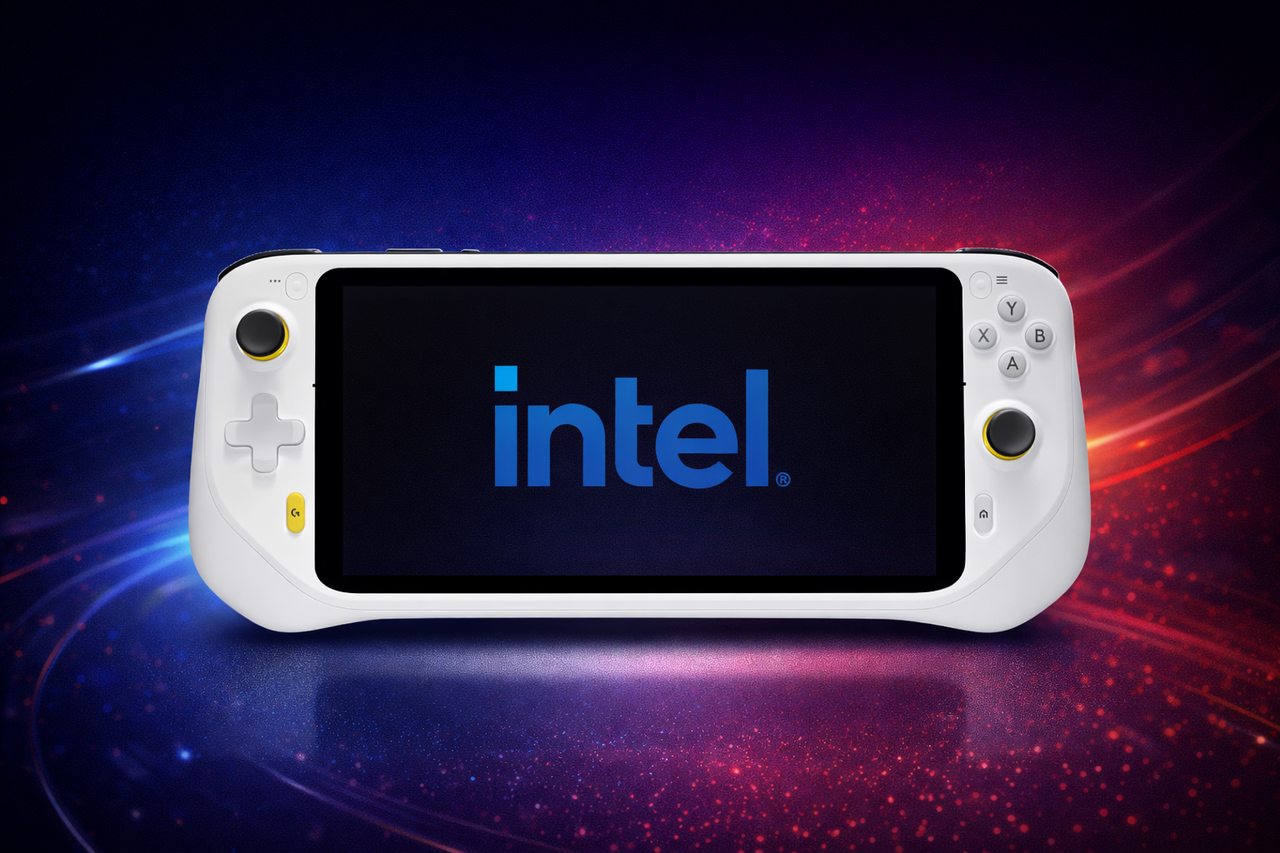
Intel Core G3 Panther Lake Handheld Chips Target LPDDR5X-8533 Memory

Intel continues to prepare its first serious push into handheld gaming PCs, and new details around the Core G3 Panther Lake lineup are now coming into focus. With Intel’s Core G3 chips expected to power future handheld devices, memory configuration choices reveal how the company plans to balance cost, performance, and scale.

Intel Core G3 will use LPDDR5X-8533 memory

According to VideoCardz, Intel’s Core G3 series for gaming handhelds appears listed with LPDDR5X-8533 memory support. This places Core G3 squarely between the slowest and fastest memory tiers in the broader Panther Lake lineup.

Panther Lake supports LPDDR5X speeds up to 9600 MT/s, but Intel reserves that top configuration for select X-series processors. LPDDR5X-9600 shows up only on high-end SKUs such as Core Ultra X9 388H, Core Ultra X7 368H, and Core Ultra X7 358H, all paired with Arc B390 graphics.

By contrast, the Core Ultra 5 338H, which features the Arc B370 iGPU, drops to LPDDR5X-8533. Even lower-tier Panther Lake parts, including Core Ultra 7 365 and 355 as well as Core Ultra 5 335 and 325 models, step down further to LPDDR5X-6800.

Why LPDDR5X speed matters for handheld gaming

Memory bandwidth plays an outsized role in handheld gaming systems. Integrated GPUs depend entirely on shared system memory, so higher LPDDR5X speeds can translate into smoother frame rates and better performance in bandwidth-limited scenarios.

LPDDR5X-8533 strikes a middle ground. It offers a meaningful uplift over LPDDR5X-6800, while avoiding the higher costs and tighter availability associated with LPDDR5X-9600. Real-world performance still depends on GPU configuration, power limits, and OEM tuning, but the memory choice hints at Intel’s priorities for this segment.

G3 and G3 Extreme target volume, not flagship pricing

Several handheld-relevant SKUs, including Core Ultra 9 386H, Core Ultra 7 366H, Core Ultra 7 356H, and Core Ultra 5 338H, appear tied to LPDDR5X-8533. These processors carry Core G3 or G3 Extreme branding, although Intel’s naming remains inconsistent across documents.

Choosing LPDDR5X-8533 instead of the fastest available memory suggests Intel aims these chips at higher-volume, lower-cost devices rather than premium X-series handhelds. That strategy could help OEMs keep overall platform costs down and deliver more aggressive pricing in a crowded handheld market.

Launch timing and early performance signals

Intel’s internal roadmap currently places the Core G3 series launch window in Q2 2026, with no OEMs yet confirming which handheld systems will arrive first. Separately, Intel Z990 and Z970 chipsets have also appeared in roadmap leaks, pointing to a broader platform refresh underway.

Recent benchmarks already show encouraging signs for Intel graphics. Intel’s Arc B390 iGPU has outperformed comparable solutions from AMD in Linux gaming tests, reinforcing Intel’s progress with integrated graphics. In practical terms, Arc iGPUs have also demonstrated performance levels comparable to Xbox Series S, strengthening Intel’s case for handheld gaming.

As Panther Lake approaches launch, memory choices like LPDDR5X-8533 make it clear that Intel wants Core G3 to compete on value, efficiency, and availability rather than chasing absolute peak specifications.

Intel Z990 And Z970 Chipsets Surface as Nova Lake-S Plans Move Forward

After weeks of mixed rumors around canceled products, Intel appears to be moving forward with its next desktop platform. While reports suggest the company has scrapped the Core Ultra 9 290K Plus and the Arc B770 due to rising VRAM costs, new chipset details point to longer-term plans beyond Arrow Lake.

According to VideoCardz, Intel has added two new chipsets, Z990 and Z970, to its internal roadmap. Both chipsets reportedly target the upcoming Nova Lake-S desktop platform and introduce a brand-new socket.

Z990 and Z970 tied to LGA1954

Z990 and Z970 are both linked to the new LGA1954 socket, meaning Nova Lake-S will require entirely new motherboards. Intel has not disclosed any official specifications so far, leaving I/O capabilities, PCIe lane counts, and platform features unknown.

The two chipsets reportedly sit at the top of the stack for Nova Lake-S, with Z990 expected to serve as the flagship option. Z970 may take on a role similar to past H-series chipsets, although Intel skipped an H870 release for Arrow Lake-S.

Z970 may replace the missing H-class tier

One notable detail from the report suggests that Z970 could act as a spiritual successor to the missing H870. Intel is still expected to maintain an H-class desktop tier, but under a different naming scheme for this generation.

Z970 is also rumored to share the same underlying chipset silicon as B960. If accurate, Intel may rely on firmware limitations, BIOS options, and motherboard-level features to differentiate product tiers, rather than producing separate chipset dies. Overclocking support could remain a key divider, though Intel has not confirmed this.

Nova Lake-S targets late 2026 launch window

Both Z990 and Z970 are part of Intel’s Nova Lake-S desktop platform, which is expected to launch as the Core Ultra 400S series. Intel has already stated that Nova Lake will arrive toward the end of 2026, placing these chipsets firmly in the late-2026 desktop cycle, assuming no schedule changes.

So far, Intel has not shared official platform positioning or chipset segmentation details, leaving many questions unanswered about how Nova Lake-S systems will compare to current Arrow Lake desktops.

Beyond desktop platforms, Intel’s roadmap appears busy. Reports suggest G3 Panther Lake handheld chips could debut later this year, and the Arc B390 integrated GPU continues to dominate Linux gaming benchmarks, reinforcing Intel’s growing strength in that space despite recent cancellations.

For now, Z990 and Z970 signal that Intel’s next major desktop refresh remains on track, even as the company reshuffles parts of its product lineup.

Next-Gen Xbox 2027 Launch Reportedly on the Table, Not Locked In; Price Still a Mystery

The PlayStation 6 (PS 6) and next-gen Xbox console have been the topic of interest across the gaming industry for quite some time now. We have come across multiple rumors suggesting a 2027 launch, with recent ones even claiming that the ongoing memory crisis could push the next-gen Xbox console further to 2028. Well, if you have been wanting some new details regarding the launch of the next-gen Xbox console, we may have some.

2027 isn’t locked in for the next-gen Xbox console launch yet

Last week, a few reports hinted that AMD CEO Dr. Lisa Su, during the company’s Q4 2025 earnings call, gave a hint at the next-gen Xbox’s launch timeline. Per Su, “Development of Microsoft’s next-gen Xbox featuring an AMD semi-custom SoC is progressing well to support a launch in 2027.” For those unaware, last year AMD and Xbox entered a multi-year partnership to power the latter’s next-gen gaming devices. For those unaware, the ROG Xbox Ally series handhelds are the result of that collaboration. Last year, we got to know that AMD’s semi-custom SoC, which will power the next-gen Xbox console, is codenamed “Magnus.” Just to be clear, that’s not the codename for the new Xbox console.

Although AMD’s CEO hinted at the 2027 launch, Jez Corden from Windows Central reports that Microsoft “hasn’t fully internally committed to a hard 2027 launch window for the next-gen Xbox platform.” That’s primarily due to pending Windows 11 improvements and other factors, like Microsoft’s expectation for the current Xbox generation to have a longer lifespan. Speaking of AMD’s hinted launch timeline, Corden notes, “Microsoft insiders were a little taken off-guard by Lisa Su’s comments on Xbox’s Gen-10 timeline.” In his words, a 2027 launch for the next-gen console would be the “best case scenario.”

Pricing is still unclear as Microsoft juggles hardware plans and big game releases

If you are eager about the price of the new Xbox console, sadly, there’s no surety about that, too. That has more to do with global economic conditions, the memory crisis, and more. Interestingly, the report also talks about potential collaboration between Microsoft and other OEMs like ASUS for developing different next-gen Xbox options, which could give players the ability to choose across multiple price points. Furthermore, Microsoft’s Windows and Xbox teams are reportedly “working more closely than ever” to bring the best Windows experience to Xbox.

Speaking of Xbox, let’s not forget that bunch of big games are also on track for 2026 launch. Last week, a similar report by The Verge’s Tom Warren hinted that Microsoft is aiming to release big 2026 Xbox games earlier than November to avoid clashing with GTA 6’s release, which reportedly will have its marketing kicked off this summer. In the same report, Warren added that the next Xbox controller could launch with Wi-Fi in 2026.

Are you excited for the next-gen Xbox console? If yes, what price point do you think Microsoft should hit to make you buy one? Let us know in the comments below.

PS6 Tipped to Launch With 30GB GDDR7 RAM, Handheld Likely to Get 24GB

Sony hasn’t even acknowledged the PlayStation 6 (PS6) yet. However, the rumor mill is already doing its job, slipping some of the details as each day passes by. If we have to consider some previous rumors, we are apparently still years away from the PS6 launch, reportedly sometime in 2030. That’s nearly four years from now. The reason, as you may know, is the sudden spike in the cost of memory.

New PS6 rumors point to a major RAM upgrade

Speaking of the PS6, a few new rumors have been making headlines on the internet lately, courtesy of popular leaker Kepler L2, who has a solid track record with early console and GPU details.

According to the tipster, Sony is preparing a major memory jump for its next-generation console. If the rumor turns out to be accurate, the PS6 may release with significantly more RAM than any PlayStation before it. That upgrade, however, could come with a trade-off: a higher price. Per the leaker, Sony is considering the PS6 with 30GB of GDDR7 memory (via Notebookcheck). That’s a big leap from the PlayStation 5’s 16GB GDDR6 setup. Kepler L2 also says that PS6 handheld could launch with 24GB of RAM.

PS6 could move to GDDR7 with higher bandwidth

The leaked configuration points to a 160-bit memory bus delivering up to 640GB/s of bandwidth. The design reportedly uses 10 memory modules, each rated at 3GB, spread across the motherboard. If this holds up, it would give the PS6 far more headroom for advanced rendering, larger game worlds, and heavier AI-driven workloads.

That’s not all; it would also be in line with increasing developer demands as engines become more complex and assets grow larger. For comparison, the PS5 launched with 16GB of RAM in 2020, which was considered generous at the time. Jumping to 30GB would be a bold move, even by Sony’s standards.

Rising memory prices could complicate Sony’s plans

As mentioned earlier, the catch is volatile memory pricing. Industry-wide RAM shortages and rising costs have already impacted servers, PCs, and AI infrastructure. Consoles are not immune, either. Some community speculation suggests that moving from a more conservative 20GB configuration to 30GB could add up to $100 to the console’s retail price. That’s contrary of what previous rumors have suggested.

Kepler L2 reportedly pushed back on the idea of a lower memory option, suggesting 20GB may not be sufficient for Sony’s long-term performance targets. The leaker hinted that Sony could absorb higher costs early on, expecting prices to stabilize after the first year or two.

If this leak proves accurate, it would mean Sony is willing to prioritize performance again, even if it risks pushing console prices higher than players expect.

Edge Update Finally Resolves 100% CPU Usage Issue on Mac

Microsoft continues to iterate on Edge, rolling out frequent updates that address security issues and introduce new features, such as options to hide Copilot. The latest Edge Stable release now tackles a major performance problem affecting macOS users.

Edge Stable 144.0.3719.115 targets macOS performance bug

As reported by Neowin, Microsoft has released Edge Stable version 144.0.3719.115. This update fixes a macOS bug that caused Edge to hit 100 percent CPU usage, fully saturating a single core during normal browsing sessions.

Users reported overheating, aggressive fan spin-ups, and overall performance slowdowns. The issue appeared most clearly on systems running Apple Silicon, where efficiency and thermal behavior matter most.

Reports from users prompted a confirmed fix

The bug surfaced across Microsoft support forums and Reddit, suggesting a widespread impact. A forum user named WCR first drew attention to the problem, noting extreme CPU usage on an M4-based 16-inch MacBook. Another Reddit user, Pale-Profile1570, detected the issue during testing nearly two months earlier, before it reached the Stable channel.

Microsoft acknowledged the problem directly in the changelog, stating that it fixed a macOS issue that caused Edge to fully saturate one CPU core under certain conditions. The confirmation reassured users who had struggled with persistent thermal and performance issues.

While this release focuses on bug fixes rather than new features, it brings meaningful relief to macOS users affected by excessive CPU load. At the same time, Microsoft continues to promote Edge more aggressively, including the addition of a new button that encourages users to set Edge as their default browser.

ASRock Releases Beta BIOS to Address Ryzen 9000 Failures on AM5 Boards

ASRock has acknowledged widespread Ryzen instability reports and quietly released a new beta BIOS aimed at addressing AM5 boot issues. As VideoCardz reports, the company has published BIOS version 4.07.AS01 for select AMD 800-series motherboards.

The update arrives after weeks of user complaints about Ryzen failures on ASRock boards, particularly involving no-POST behavior and memory instability. ASRock did not issue a standalone press release for the BIOS, instead posting it directly to product support pages.

New BIOS update addresses boot failure issues

BIOS 4.07.AS01 uses AGESA ComboAM5 PI 1.3.0.0a, which suggests close coordination with AMD to improve platform stability. According to the release notes, the update introduces three changes:

  • Optimized memory compatibility
  • Resolved a boot failure occurring on certain CPU configurations
  • General AGESA update

ASRock does not clarify whether the boot fix directly targets Ryzen 9000 processors, and the notes avoid naming any specific CPU family.

Affected motherboards

As of February 7, the following AMD 800-series boards have received the beta BIOS:

  • X870 Pro RS
  • X870 Pro RS WiFi
  • X870 Pro-A WiFi
  • X870 Riptide WiFi
  • X870 Steel Legend WiFi
  • X870E Nova WiFi
  • X870E Taichi
  • X870E Taichi Lite

These boards support Ryzen 7000, 8000, and 9000 CPUs, which makes it unclear how narrowly scoped the fix is.

Most failure reports remain tracked by the community on Reddit, where users describe Ryzen 9000 no-POST issues on ASRock motherboards. Community-maintained tracking currently lists 183 reported failures for the Ryzen 7 9800X3D alone, highlighting the scale of the problem.

Earlier this month, ASRock issued an official statement confirming internal reviews and ongoing work with AMD to improve firmware behavior on AM5 platforms. The release of BIOS 4.07.AS01 appears to be the first tangible outcome of that effort.

While the new BIOS may reduce future boot and stability problems, ASRock does not confirm whether it can recover systems with CPUs that already fail to boot. For affected users, the update looks more like an initial mitigation step than a complete resolution, with further AGESA revisions likely required to fully address Ryzen 9000 stability on AM5.

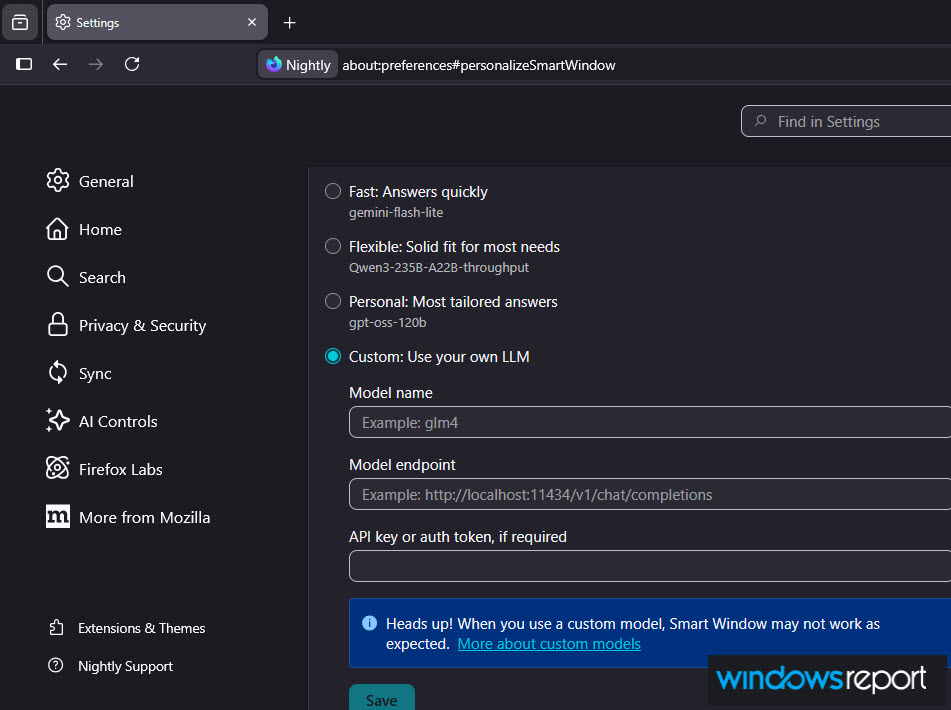
Firefox Nightly Smart Window exposes real AI models and adds custom local LLM support

Firefox Nightly now reveals the actual AI models behind Smart Window and introduces an option to connect a custom local language model. The change moves Smart Window from interface structure to visible AI processing inside the browser.

Firefox’s Smart Window first appeared as a separate browsing mode with memory controls and model selection. The latest Nightly version replaces generic labels with identifiable model backends tied to each assistant option.

Smart Window now lists real assistant models

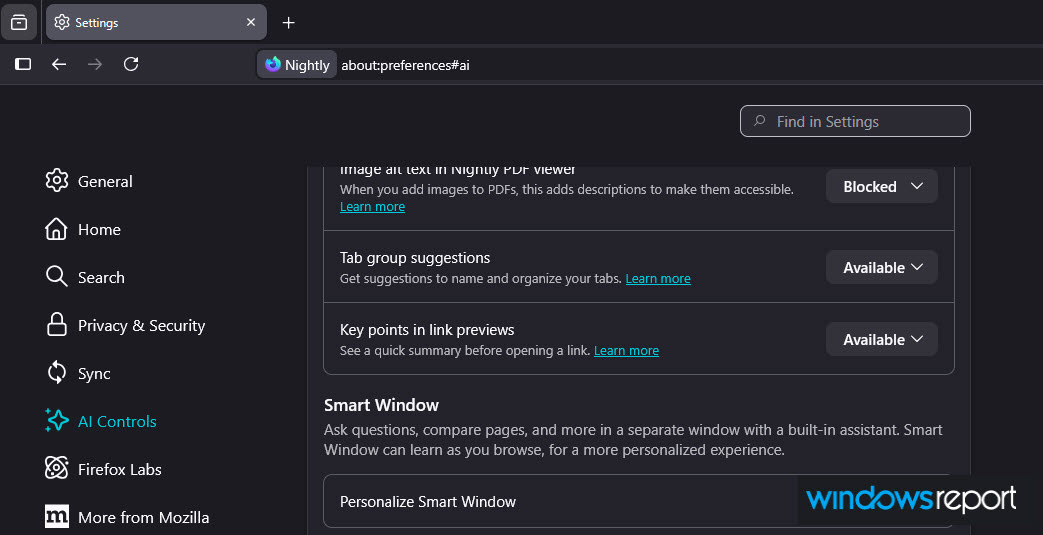
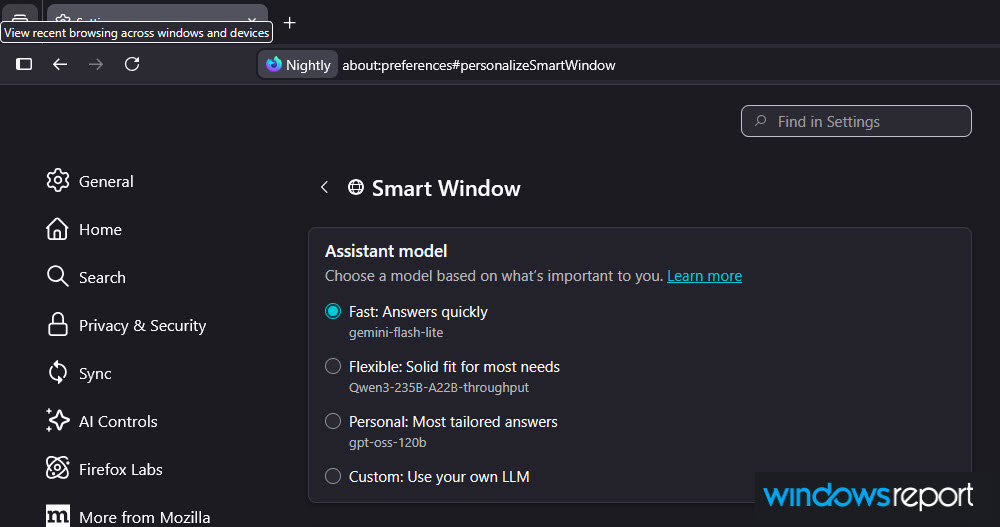
The model choices appear under Settings > AI Controls >Personalize Smart Window> Assistant model in Firefox Nightly.

Image Credit: Venkat | WindowsReport.

Smart Window settings map response styles to specific models:

  • Fast uses gemini-flash-lite for quick answers.
  • Flexible uses Qwen3-235B-A22B-throughput for broader everyday responses.
  • Personal uses gpt-oss-120b for more tailored answers.
Image Credit: Venkat | WindowsReport.

These model names point to different external language model providers connected to Smart Window in Nightly. Concrete model names replace placeholder descriptions and confirm that Smart Window connects to external language model providers.

Smart Window now supports custom local LLM connections in settings

A new “Use your own LLM” option lets Smart Window connect to a user-defined model.

Firefox provides fields for:

  • Model name
  • Model endpoint
  • API key or authentication token

Smart Window can connect to locally hosted or self-managed models, something most mainstream browsers do not expose. Firefox also displays a warning that custom models may not behave as expected, which keeps the feature limited to Nightly.

Image Credit: Venkat | WindowsReport.

Initial Smart Window versions introduced a separate window mode instead of a sidebar, along with memory and personalization controls and model selection during first setup. Visible model backends and custom configuration now show working AI integration, not only interface structure.

Smart Window is still limited to Nightly, but real model connections and local LLM configuration are now visible. Firefox now handles AI processing inside the browser instead of presenting AI only as an interface feature.

Microsoft Store Error 0x80244022 Hit Windows 11 Users, Windows Update Reportedly Also Down

Microsoft services had a fair share of outages this year, too. This year alone, multiple services, including Microsoft 365 apps, Copilot, Azure, and several others, faced widespread disruptions. Last year was no different, either. Now, it is Windows Update and the Microsoft Store that have reportedly gone down, leaving Windows 11 users unable to download or install apps.

Windows 11 users face issues downloading and installing apps via Microsoft Store, Windows Update reportedly also affected

The issue surfaced earlier today, with users reporting constant Microsoft Store error 0x80244022, which prevents app downloads and installs. Many users also say Windows Update is either failing outright or getting stuck mid-download. Many also shared images showing repeated Store issues even on clean Windows 11 installations.

Image credit: Reddit/u/really_not_unreal

The news comes via Windows Latest on X, which first reported about the growing number of complaints and linked the problem to a widespread Microsoft service disruption. Per the news outlet, Microsoft has since acknowledged the outage and confirmed that a power outage at a West US datacenter is behind the disruption. According to the company, the incident affected customers’ ability to complete operations in both Microsoft Store and Windows Update.

While power has already been restored, Microsoft says service recovery is still ongoing. Storage services are gradually coming back online, and some users may continue to see failures or timeouts until recovery fully completes.

Recovery reportedly in progress

In a detailed status update, shared by Microsoft, Microsoft explained that the outage began at 08:00 UTC on February 7, 2026, impacting a subset of Azure customers in the West US region. Backup power systems kicked in automatically, but engineers are still validating systems and rebalancing traffic through Azure’s load balancing layer.

Microsoft says services are being restored in phases as health checks complete. Affected users are advised to retry Microsoft Store and Windows Update operations later, as intermittent issues may persist for now. Moreover, the company has added that it is actively monitoring the situation and will continue providing updates as recovery progresses.

Intel Cancels Core Ultra 9 290K Plus as Arrow Lake Refresh Plans Shift

Recently leaked benchmarks for the Core Ultra 9 290K Plus looked promising, but new reports suggest Intel has quietly pulled the plug on the chip before launch.

Core Ultra 9 290K Plus reportedly canceled

According to TechPowerUp, Intel has canceled the Core Ultra 9 290K Plus, which was expected to serve as the flagship SKU of the Arrow Lake Refresh lineup. While the Arrow Lake Refresh still targets a March or April release window, Intel no longer plans to introduce a new Core Ultra 9-tier refresh model.

Instead, Intel will position the Core Ultra 7 270K Plus as the top Arrow Lake Refresh CPU.

Core Ultra 7 270K Plus becomes the top refresh SKU

Reports claim the Core Ultra 7 270K Plus will ship with 8 P-Cores and 16 E-Cores, matching the rumored configuration of the canceled 290K Plus. The processor reportedly boosts up to 5.5 GHz, with P-Cores reaching 5.4 GHz and E-Cores up to 4.7 GHz.

Clock speeds land roughly 100 to 200 MHz below what the Core Ultra 9 290K Plus would have offered, which means out-of-the-box performance gains from the Arrow Lake Refresh may look modest on paper.

Product overlap likely drove the decision

The reported cancellation appears tied to lineup overlap. Intel already sells the Core Ultra 9 285K, and adding the 290K Plus would have created three nearly identical high-end SKUs differentiated mostly by clock speeds. By removing the 290K Plus, Intel simplifies validation, manufacturing, and supply chain planning.

This move also frees resources as Intel prepares for the Nova Lake launch expected later this year.

Even without a new Core Ultra 9 refresh, Arrow Lake Refresh systems could still deliver gains through platform-level changes. Faster DDR5-7200 memory support, Intel Performance Optimizations similar to China-exclusive tuning, and refinements to P-Core and E-Core behavior could help close the gap.

Final gaming and productivity results will remain uncertain until retail CPUs ship and full reviews arrive in the coming weeks.

That is not the only potential cancellation making the rounds. Separate reports claim Intel may scrap the Arc B770 due to rising VRAM costs. In more positive news for existing users, enthusiasts recently managed to triple Arc A380 performance using an experimental XeSS 3 workaround, showing that Intel’s graphics stack still has untapped potential.

Memory Suppliers Reportedly Betting on “Post-Settlement” Pricing and “Ultra-Short Contracts” Amid Skyrocketting Prices

The global memory market has been under significant pressure due to a sudden spike in prices amid a shortage. That’s not only hampering end-consumer but also the big tech giants that want to secure DRAM and NAND.

Samsung, SK hynix, and Micron are reportedly hardwiring skyrocketing DRAM costs into every new supply contract

According to a recent report by Korean news outlet ET News, Samsung, SK hynix, and Micron are now turning towards short-term supply contracts and “post-settlement” pricing methods, hinting at a major change from the traditional long-term agreements. Normally, memory contracts lock in prices for months or even a year, with only minor quarterly adjustments of around 10%.

But with current market volatility, suppliers are now agreeing to post-settlement contracts, where the final payment reflects the actual market price at the end of the supply period. The report mentions (machine-translated), “even if you decide to supply DRAM for 100 won for one year, if the DRAM market price rises by 100% at the end of the contract period, an additional 100 won will be paid. It is a kind of post-settlement.”

Apparently, this method is being used to target big North American tech companies. While suppliers risk losses if prices fall, the potential gains from further price surges outweigh the downside.

“It’s more important for major customers to secure memory than the contract terms. “Companies are willing to accept additional costs later to guarantee supply now,” a industrty insider told the news outlet.

That’s not all; the contract durations are reportedly also changing. Memory customers are seeking two-year agreements to support expanding AI infrastructure. Suppliers, however, are reluctant due to high volatility and limited supply, sometimes opting for quarterly or even monthly deals instead.

ETNews also reports that mass production of next-gen memory, like Micron’s HBM4, is expected in the second quarter of next year, but industry sources expect these supplier-favored contract trends to continue at least through the second half of 2026 as memory prices remain elevated.

via: Wccftech

Redditor Shares RTX 4080 Super’s PCB Blown by Fiery Short Circuit

If you have been using a GeForce RTX 4080 for some time now, this news will surely blow your mind. In fact, it’s one of the wildest GPU failures reported and documented on Reddit. The news comes via Wccftech, which reports that a Reddit user, u/TwistedCollossus, has noted that the MSI GeForce RTX 4080 Super Ventus 3X OC basically blew up on a test bench, leaving a literal hole in the PCB near the 16-pin power connector.

The incident triggered a fire hazard, as the user mentioned that flames shot out almost immediately after powering it on. Earlier this week, we reported on streamer Jessick showing RTX 4090 emitting smoke inside a running PC. The footage captured a visible puff of smoke near the power connector area before the clip ended. But this one, this has to be next-level chaos.

The images shared by the Redditor show severe burn marks under the heatsink. The capacitors near the burned area look completely destroyed. It’s unclear whether the problem started with one of the capacitors blowing up, which caused voltage instability and burned out the MOSFETs, or if the MOSFETs failed first, sending a huge amount of current through the board. Either way, GPUs should not catch on fire when operating normally.

The user has not shared pictures of the test bench, so we do not know the details about it. However, the Redditor took the card apart afterward to take photos of the damage. A lot of people on Reddit said that taking the card apart could make it hard to get the card replaced under warranty. As of now, MSI has not said anything about this incident, and it is not clear if the card will be covered under warranty.

Short-circuit failures this extreme are rare, but when they happen, they’re dramatic and dangerous. For RTX 40 series owners, this is a reminder that even high-end GPUs can go catastrophically wrong. Hopefully, MSI provides clarity on whether this fiery failure qualifies for a replacement.

Article feature image and in-content image source: Reddit/u/TwistedCollossus