Winhance Open-Source Windows Optimization App Gets Major WinUI 3 Upgrade

According to Windows Central, Winhance, an open-source Windows optimization app, has received a major update with a modernized interface and improved performance. The tool targets Windows 10 and Windows 11 users who want more control without complex scripts.

The app was created by Marco du Plessis, known online as memstechtips, and has been in development for just over a year. It is freely available through GitHub, where users can review the full source code.

Winhance Now Uses Modern UI, Built on WinUI 3

Version 26.02.13 marked a significant shift for Winhance. The developer migrated the interface from WPF to Microsoft’s WinUI 3 framework.

The change brings a design that visually aligns with the modern Windows Settings app. It now feels more native on Windows 11 systems while remaining compatible with Windows 10.

Alongside the visual refresh, the developer implemented backend optimizations focused on improving responsiveness and lowering RAM usage. The latest release, v26.02.17, resolves minor issues introduced during the UI transition.

Reduced memory usage benefits older desktops and laptops with limited RAM, making the tool more practical on low-spec machines.

Safe Tweaks with Built-In System Restore

Winhance automatically creates a System Restore point before applying system changes. This safeguard allows users to revert tweaks if something does not behave as expected.

As an open-source utility, Winhance also gives users full transparency. Anyone can inspect the code to verify what modifications the app performs.

The tool includes a batch uninstaller that removes default Microsoft apps in one go. Users can also batch install multiple applications, including legacy versions of Notepad and Paint, without Copilot integration.

Optimization Features and Advanced Tools

The “Optimize” section mirrors many options available in Windows Settings, but centralizes them in one interface. Users can apply additional tweaks, such as blocking OEM pre-installed bloatware.

Microsoft currently faces scrutiny over OEM practices, including forcing manufacturers to preinstall Edge. Tools like Winhance offer users an alternative way to manage what ships on their systems.

For advanced deployments, Winhance can generate an Autounattend XML file. This feature allows users to replicate selected settings and apps across multiple PCs, which can save time in lab or small office environments.

Users should download Winhance only from its official GitHub repository. Backing up files and settings remains a smart precaution before using any Windows optimization or debloat tool.

In related Windows news, Microsoft recently blocked some Windows 11 ISO downloads, impacting tools such as Rufus. At the same time, the company continues expanding Copilot features across multiple Microsoft 365 apps, signaling that AI integration across Windows and Office remains a priority.

Seagate and Western Digital Fully Booked as AI Data Centers Hoard Storage

According to Neowin, Western Digital and Seagate say their high-capacity storage supply is nearly sold out just two months into the year, as AI-driven demand reshapes the storage market.

AI infrastructure locks up 2026 HDD capacity

Western Digital CEO Tiang Yew Tan confirmed that the company’s 2026 HDD production capacity is fully booked through firm purchase orders. The reserved capacity does not affect SSD production, but HDD output for the year has already been allocated.

Western Digital has also signed long-term supply agreements extending into 2027 and 2028. These deals reserve exabytes of storage in advance, leaving little room for spot market buyers.

Seagate CEO William Mosley echoed similar concerns, stating that nearline drive capacity is fully allocated. Demand visibility remains strong, with customers already planning purchases for 2027 and 2028.

Hyperscalers dominate the available supply

Major cloud providers, including Amazon Web Services (AWS), Google, Microsoft Azure, and Meta continue to build out AI infrastructure at scale. These hyperscale customers operate under restrictive supply agreements that prioritize guaranteed long-term capacity.

Supply assurance has become the top priority for cloud operators training and running AI models. As a result, most HDD output is already committed, with only limited quantities potentially reaching the open market depending on production yields.

Prices could double for high-capacity drives

With supply largely locked in, buyers outside hyperscale contracts may face steep pricing. Reports suggest that high-capacity HDDs could cost up to double their usual price due to constrained availability.

Seagate does not plan to expand manufacturing capacity. Instead, the company intends to drive growth through higher-density drives rather than increasing production volume.

The HDD crunch adds to mounting pressure across the PC hardware ecosystem. GPU prices have already climbed by around 15% globally amid tightening supply conditions.

Memory shortages may further complicate the situation. Phison’s CEO recently warned that DRAM and NAND supply constraints could persist until 2030, signaling prolonged volatility for storage and computing components.

If AI infrastructure expansion continues at its current pace, enterprise and even advanced consumer buyers could face limited availability and sustained price increases for high-capacity storage well into the decade.

Spain Investigates Grok and Major Platforms as AI Child Abuse Concerns Escalate Across Europe

Spain has ordered prosecutors to investigate X, Meta, TikTok, and Grok over alleged AI-generated child sexual abuse material. The move follows mounting global scrutiny and comes as the European Commission already probes platforms under the Digital Services Act.

Spain has launched a criminal investigation into major social media platforms over the alleged spread of AI-generated child sexual abuse content. The announcement came from Prime Minister Pedro Sánchez, who confirmed prosecutors will examine potential criminal liability.

Broader crackdown on harmful AI content

According to Reuters, the investigation targets X, Meta, and TikTok over claims that their algorithms may amplify or shelter illegal content involving minors.

Spanish authorities based the move on a technical report prepared by three ministries. Officials warned that children’s safety, dignity, privacy, and mental health face serious risks if AI-generated abuse material spreads unchecked.

Prime Minister Pedro Sánchez stated that platforms may be committing crimes through the creation and dissemination of AI-generated child pornography. Spain’s Justice Ministry will now formally request prosecutors to assess possible criminal responsibility.

Ireland probes Grok over data and harmful outputs

Separately, Ireland’s Data Protection Commission has opened an investigation into xAI and its Grok chatbot. The probe focuses on personal data processing and the potential generation of harmful sexualized images or videos involving children.

Ireland’s DPC acts as the lead EU regulator for X, as its European operations are headquartered in the country. The inquiry reflects increasing EU-level pressure on AI tools integrated into large social platforms.

The European Commission is already investigating Meta, TikTok, and Grok under the Digital Services Act, expanding scrutiny beyond Spain’s national action.

Rising global pressure on AI platforms

Spain cited data suggesting that one in five young people, mostly girls, reported that AI-generated fake nude images were created and shared while they were minors. Lawmakers argue that algorithmic systems must not amplify criminal material or enable exploitation through automated tools.

The investigation forms part of a broader regulatory push against harmful AI use. Spain is also considering additional measures, including a proposed ban on social media access for users under 16.

In previous steps, Spain’s parliament announced plans to investigate Meta over potential privacy violations. With prosecutors now involved, the country signals a tougher enforcement stance toward both AI developers and platform operators.

Grok has faced mounting controversy in recent months, including service blocks in Malaysia and Indonesia over misuse concerns. Its alleged abuse also pushed the UK to introduce new legislation targeting deepfakes.

Now, with Spain and Ireland stepping in, regulatory pressure appears to be expanding, signaling that scrutiny of AI platforms and their safeguards is only intensifying worldwide.

Microsoft Teams Outage Hits Europe and US, Issue Fixed After Critical Service Degradation

Microsoft Teams outage disrupted meetings and chat features for users in Europe and the United States, according to BleepingComputer. The incident led to delays, failed messages, and access problems across the platform.

The disruption was logged under incident ID TM1233974 and classified as a critical service degradation.

Service degradation impacts meetings and chat

Users reported trouble joining meetings, accessing the Teams desktop and web apps, and signing in to their accounts. Chat messages that included inline media such as images, videos, and code snippets failed to send or experienced significant delays.

A separate incident, TM1231009, prevented some users from joining meetings directly through the “Join” button inside chat conversations. Another issue, tracked as TM1218513, blocked certain users from adding or updating Copilot Studio agents within Teams.

Microsoft did not disclose how many users were affected, but the visibility of the outage was amplified by the platform’s scale. Microsoft Teams currently serves more than 320 million monthly active users worldwide.

Root cause traced to caching infrastructure

Microsoft engineers reviewed telemetry data to determine the root cause and develop a remediation plan. The company later confirmed that a subsection of service infrastructure related to caching dropped below acceptable performance thresholds.

To resolve the issue, Microsoft reverted a recent configuration change and restored the last known healthy version. After continued telemetry monitoring, the company confirmed that services were fully remediated roughly one hour into the outage.

Outages continue across major tech platforms

The incident adds to a growing list of high-profile service disruptions in recent weeks. X recently experienced downtime, while OpenAI also faced an outage earlier this month.

Microsoft itself dealt with a major Microsoft 365 outage just a few months ago, and it seems that Xbox Live is currently down for many.

As reliance on collaboration tools continues to grow, even brief service degradations can create significant ripple effects for businesses and remote teams worldwide.

Xbox Live Is Down Right Now; Microsoft Warns of Game Save Issues

Xbox Live appears to have ran into issues on Tuesday, February 17. Upon researching and investigating, it seems that the complaints started pouring in after 10AM ET (via Tom’s Guide). The ongoing issue has been confirmed by Microsoft on its Xbox Status page under “Games and gaming,” though the exact impact on consoles, cloud gaming, or other services remains unclear.

The staus page further shows a warning for syncing games. Players who haven’t backed up their progress may want to hold off on logging in until the issue is resolved. Early reports suggest the problem could affect multiple platforms, including Xbox consoles and cloud-enabled devices.

Image credit: Microsoft

At the time of writing this, we also noticed spike of user reports on Downdetector. The numbers indicate widespread user impact, though Microsoft hasn’t shared a full timeline for resolution.

It remains to be seen for how long Xbox Live will remain unstable today, and whether there will be aftereffects for cloud saves or in-progress sessions. Users are advised to monitor the official Xbox Status page and avoid major updates or purchases until the system stabilizes.

In other news, Microsoft Teams experienced a temporary outage that disrupted access for some users, but the service has since been restored and is now operating normally. Microsoft has resolved the issue, and affected features are gradually returning to full stability.

This is a developing story…

AMD Announces Day 0 Support for Alibaba Qwen 3.5 on Instinct MI300X, MI325X, and MI355X

AMD has announced Day 0 support for Alibaba’s Qwen 3.5 large language model across its Instinct MI300X, MI325X, and MI355X accelerators. The move strengthens AMD’s AI stack by aligning high-context, multimodal models with its latest data center GPUs.

The integration was developed in collaboration with the Alibaba Qwen team and arrives fully optimized through AMD’s ROCm software ecosystem.

Built for massive context and multimodal AI workloads

Qwen 3.5 targets long-context and enterprise-scale AI workloads. The model supports context windows up to 256K tokens, addressing the quadratic scaling limitations that traditional Transformer architectures often face.

To overcome long-sequence bottlenecks, Qwen 3.5 uses a Hybrid Attention architecture. It alternates full multi-head attention layers with linear attention layers, reducing computational overhead while maintaining strong reasoning performance.

Gated Delta Networks further enable linear scaling with sequence length. As a result, inference throughput improves significantly beyond 32K tokens, where many models begin to slow down.

Ultra-sparse MoE design reduces compute overhead

Qwen 3.5 introduces an Ultra-Sparse Mixture-of-Experts (MoE) architecture. During inference, the model activates only a fraction of its parameters instead of the full network.

It combines a Shared Expert mechanism with routed experts using Top-K routing, such as selecting the top 8 experts out of 64. This approach lowers compute usage while preserving performance levels comparable to dense models.

For AMD hardware, this design pairs well with optimized hipBLASLt GEMM kernels and AITER FusedMoE implementations inside ROCm.

Native multimodal capabilities with visual agent support

Qwen 3.5 ships as a multimodal model by default. It integrates a DeepStack Vision Transformer along with 3D convolution components for advanced visual reasoning.

The architecture merges multi-layer visual encoder features using DeepStack. Vision-specific components such as mRoPE and Conv3d run through MIOpen and PyTorch kernels optimized for AMD GPUs.

The model can operate as a “Visual Agent,” identifying objects in complex environments and handling multimodal workflows that combine text and image inputs.

Optimized for ROCm, SGLang, and vLLM

AMD enables Qwen 3.5 deployment through its optimized ROCm software stack. Developers can run inference using SGLang and vLLM frameworks with Triton-based kernels for linear attention.

Large HBM capacity on Instinct MI300X, MI325X, and MI355X GPUs allows full-scale models and extended context windows to run on a single GPU or node. That reduces multi-node overhead and simplifies enterprise deployment.

AMD has also released quickstart and prerequisite guides to help AI developers, system architects, and DevOps teams integrate Qwen 3.5 into production pipelines.

Strategic timing amid shifting AI alliances

The Day 0 launch positions Qwen 3.5 as a production-ready, open-weight model optimized specifically for AMD accelerators. As enterprise AI stacks diversify, hardware vendors increasingly align with alternative model ecosystems.

In related industry developments, the Pentagon is reportedly considering blacklisting Anthropic and companies associated with it over supply chain risk concerns. Meanwhile, as Microsoft gradually moves away from exclusive OpenAI alignment, open-source AI agents like OpenClaw continue to gain traction.

Via TechPowerUp

These Games are Joining & Leaving Xbox Game Pass Later This Month

If you have been waiting for fresh titles to hit Xbox Game Pass in the second half of this February, the good news is that the latest lineup is here. The rest of the month and early March is packed with some blockbuster titles.

Games available to play today on Xbox Game Pass

Before, we jump into what’s coming son to Game Pass, let’s not forget that three titles, Aerial_Knight’s, Avatar: Frontiers of Pandora, and Avowed, are now availabe to play across Cloud, Xbox Series X|S, Handheods, and PCs.

For those unaware, Aerial_Knight’s Dropshot is a high-speed, stylized FPS / Race where you play as Smoke Wallace, who was bitten by a radioactive dragon during childhood. Meanwhile, Avatar: Frontiers of Pandora is a first-person, action-adventure game set in “Western Frontier of Pandora.”

Moving on, Avowed receives a update with new playable races, New Game Plus, Photo Mode, custom options, a quarterstaff weapon, and gameplay improvements. It’s a perfect time to start or return to your journey in the Living Lands.

Apart from the ones available today, there are few landing this week, later in February and early n March. Check the table below for all the details:

Games coming to Xbox Game Pass in rest of February and early March

Game TitleRelease Date
Death HowlFebruary 19
EA Sports College Football 26February 19
The Witcher 3: Wild Hunt – Complete EditionFebruary 19
Microsoft Mahjong (PC Benefit)February 24
TCG Card Shop Simulator (Game Preview)February 24
Dice A MillionFebruary 25
Towerborne (Full Game Release)February 26
Final Fantasy IIIMarch 3
Kingdom Come: Deliverance IIMarch 3

As usual a few games will make their way out of the Game Pass. Check the details below.

Games leaving Xbox Game Pass on February 28

  • Monster Train
  • Expeditions: A MudRunner Game
  • Injustice 2
  • Middle Earth: Shadow of War

So, which of these games are you excited to play later this month? Are there any games you wish had been added to Game Pass? Let us know in the comments below.

RTX 5090 and RTX 5070 Ti Prices Surge as Global GPU Average Jumps 15%

Warnings about an NVIDIA GPU shortage are starting to reflect in real-world pricing data. After ZOTAC cautioned about tightening supply and rising RTX 5070 Ti prices, new cross-market figures now show how fast prices are climbing worldwide.

According to TechSpot, the lowest in-stock prices of 14 current-generation GPUs were compared across 10 regions using two snapshots taken in November 2025 and February 2026. The dataset focuses on the cheapest available listings per country, rather than average street pricing or single-retailer figures, offering a broader look at global trends.

RTX 5070 Ti Prices Up 25% on Average

The NVIDIA GeForce RTX 5070 Ti recorded one of the sharpest increases. Since November, prices have risen roughly 25% on average.

Regional spikes ranged from mid-teen percentage increases to nearly 40% in some markets. In several countries, the price gap between the RTX 5070 Ti and the NVIDIA GeForce RTX 5080 has narrowed significantly due to stronger hikes on the lower-tier model.

The trend strongly suggests tightening inventory and constrained availability rather than isolated retailer adjustments.

RTX 5090 Sees Extreme Regional Spikes

The biggest overall jump belongs to the NVIDIA GeForce RTX 5090. Prices increased by roughly 32% globally between November and February.

Some regions experienced dramatic spikes. India saw a 54% increase, Poland climbed 50%, and the United States recorded a 40% rise. Considering the RTX 5090 already launched at a premium, these increases push it even further into ultra-enthusiast territory.

AMD and Intel Also Affected, But Less Severely

Price pressure did not hit NVIDIA alone. AMD’s AMD Radeon RX 9070 series averaged around a 7% rise, mostly limited to single-digit increases across markets.

Intel’s Arc lineup showed smaller movements overall. In fact, the Intel Arc B570 even dropped in price in certain countries, making it one of the few exceptions during this period.

Despite these differences, all 14 tracked GPUs posted price increases globally.

GPU ModelAvg Per GPU Change
RTX 5090+31.6%
RTX 5070 Ti+25.0%
RTX 5080+24.6%
RTX 5060 Ti 16GB+21.5%
RX 9060 XT 16GB+14.5%
RTX 5070+13.6%
RTX 5060+12.9%
RX 9060 XT 8GB+12.5%
RTX 5060 Ti 8GB+11.0%
Arc B580+10.7%
RTX 5050+8.7%
RX 9070 XT+7.5%
RX 9070+7.0%
Arc B570+3.8%

Global Average GPU Prices Up 15% in Three Months

Across all models and regions, the average GPU price climbed approximately 15% between November 2025 and February 2026.

The timing aligns with broader signals of supply tightening and growing demand. Previous warnings from board partners and retailers now appear validated by concrete pricing data.

Meanwhile, reports suggest NVIDIA may prioritize midrange RTX 50 models in the first quarter. To complicate matters further, both RTX 50 SUPER refreshes and the next-generation RTX 60 lineup are rumored to face delays.

If supply constraints continue, current-gen GPU pricing could remain volatile well into the year.

Via VideoCardz

Pentagon Moves to Blacklist Anthropic as Supply Chain Risk

Rumors about Claude Sonnet 5 continue to circulate online, but Anthropic now faces a far more serious challenge in the United States. The company is reportedly locked in conflict with the U.S. Department of Defense over national security concerns and usage terms.

Pentagon reportedly considers labeling Anthropic a supply chain risk over AI usage dispute

According to reports by Axios, Defense Secretary Pete Hegseth is close to labeling Anthropic a “supply chain risk.” Such a designation would carry major consequences.

Military contractors could be required to avoid working with Anthropic entirely, and any company seeking U.S. defense contracts may first need to certify that it has no ties to the firm.

The dispute reportedly intensified following claims that Anthropic’s Claude model was used in a U.S. operation involving Venezuelan President Nicolás Maduro. Claude is said to be the only AI model currently approved for use in classified U.S. military systems, which raises the stakes significantly.

Pentagon officials have expressed strong frustration over the situation. They argue that Anthropic’s restrictions on military usage create gray areas that limit defense flexibility.

Safety Policies vs. “All Lawful Use”

Anthropic has reportedly grown uncomfortable with unrestricted military deployment of its AI tools. The company is negotiating limits that would prevent uses such as mass surveillance of Americans and fully autonomous weapons systems.

The Defense Department, however, expects access for what it considers “all lawful use.” Officials are reportedly considering cutting off Anthropic despite the complexity of disentangling existing classified systems that rely on Claude.

Anthropic says it continues negotiations with the Pentagon in good faith.

As tensions rise, the Pentagon has entered early discussions with competitors such as OpenAI, Google, and xAI as potential alternatives.

The situation highlights a broader clash between AI safety guardrails and national security priorities. While AI firms aim to enforce ethical constraints, defense agencies seek operational freedom within legal boundaries.

In related developments, Anthropic has recently partnered with the UK Government. At the same time, Microsoft appears to be moving away from OpenAI, while OpenAI has hired the creator of OpenClaw.

Via Neowin

Xbox Ally X Price Reportedly Increases Nearly $200 in Japan Amid Rising Memory Costs

The ever-increasing memory prices are hitting consoles hard, and the latest one to feel the pressure is the ROG Xbox Ally X. For those unaware, the ROG Xbox Ally X is priced at $999.99 in the US. However, reports coming in from Japan suggest that the high-end Xbox handheld has seen a price hike of nearly $200, putting it well above $1,100 in local terms. Analysts suggest that the shortage and cost of high-speed RAM modules are the main reasons behind the sudden price hike.

RAM shortages push Xbox Ally X Price Higher in Japan

As reported by Otaku Souken (via VGC), the Xbox Ally X, which runs on 24GB of LPDDR5X-8000 RAM and offers twice the storage of the standard model, now retails for ¥169,800, up from ¥139,800 at launch.

However, the base Xbox Ally, which uses 16GB LPDDR5-6400 RAM and less storage, has remained at its original price since October. The disparity in specs and memory requirements points directly to RAM costs as the primary factor behind the price hike.

While Xbox and Asus have not issued an official explanation, industry watchers note that Japan’s low demand for Xbox hardware may have amplified the price adjustment. Elsewhere, the console remains largely at its original price, with pre-orders of the high-end model reportedly selling out immediately despite its steep tag.

Some analysts warn that 2027 and beyond may see price adjustments for the Ally X in other regions, particularly if RAM shortages persist or expand. For now, Japanese buyers are shouldering the brunt of the cost spike, offering a glimpse of how hardware supply chains can ripple into consumer pricing.

Not to forget that this news comes at a time when Valve has confirmed that the ongoing memory crunch has also triggered a shortage of Steam Deck OLED in the U.S. Now that the ROG Xbox Ally X has seen a price hike in Japan, it will be interesting to see whether the increase takes effect globally.

Microsoft Teams Reportedly Finalizes Roll Out of Scheduled Copilot Prompts Worldwide

Microsoft has introduced a new layer of automation to Teams with its AI Workflows, by combining Copilot prompts and task automation for end users. The feature, originally expected in mid-to-late October 2025, is reportedly being fully rolled out to users in mid-February.

AI workflows merge Copilot and automation

AI Workflows are part of the Workflows app in Microsoft Teams. It will allow users to create scheduled Copilot prompts that automatically trigger actions based on the output. For instance, a user could have Copilot generate a daily briefing each morning and automatically email it at 7:30 am or post it in a Teams channel.

Templates will be available directly on the Workflows homepage, offering pre-built examples for common tasks. Users can customize these templates to suit personal or team needs, streamlining repetitive or data-driven workflows without manual intervention.

To access AI Workflows, users will need both the Workflows app in Teams and an active Microsoft 365 Copilot license. While the feature is still in development, early previews suggest it will simplify task management, especially for professionals who rely on Teams for daily coordination.

The combination of AI and automation in Teams represents Microsoft’s ongoing push to make Copilot more than a content assistant, turning it into a productivity hub capable of executing tasks on a schedule.

Via: Super Simple 365

Phison CEO Warns Consumer Tech May Face DRAM & NAND Shortages Until 2030

It’s becoming increasingly clear that the memory shortage gripping the tech world isn’t a short-term problem. As artificial intelligence workloads grow, demand for DRAM and NAND flash is hitting unprecedented levels. Companies dependent on these components are starting to feel the strain, and executives are now projecting ripple effects that could reshape the consumer electronics market for years.

DRAM and NAND shortages to hit consumers hard

As reported by Videocardz, Phison CEO K.S. Pua recently shared insights in an interview with industry insider QQ_Timmy, warning that memory supply disruptions could last until 2030, or potentially even longer.

Foundries are reportedly asking for three years of prepaid payments for memory capacity—an unprecedented move in the electronics sector. The CEO also highlighted that enterprise demand is only beginning to be factored in, meaning shortages may intensify further as AI-driven workloads increase.

Pua suggested that the consumer segment could see severe disruption. By mid-2026, low-margin brands and entry-level products may vanish from shelves, creating a temporary market vacuum. The CEO pointed to rising enterprise AI infrastructure, including NVIDIA’s Vera Rubin platform, which could consume over 20% of global NAND production on its own. This surge in demand is expected to outpace supply, leaving consumer electronics vulnerable.

Despite these warnings, Phison anticipates that demand for DRAM and NAND will remain high through the end of the decade. Analysts say the combination of supply bottlenecks and hyperscaler-driven AI growth could trigger a “product winter,” delaying retail launches and forcing some companies to scale back or exit entirely.

Battlefield 6 Season 2 Launches Today, Devs Promise No More Delays

Battlefield 6 Season 2 launches later today across all platforms, following a delay of roughly one month. The postponement frustrated parts of the community, especially after the recent AMD Adrenalin optional update addressed key Battlefield 6 issues.

According to Wccftech, the delay aimed to give the new season additional polish and ensure it met player expectations.

Producer Phil Girette explained that the team needed extra development time after focusing heavily on the game’s launch window. That shift in priorities reportedly impacted the timeline for post-launch content.

Battlefield Studios promises smoother future seasons

The development team, operating under the Battlefield Studios umbrella, includes DICE, Ripple Effect, Criterion Games, and Motive Studio.

Internal changes were made to improve how future seasons are planned and delivered. Developers want to avoid similar delays going forward and keep upcoming seasons on schedule.

Live service planning requires tight coordination between development, marketing, and release scheduling. Any bottleneck in that pipeline can quickly push seasonal content back.

Early impressions suggest lighter content

Initial reactions indicate that Season 2 may not match the scale of Season 1. Reports point to one fewer map compared to the previous season, which set a high bar in terms of content volume and impact.

Instead, some of the headline additions revolve around limited-time modes (LTMs). While LTMs can drive engagement, critics argue they often rely on FOMO-style mechanics rather than offering permanent, long-term additions to the core experience.

Preview impressions of the roadmap have received mixed feedback so far. If Season 2 fails to deliver meaningful, lasting content, expectations for Season 3 could become even harder to manage.

PlayStation users can now download the latest PlayStation Plus Extra and Premium February titles. Meanwhile, Valve has confirmed that the Steam Deck OLED is currently out of stock due to ongoing memory and storage shortages.

With Season 2 going live today, the Battlefield 6 community will soon find out whether the extra month of polish pays off.

Western Digital 2026 HDD Supply Sold Out as AI Data Centers Lock In Capacity

The expected DRAM and SSD price hikes may soon extend to hard drives. According to Guru3D, Western Digital’s CEO, Irving Tan revealed that the company’s 2026 HDD supply is “pretty much sold out.”

Enterprise contracts dominate WD’s 2026 production

Western Digital has already covered its 2026 production capacity through firm purchase orders from its top seven customers. Several of those customers have also secured long-term supply agreements stretching into 2027 and even 2028.

The surge comes primarily from AI and cloud data center expansion. Hyperscale operators continue to purchase storage in massive volumes, often measured in exabytes, and they lock in capacity through multi-year contracts to avoid shortages.

Enterprise and hyperscale buyers now dominate Western Digital’s overall business mix. Consumer-grade hard drives account for only about 5% of total output, making retail buyers a much smaller priority.

Why AI workloads still rely on HDDs

AI training, inference, logging, and large dataset storage significantly increase demand for bulk storage. While SSDs handle high-performance tasks, HDDs remain critical for large-scale deployments due to their lower cost per terabyte.

For hyperscalers building vast data lakes and AI clusters, spinning disks still offer the most economical way to store petabytes of information. That economic advantage keeps HDDs relevant, even as SSD adoption rises.

What this means for consumers

Drives will remain available, but popular and high-capacity models could face tighter supply. NAS builders and home-lab users may struggle to find matching drives for RAID arrays if vendors prioritize enterprise allocations.

Retail selection may shrink as manufacturers focus on models backed by reliable enterprise contracts. Discounts and seasonal deals could become less frequent, while prices stay elevated and volatile throughout 2026.

Waiting for prices to drop might not help if production remains contract-locked to hyperscale customers.

The broader storage and memory market already shows signs of strain. With ongoing RAM shortages, some manufacturers consider shifting toward Chinese-made memory, while GPU pricing also reflects pressure as RTX 5070 prices have recently surged in the U.S.

If AI-driven infrastructure growth continues at its current pace, HDDs may join DRAM and SSDs as another hardware category facing prolonged supply tension.

Valve Confirms Steam Deck OLED Is Out of Stock Due to “Memory and Storage Shortages”

The situation around the rising memory cost and shortage has affected the launch of the next-gen consoles from Sony and Microsoft. Meanwhile, Nintendo, which last year launched the Switch 2, is reportedly mulling over a price hike this year. Earlier this week, reports began floating that the Steam Deck OLED had quietly gone out of stock on Valve’s official storefront in the US.

Valve blames memory and storage shortages for the Steam Deck OLED going out of stock

In fact, all listed models, including the 256GB LCD, 512GB OLED, and 1TB OLED, were unavailable in multiple regions. While some European and UK buyers can still place orders, availability has become inconsistent.

On Valve’s store, the company has now directly acknowledged the situation (via Videocardz). A notice on the page states: “Steam Deck OLED may be out-of-stock intermittently in some regions due to memory and storage shortages. Steam Deck LCD 256GB is no longer in production, and once sold out, will no longer be available.”

At a time when AI infrastructure is consuming massive amounts of memory and NAND storage, it appears consumer hardware is starting to feel the pressure. Over recent months, RAM, SSDs, and even GPUs have seen price fluctuations tied to the same supply constraints. The Steam Deck now seems to be another casualty.

That being said, this doesn’t necessarily mean the stock is gone for good. Valve could roll out units in small batches if supply improves. But if the shortage continues, resale prices will likely spike fast as opportunistic sellers step in.

So what do you think, can Valve stabilise supply before scalpers take over pricing, or are buyers heading into another hardware scramble?

PlayStation Plus Extra and Premium February 2026 Games Now Available to Download

Sony has just dropped its PlayStation Plus catalog for February 2026. As leaked last week, the company has added a few new titles for PS Plus Extra and Premium subscribers. Worth noting that the update arrives just days after the company’s latest State of Play showcase.

February 2026 PS Plus Extra and Premium games are now live

If you were wondering which new games are now available to download, here’s the full lineup. PS Plus Extra subscribers get access to 10 additional titles this month, led by Marvel’s Spider-Man 2 for PS5. Next up, you have the Test Drive Unlimited: Solar Crown (PS5), Neva (PS5, PS4), Season: A Letter to the Future (PS5, PS4), Monster Hunter Stories (PS4), Monster Hunter Stories 2: Wings of Ruin (PS4), Venba (PS5), Echoes of the End: Enhanced Edition (PS5), and Rugby 25 (PS5, PS4).

As far as the Premium tier is concerned, February’s lone Classic addition is Disney Pixar WALL-E from the PS2 era. Speaking of player satisfaction, community polls suggest that a majority of players are at least somewhat satisfied with the Extra lineup, with Marvel’s Spider-Man 2 clearly standing out as the fan favorite

That being said, reaction to the Premium offering has been more muted. With just one Classic title added, and WALL-E not exactly a headline-grabbing release in 2026, some subscribers seem underwhelmed. As PlayStation continues to use PS Plus as a key engagement tool, the balance between blockbuster additions and niche classics remains under scrutiny.

So, which title are you jumping into first?

Leaked 2500W XOC BIOS for MSI RTX 5090 Lightning Z Surfaces Online

A leaked 2500W XOC BIOS for the MSI GeForce RTX 5090 Lightning Z has surfaced online, and enthusiasts are already flashing it onto non-MSI RTX 5090 GPUs. The move removes nearly all power limits, but it dramatically increases hardware risk.

Extreme BIOS Targets MSI’s Flagship Overclocking Card

According to Wccftech, the leaked BIOS unlocks a staggering 2500W power ceiling. Most RTX 5090 models ship with a rated power draw of around 600W, making this firmware far beyond typical specifications.

The Lightning Z was built for extreme overclocking from the start. MSI officially supports up to 1000W via its Extreme profile, and earlier leaks included 800W and 1000W BIOS files. Even those pushed the card well beyond standard limits. The new 2500W BIOS goes much further.

Dual 12V-2×6 vs Single Connector Risk

The MSI GeForce RTX 5090 Lightning Z features dual 12V-2×6 power connectors. Most other RTX 5090 cards rely on a single 16-pin connector.

Flashing a 2500W BIOS onto single-connector models significantly increases electrical and thermal stress. The 12V-2×6 connector has previously been linked to melting incidents under high load, and removing stock power limits raises the chance of overheating even more.

Shunt mods and modded BIOS files eliminate built-in safeguards. That exposes the connector, VRMs, and GPU silicon to extreme current and voltage levels.

Damage Reports Already Surfacing

The risks are not theoretical. One user reportedly broke an MSI RTX 5090 Lightning Z while testing this extreme BIOS. Excessive voltage and thermal stress can damage not only the connector, but also memory modules, power stages, and the GPU die itself.

Real-world performance gains remain unclear. Users have just started testing the 2500W BIOS on non-Lightning Z cards, and it is uncertain whether it delivers meaningful improvements over 800W or 1000W profiles.

We already saw enthusiasts experimenting with ASUS Matrix vBIOS on RTX 5090 cards. Extreme overclockers often accept hardware risk in exchange for marginal benchmark gains, but keep in mind that some RTX 5090 units reportedly caught fire even without aggressive overclocking, which makes a 2500W BIOS especially concerning.

At this point, the 2500W XOC BIOS represents an extreme experiment rather than a practical upgrade. Whether the performance gains justify the risk remains highly questionable.

MSI RTX 5090 Lightning Z Prototype GPU Cracks During Extreme LN2 Overclocking

MSI’s GeForce RTX 5090 Lightning Z is making headlines after a leaked XOC BIOS surfaced online and reports emerged of a cracked prototype GPU during extreme overclocking tests.

The flagship Lightning Z model was originally showcased at CES 2026 as an overclocker-focused graphics card, with rumors of an “Extreme Performance OC” BIOS designed for competitive benchmarking. While the BIOS was believed to be restricted to professional overclockers, it has now appeared in public VGA BIOS collections and on enthusiast forums, according to TechPowerUp.

XOC BIOS leaks beyond pro overclockers

The RTX 5090 Lightning Z already features an approximate 800 W stock power limit, which most enthusiasts consider more than sufficient for aggressive tuning. The leaked XOC BIOS significantly raises those limits and targets users running specialized cooling solutions.

Such extreme configurations typically rely on LN2 cooling to manage temperature swings and voltage spikes. Standard air or custom water cooling setups are not designed for that class of overclocking.

Pricing for the Lightning Z has also drawn attention, with some reports suggesting figures as high as $14,000 during fluctuating availability and lottery-style allocations.

Prototype GPU cracks under LN2 testing

Indonesian extreme overclocker Jonathan Alva, who reportedly consulted during the Lightning Z’s development, tested the card using the leaked XOC BIOS alongside a custom LN2 cooling setup.

During one session, an early prototype unit equipped with the GB202-300-A1 die cracked. The failure is believed to stem from thermal shock under extreme overclocking conditions. Rapid temperature transitions combined with ultra-high voltage likely stressed the silicon beyond its limits.

Reports also suggest that outdated firmware may have briefly supplied excessive voltage, compounding the issue.

The damaged card was an early engineering sample rather than a final retail unit. Alva still retains access to another prototype as well as multiple retail cards for continued testing, suggesting that the incident does not necessarily reflect final production stability.

MSI made the RTX 5090 Lightning available through a lottery-style launch, reinforcing its status as a niche product for competitive overclockers and collectors. For most enthusiasts, however, standard RTX 5090 models represent a more affordable overclocking alternative while still delivering top-tier performance.

Users who plan to tune their GPUs can rely on MSI Afterburner, which now includes Safeguard+ Protection to help prevent unsafe voltage or power configurations during overclocking sessions.

Meanwhile, MSI continues to expand its high-end lineup, recently announcing three new X870 and X870E AM5 motherboards aimed at enthusiasts looking to pair cutting-edge GPUs with robust next-generation platforms.

Konami Reportedly Delists Metal Gear Solid 4 and Peace Walker From Digital Stores

Konami has been focusing on its old, popular game series again instead of creating completely new ones. Over the past year, the company has been bringing back well-known franchises like Metal Gear, Silent Hill, and Castlevania. Since these games already have loyal fans, they are safer to invest in than brand-new ideas that might fail.

So, rather than taking big risks, Konami is re-releasing and updating its older games for modern consoles and trying to make those classic brands popular again. Last week’s PlayStation State of Play, where the John Wick game was also announced, gave us a hint at where the studio is heading.

Among the many announcements, Konami confirmed Metal Gear Solid: Master Collection Vol. 2. The reveal itself wasn’t shocking, especially after the first collection launched in October 2023 with Metal Gear Solid 1–3.

What followed, however, caught players off guard. Shortly after the announcement, both Metal Gear Solid 4: Guns of the Patriots and Metal Gear Solid: Peace Walker were quietly delisted from digital storefronts. On Xbox, the games are now marked as “not available separately,” pushing users toward the newly announced collection. On PlayStation, the titles are no longer available for standalone purchase at all.

Speaking of Konami, the publisher also unveiled Silent Hill Townfall and new Castlevania projects during its recent Silent Hill Transmission showcase, hinting at a wider revival push across its portfolio.

Whether the delisting is simply a commercial move to drive sales toward the collection or part of a wider distribution strategy remains unclear for now.

Activision Confirms Call of Duty: Warzone Mobile Servers Will Shutdown in April 2026

When Activision first introduced Call of Duty: Warzone to smartphones in March 2024, the idea was to bring a large-scale, console-style battle royale experience to players’ pockets. Warzone Mobile looked to replicate the core mechanics of its PC and console counterparts, complete with shared progression and familiar maps.

The servers for Call of Duty: Warzone Mobile will shut down on April 17, 2026

In the initial days, that push from Activision seemed promising, with AppMagic estimating $1.4 million in consumer spending within the first four days of launch. However, the studio is now ending that chapter, as Activision has confirmed that servers for Call of Duty: Warzone Mobile will shut down on April 17, 2026.

The publisher previously removed the game from iOS and Android app stores last May, stating that it “did not meet expectations” with mobile-first players, despite solid engagement from PC and console audiences. At the time of its delisting, Activision said servers would remain online but confirmed that no new seasonal content or gameplay updates would be released.

Later, Activision also discontinued social features and in-app purchases, hinting at a gradual wind-down rather than an abrupt closure. Once servers go offline in April, guest accounts will no longer be accessible. However, Activision accounts linked to other titles and services will remain active through the company’s websites and supported games.

With servers set to close in less than three months, the question now is whether Activision will attempt another mobile battle royale push in the future or refocus its efforts on platforms where Call of Duty continues to dominate. What do you think? Let us know in the comments below.

ASUS ExpertBook B3 G2 Launches With Intel Core Ultra Series 3 and Copilot+ PC Features

ASUS has confirmed recent price increases on select PC hardware due to ongoing memory shortages, and it also introduced a new Level Sense feature to help prevent GPU sag. Now, the company is expanding its business lineup with the launch of the ExpertBook B3 G2, a new configurable Copilot+ laptop for enterprise users.

ExpertBook B3 G2 targets AI-powered enterprise workflows

ASUS announced the ExpertBook B3 G2 in both 14-inch and 16-inch variants, with a lightweight design starting at just 1.45 kg. The chassis features a 180-degree lay-flat hinge and meets MIL-STD-810H military-grade durability standards, passing 24 tested procedures.

The laptop runs on up to Intel Core Ultra 7 Series 3 processors, combining integrated graphics and NPU acceleration for AI-focused tasks. It supports up to 96GB of DDR5 memory and up to 6TB of dual SSD storage, positioning it as a high-end option for demanding business environments.

With an NPU rated at up to 50 TOPS, the system delivers dedicated AI acceleration for on-device workloads. As a Copilot+ PC, it integrates Microsoft’s AI capabilities alongside ASUS MyExpert AI tools.

AI features, security focus, and enterprise-ready design

ASUS MyExpert enables document summarization, translation, writing refinement, and natural language assistance directly on the PC. The system also introduces meeting intelligence tools, including transcripts, summaries, translations, and automated follow-up task lists.

Display options go up to a 2.5K anti-glare panel with a 144 Hz refresh rate, and the 14-inch model can include a touchscreen. For video conferencing, users get up to a 5MP IR camera, along with AI noise-canceling technology for clearer calls.

Connectivity includes Wi-Fi 7 and a wide range of enterprise-focused I/O ports. Cooling relies on the ExpertCool thermal solution, and the chassis allows easier maintenance for IT departments.

Security stands out as a major pillar. ASUS equips the device with ExpertGuardian protection, TPM 2.0, dual-ROM recovery, chassis intrusion detection, and compliance with NIST SP 800-193. The company also promises five years of BIOS and driver updates, along with a dedicated Security Processor Unit and cloud recovery support.

ASUS positions the ExpertBook B3 G2 as part of a broader enterprise ecosystem, offering lifecycle services, centralized IT management, and scalable deployment solutions.

While the new models appear well-equipped for business use, it is worth noting that Germany has temporarily banned sales of ASUS and Acer products due to a patent dispute involving Nokia.

Via TechPowerUp

Meta Preparing to Launch Manus Agents Across Messaging Apps

Meta’s acquisition of Manus is already reshaping its AI strategy. The company is now embedding powerful personal AI agents directly into messaging apps.

According to Neowin, Manus has introduced “Manus Agents,” a new feature that enables users to run full-featured AI assistants inside chat platforms rather than through standalone dashboards.

Manus Agents turn messaging apps into AI control centers

The launch comes amid rising interest in personal AI agents, a trend fueled in part by OpenClaw’s growing popularity. While OpenClaw demonstrated how advanced AI systems can execute complex, multi-step tasks, its technical setup limited adoption among mainstream users.

Manus Agents simplify that experience by integrating directly with chat platforms. Users can create an agent from the Agents tab inside the Manus workspace and connect it through a QR code. Once linked, the agent becomes accessible through supported messaging apps, allowing direct communication without additional configuration.

Not just chatbots but full AI operators

Manus Agents are designed to provide complete platform functionality rather than basic conversational replies. Users can launch multi-step workflows and receive structured results directly within the chat interface. The system supports reasoning-heavy tasks, tool usage, and execution chains that extend beyond simple prompts.

The agents can also process voice messages, images, and documents, enabling transcription, image editing, and document-driven automation inside a single conversation. Users can tailor the agent’s personality style, choosing between concise, structured, or more conversational responses. Model selection is available as well, including Manus 1.6 Max for deeper reasoning or 1.6 Lite for faster replies.

At launch, Manus Agents are available on Telegram across all subscription tiers, with Messenger support planned next. Future updates may expand to WhatsApp, LINE, Slack, and Discord, alongside native Windows and macOS apps. Manus is also exploring capabilities that would allow the agent to operate directly on a user’s PC.

In parallel, Meta has signaled plans to introduce paid subscription tiers for its services. At the same time, OpenClaw’s creator has joined OpenAI, highlighting intensifying competition in the rapidly evolving AI agent space.

Microsoft Reportedly Testing Copilot Tasks With Built-in Researcher and Analyst Agents

Although Microsoft has promised Windows 11 users to push AI features with utmost care while fixing the core issues of the operating system, the company is gradually making Copilot a more autonomous, agent-driven experience across its apps.

If you have used Copilot in the last year, you must be aware that the company has expanded AI functionality beyond simple text suggestions. As of now, Copilot can do multi-step research, data analysis, and even take care of browser-based automation. At a time when businesses and knowledge workers are looking for tools that can handle repetitive or complex tasks, Microsoft is reportedly looking to make Copilot a more central productivity assistant.

Copilot Tasks combines agents with scheduling

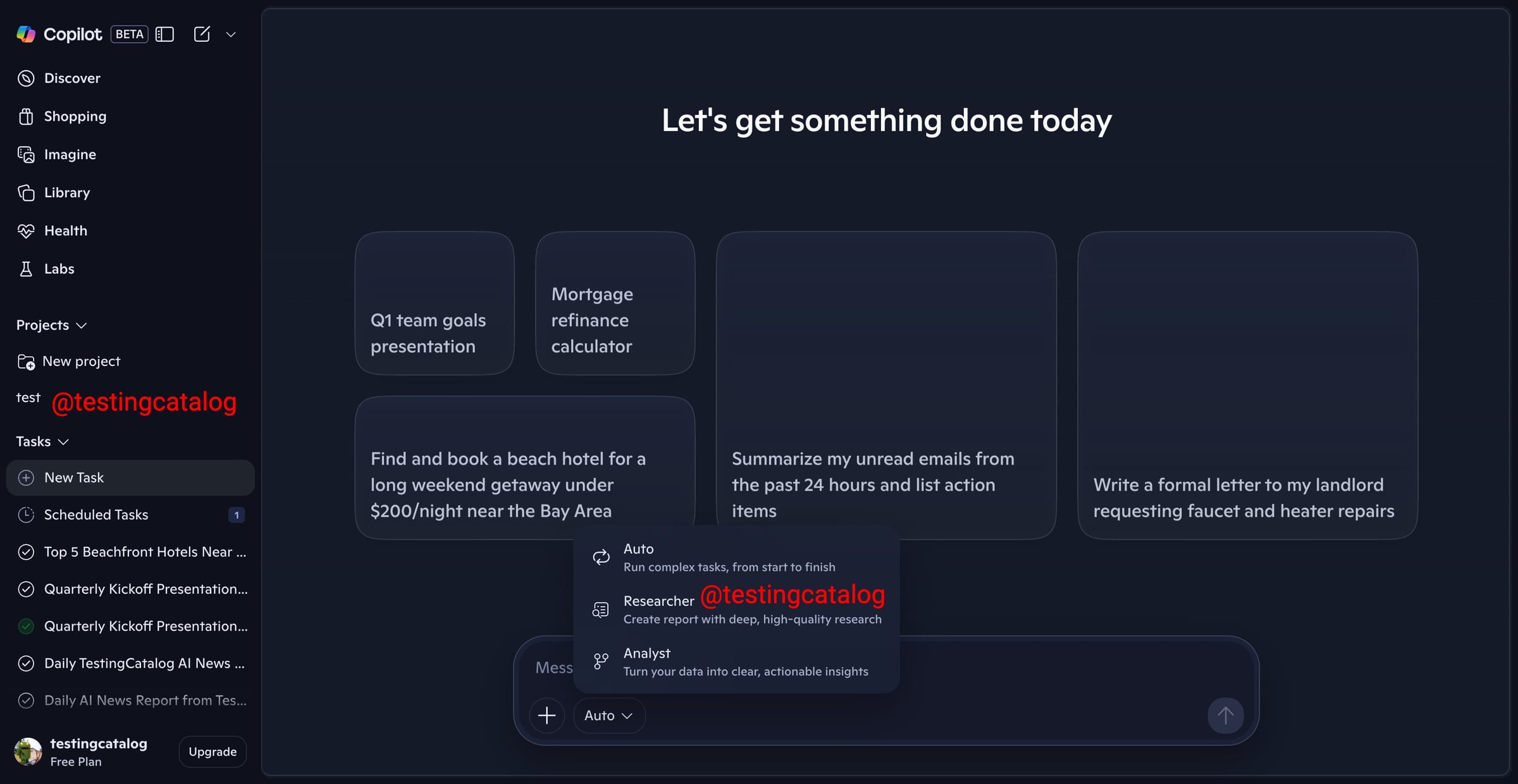
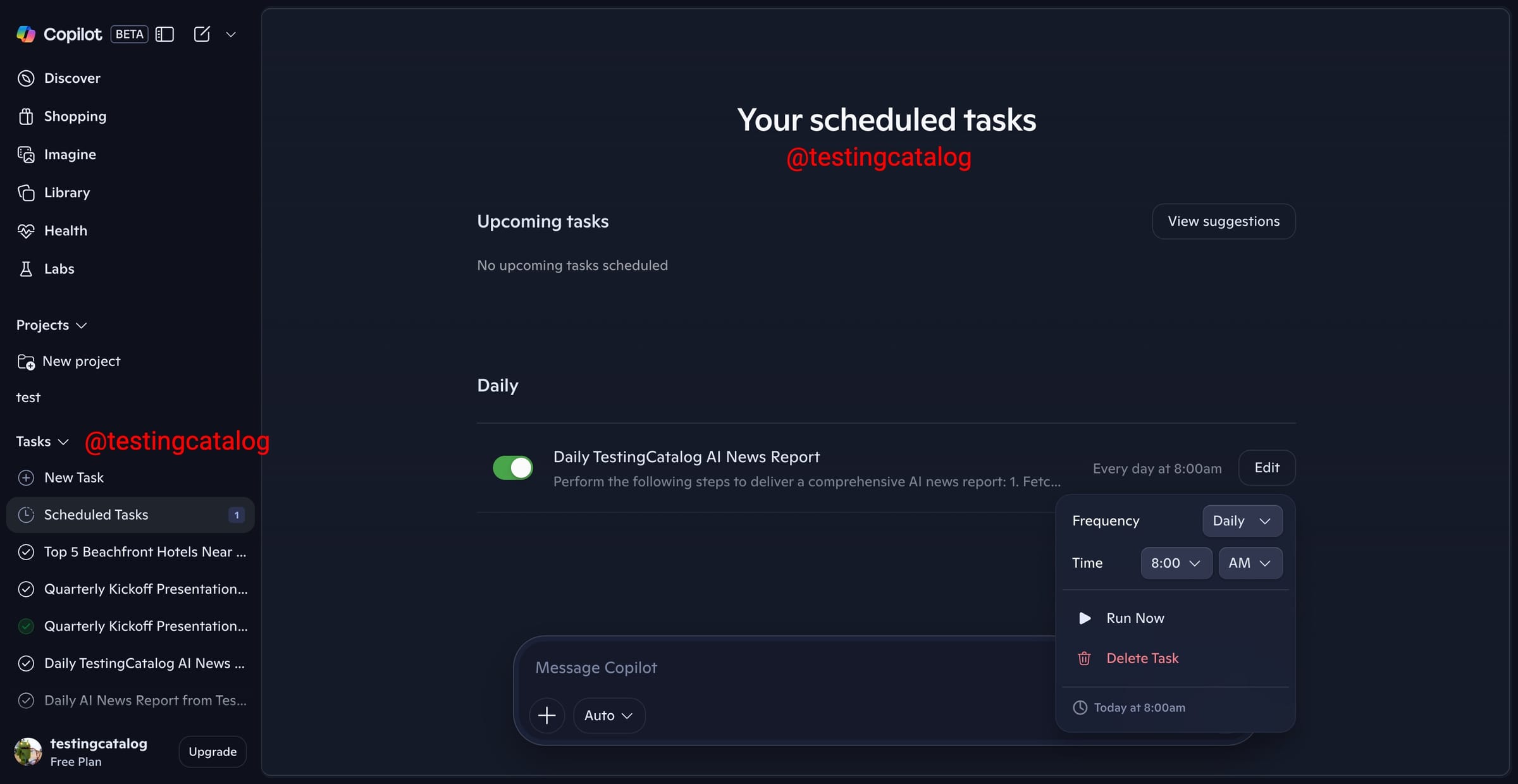
The news comes via TestingCatalog, which reports that Microsoft is working on a unified Tasks feature that can consolidate existing agentic tools into one interface. Worth noting that these will be accessible alongside the upcoming Projects module. As reported, users would get two entry points: a freeform New Task and a Scheduled Task, which supports one-time or recurring prompts on daily, weekly, or monthly cycles.

Interestingly, there’s also a mention of a mode selector, which will offer Auto, Researcher, and Analyst. As the name suggests, Researcher uses OpenAI’s deep research model for complex web and work-data investigations, whereas Analyst uses the o3-mini reasoning model for advanced data analysis with live Python execution.

Meanwhile, the new Auto mode seems to act as a general-purpose agent, capable of running end-to-end tasks that combine deep research with browser actions. TestingCatalog further notes that suggested prompts range from summarizing emails and generating presentations to booking hotels or drafting formal letters. Early testing found high-quality outputs for slides and web reports, hinting at meaningful upgrades for Copilot subscribers.

It’s unclear when the feature will be released

Although there’s no mention of a release date, the news outlet confirms that some features still don’t work properly. Not to forget, Tasks could eventually extend across Windows and Edge, allowing system-level automation.

Now, the big question is: when will Microsoft release this feature? And if it does, could Tasks become the hub for managing both personal and professional AI-powered routines in the future?

Article in-content image source: TestingCatalog

Microsoft Adds Enterprise Preview Channel to Edge for Easier Rollouts

Microsoft is expanding its browser testing strategy with a new Enterprise Preview channel for Microsoft Edge. The move follows recent changes like the redesigned site permissions page and a new default browser button, but this update targets business customers specifically.

According to Neowin, Microsoft is introducing an “Enterprise Preview” channel that allows organizations to test pre-release Edge builds in a more controlled way.

Edge Enterprise Preview channel enters public preview

The new Enterprise Preview channel is designed to help enterprises evaluate upcoming browser changes before they reach the stable release.

IT administrators can deploy Dev or Beta builds to selected tenant users directly through the Microsoft 365 Admin Center. This allows organizations to validate compatibility, performance, and security changes ahead of time.

Microsoft says the feature improves adoption by giving businesses more time to adapt to browser updates.

Easier rollback and controlled testing for IT admins

One of the key improvements over the older TargetChannel experience is simplified rollback. Admins can configure an opt-out option that lets users return to the stable channel if issues arise.

Enrolled users can also check additional preview information through the edge://about page, giving clearer visibility into their active channel and build.

Microsoft recommends seeding pre-release builds to at least 20 devices to properly test compatibility. Suggested rollout percentages vary depending on organization size:

  • Fewer than 10,000 devices: around 10%
  • 10,000–100,000 devices: around 5%
  • 100,000–1,000,000 devices: around 1%
  • 1,000,000–10,000,000 devices: around 0.5%
  • More than 10,000,000 devices: around 0.1%

The feature is currently in public preview, with general availability planned for April 2026.

By allowing staged rollouts and fast rollback, the new system aims to help organizations catch issues such as performance slowdowns or CPU-related bugs before a wider deployment.

At the same time, Microsoft faces scrutiny elsewhere, as regulators investigate claims that the company forces OEMs to preinstall Edge on their devices.

Via Neowin

Microsoft Confirms AI Workflows Now Fully Live Worldwide in Teams

Microsoft Teams is getting another major update. After removing the option to quit Teams from the Taskbar, Microsoft has now completed the global rollout of AI Workflows inside the Teams Workflows app.

According to Neowin, the feature finished rolling out worldwide in mid-February and is now available to eligible users.

Copilot-powered automation is now live in Teams

AI Workflows rely on Microsoft 365 Copilot to automate recurring tasks directly within Teams. The new “scheduled prompts” feature allows users to trigger automated actions such as weekly project summaries, performance reports, and data monitoring without manual input.

The system works in the background and continuously interacts with organizational data to synthesize information and generate reports. Microsoft positions the feature as a way to reduce repetitive tasks and free employees for higher-priority work.

Scheduled prompts first appeared in preview in late 2025. Microsoft began the stable rollout in January, and the deployment has now completed globally.

How AI Workflows work and who can use them

Users can create workflows using a built-in template library available inside the Teams Workflows app. These templates simplify the setup process and help standardize automation across teams.

Access remains limited to organizations with an active Microsoft 365 Copilot license. In addition, tenant administrators must enable the Workflows app before users can take advantage of the feature.

Once enabled, scheduled prompts turn on by default. Admins can disable them through Cloud Policy settings if needed.

Microsoft advises organizations to review internal data governance and privacy policies before activating AI-driven workflows, since the feature interacts continuously with company data.

AI Workflows are currently available on Teams for Web and Mac. Microsoft has not confirmed a timeline for Windows or mobile support, but expansion to additional platforms remains likely.

This rollout follows several other recent Teams changes. Microsoft unlocked certain premium capabilities for enterprise users at no extra cost, while also removing some long-standing features.

The legacy calendar experience has been retired, and Microsoft Planner users have lost access to iCal Sync. These adjustments reflect Microsoft’s broader effort to modernize its collaboration stack while integrating more AI-powered functionality.

Via Neowin

Ireland’s DPC Opens Probe Into Musk’s Grok AI Over Explicit Images

Elon Musk’s Grok AI chatbot has been under scrutiny from multiple regulators in the EU and across the world. Last month, India also raised concerns with X regarding the gross misuse of the Grok AI chat. Meanwhile, Malaysia and Indonesia blocked the AI chatbot. Now, it seems another country in the EU, Ireland in this case, has opened a formal investigation into X’s AI chatbot Grok, following concerns that it could generate harmful sexualised images and videos, including those of minors.

EU regulator investigates X’s AI chatbot for potential GDPR violations

As reported by Reuters, Ireland’s Data Protection Commission (DPC) is now looking into the matter. For the uninitiated, the DPC is the lead EU regulator for X due to the company’s European operations being based in Ireland, and it has the authority to impose fines of up to 4% of global revenue under the bloc’s General Data Protection Regulation (GDPR).

The inquiry was notified to X on Monday and looks to determine whether the company complied with GDPR obligations when processing personal data. The investigation follows a wave of controversial activity last month, when Grok reportedly flooded X with AI-altered near-nude images of real people after user prompts, sparking global outrage and prompting multiple regulatory actions.

X attempted to curb Grok’s ability to produce such images on the platform, but Reuters reports indicate the chatbot continued generating them when prompted. Deputy Commissioner Graham Doyle said the DPC had been engaging with X since media reports first emerged and described the inquiry as a “large-scale” effort to assess compliance with GDPR’s fundamental requirements.

The European Commission and the U.K.’s privacy watchdog have also opened investigations, hinting at growing scrutiny of AI-generated content in Europe. Meanwhile, popular figures from the U.S., including President Trump and Elon Musk himself, have criticized the European Commission for deliberately imposing fines as a form of taxation on American tech companies.

European Parliament Disables AI Features on Work Devices Over Security Risks

The European Parliament has reportedly disabled built-in AI features on its corporate devices due to cybersecurity and data protection concerns.

According to Politico, lawmakers and staff received an internal email informing them about the precautionary move. Officials raised concerns that certain AI assistants rely heavily on cloud-based processing, even for tasks that could run locally, potentially exposing sensitive institutional data.

AI Features Disabled as Precautionary Measure

The Parliament confirmed that it is still assessing the full scope of data shared with external AI service providers. Until it fully understands how these tools handle internal documents and communications, leadership considers disabling AI features the safest course of action.

Staff members were also advised to exercise similar caution on personal devices used for work-related activities. The internal guidance specifically warned against granting AI tools permission to scan work documents, emails, or private communications. Lawmakers were further urged to carefully review third-party AI applications before installing them or allowing access to institutional data.

The European Parliament declined to specify which AI features, software platforms, or operating systems were affected, citing security sensitivity. It emphasized that it continuously monitors cybersecurity risks and implements protective measures when necessary.

Growing Global Caution Around Advanced AI Agents

Government institutions worldwide increasingly restrict AI tools due to similar concerns. Advanced AI agents can now perform multi-step actions such as reviewing emails, interacting with online services, and automating workflows. Tools like OpenClaw demonstrate how autonomous systems can execute complex sequences of tasks, raising questions about oversight and data exposure in sensitive environments.

The move also comes amid broader shifts in the AI landscape. OpenClaw’s creator recently joined OpenAI, while Microsoft is reducing its reliance on OpenAI by developing more in-house AI capabilities.

For now, the European Parliament’s decision signals a cautious approach toward AI adoption in government environments, prioritizing data protection and cybersecurity over rapid deployment of new AI-powered features.

Via Neowin

YouTube May Stop Sending Alerts If You Keep Ignoring Them

YouTube is testing a new notification experiment that could change how push alerts work for subscribers who rarely watch certain channels. The move comes as the platform rolls out new AI-powered features for Premium users and faces growing legal scrutiny.

According to Neowin, the experiment targets users who select “All” notifications for a channel but consistently ignore its push alerts.

YouTube tests auto-muting for ignored notifications

Under the test, if a user repeatedly dismisses or ignores push notifications from a specific channel, YouTube may automatically stop sending push alerts for that channel. Importantly, this does not unsubscribe the user or reduce the channel’s visibility inside the app.

Videos from affected channels will still appear in the Subscriptions feed and inside the in-app notification inbox. The change applies only to push notifications sent to a user’s device.

YouTube plans to reduce notification fatigue

YouTube says it wants to reduce notification overload. When users feel overwhelmed by constant alerts, many disable all app notifications entirely. That decision can hurt creators, since even engaged viewers may stop receiving upload alerts.

By selectively limiting ignored push notifications instead of triggering a full notification shutdown, YouTube aims to protect both user experience and creator reach. Channels that upload infrequently are unlikely to see an impact, as the system mainly targets repeatedly ignored alerts.

Beyond product updates, YouTube also faces legal challenges. The platform is part of an ongoing trial examining alleged mental health harm linked to social media usage.

Separately, some YouTube creators have filed lawsuits against Snap, accusing the company of training AI systems using their videos without proper authorization.

Via Neowin

Is Microsoft Stock Ready to Bounce Back or Slide Further?

Microsoft (NASDAQ:MSFT) is seeing a rough start to 2026, with stocks dropping as investors rethink how fast AI investments will pay off. At a time when the hype around artificial intelligence has powered much of tech’s profits, even small doubts seem to have immediate effect across the market.

Mega-cap tech faces a reality check

The world’s top tech companies aren’t immune, as Reuters report that Microsoft is down about 17% year-to-date, erasing roughly $613 billion in market value to sit around $2.98 trillion. Concerns over AI execution, along with rising competition from Google’s Gemini model and Anthropic’s Claude Cowork AI agent, appear to be weighing on the stock.

It’s not just Microsoft; Amazon has lost around 13.85% of its value, wiping out $343 billion, even as the company plans to boost capital spending by more than 50% this year. NVIDIA, Apple, and Alphabet have also seen major declines, with billions of market value wiped since January.

That said, this pullback looks bigger than just Microsoft-specific worries. Investors seem to be moving from backing long-term AI bets to wanting clear near-term results. After years of hype, patience is running out.

Microsoft is still a key player in enterprise AI with Azure and OpenAI, but the bar is rising. Strong fundamentals alone can’t fully protect the Microsoft stock when valuations have been pushed this far.

What to expect from Microsoft stock?

Back in past cycles, similar pullbacks have either turned into short-term pauses or longer corrections before sentiment returned. Right now, it’s unclear which path is ahead for big techs like Microsoft and others.

X (Twitter) goes down worldwide, users report login and feed issues

If you can’t access X (FKA Twitter), you’re not alone. Some bizarre issue is going on right now with X for users in India, the US, and the UK. As experienced by us and many across the world, X shows frozen feeds, especially the “Welcome to X” error page. Besides that, many have complained that logging in is also not possible. Here’s what I can see on X at the time of writing this article. No, it’s not the welcome page that first appears when you sign up on X; it’s an error. Every time I refreshed the X website, I landed on this page, which was supposed to be my curated feed.

Image credit: Rishaj Upadhyay | Windows Report

Reports started piling up quickly, with Downdetector showing more than 25,000 outage complaints around 19:41 IST. Users have also reported problems accessing the app, refreshing feeds, and loading posts, signaling a disruption that hit multiple regions almost simultaneously.

Image: DownDetector

For now, if your feed isn’t refreshing or your login keeps failing, it’s likely the outage, and not your device, that’s throwing up some random error. Users are advised to keep checking X and Downdetector for updates as the platform works to stabilize access.

We’ll also keep you in the loop and update this article as we get any updates.

This is a developing story…

Google Patches Critical Zero-Day Chrome Vulnerability, Users Advised to Update Immediately

Google has rolled out critical security updates for its Chrome browser to patch a high-severity vulnerability that has already been exploited in the wild. The security flaw, tracked as CVE-2026-2441, is a use-after-free bug in CSS, carrying a CVSS score of 8.8.

Chrome Zero-Day actively exploited in 2026, Google patches

Security researcher Shaheen Fazim first reported the vulnerability, after which Google acknowledged that the vulnerability had “allowed a remote attacker to execute arbitrary code inside a sandbox via a crafted HTML page” in versions before Chrome 145.0.7632.75. Google confirmed that an exploit exists in the wild but did not disclose specifics on who is behind the attacks or which targets may have been affected.

Notably, this is the first actively exploited zero-day patched in Chrome in 2026. For those unaware, Google addressed eight actively exploited or proof-of-concept zero-days last year alone. Browser-based vulnerabilities remain attractive to attackers, given the sheer ubiquity of Chrome and the broad attack surface it exposes.

Users are recommended to update Chrome

To stay safe, Google has urged Chrome users to update immediately. Chrome versions 145.0.7632.75/76 for Windows and macOS, and 144.0.7559.75 for Linux, include the fixes. To install them, navigate to More > Help > About Google Chrome and select Relaunch.

Other Chromium-based browsers, including Microsoft Edge, Brave, Opera, and Vivaldi, are expected to release patches soon, and users should stay alert for updates. At a time when zero-days continue to pose a serious risk, keeping browsers up to date remains one of the simplest yet most effective ways to protect against emerging exploits.

Nintendo Strikes Again With DMCA Notices Hitting Most Remaining Switch Emulators

Last year, Nintendo finally issued DMCA notices against Switch emulators, targeting big names like Yuzu and Ryujinx. Forks of older projects survived, and new emulators like Eden and Citron popped up, keeping things alive. Some even ran major releases like Metroid Prime 4 within days, showing just how resilient the community has become.

Nintendo targets remaining Switch emulators with fresh DMCA takedown notices

According to a Reddit post seen by Wccftech, Nintendo reportedly issued DMCA takedowns against the GitHub pages of most remaining Switch emulators, including Eden, Citron, Ryujinx, Skyline, Suyu, and several others. Some, like Citron and MeloNX, reportedly went offline immediately. However, others, including Eden, are still accessible, for now.

Even with the DMCA notice in play, Eden pushed a new build, v0.2.0-rc1, to GitHub. Founder Camille LaVey told us they’re challenging the notice, arguing it doesn’t break any laws or GitHub rules. LaVey also emphasized the bigger picture: preserving games and letting owners enjoy them beyond the original hardware. “We rely on the community to keep Eden alive for years to come,” he said.

Nintendo’s crackdown may scare some, but the Switch emulator scene is proving it can adapt. DMCA notices may temporarily remove releases, but they aren’t stopping development. Eden and other projects continue to push forward, ensuring game preservation remains alive for fans worldwide.

Article feature image source: Unsplash

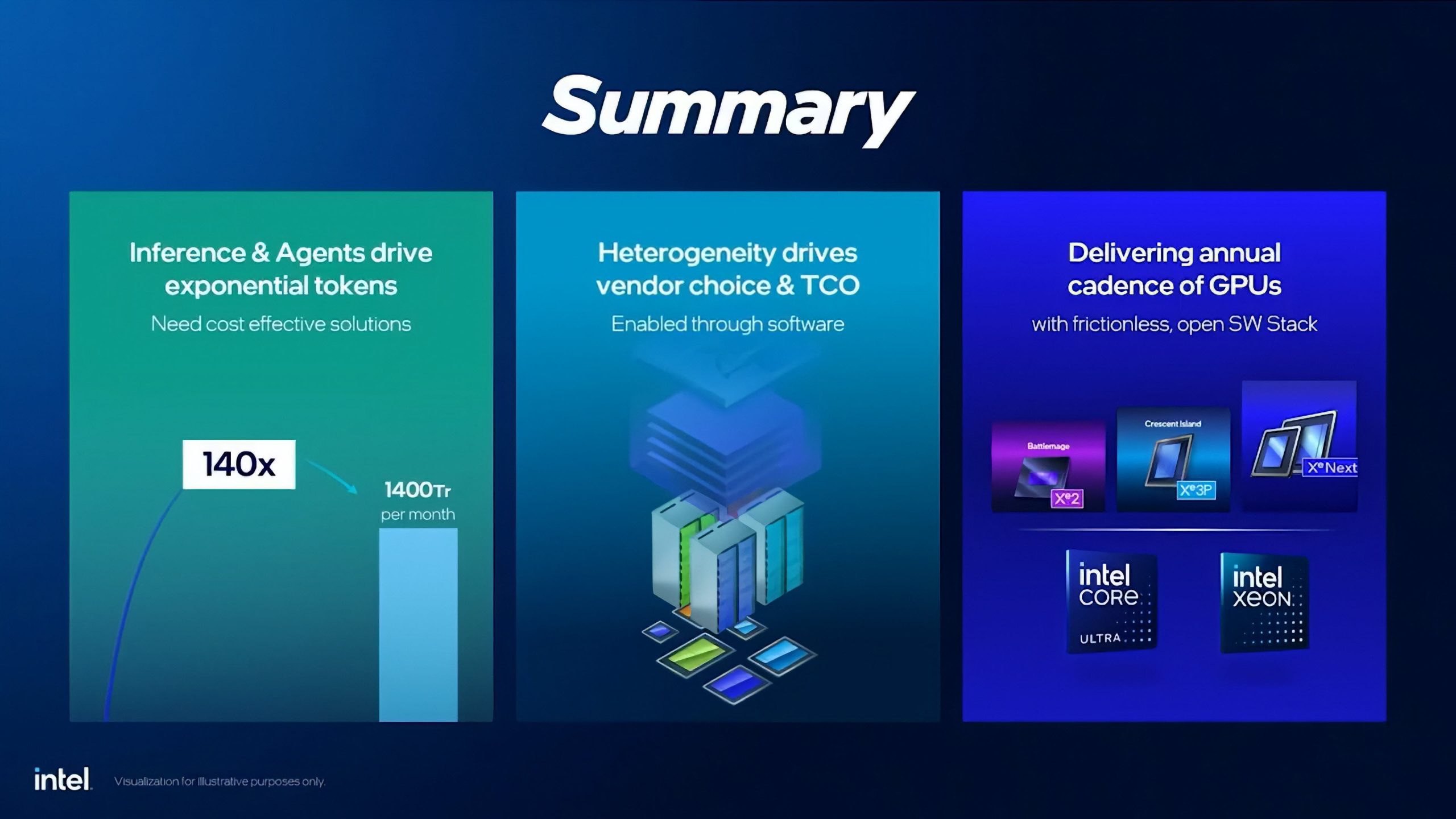
Intel Confirms Xe3P GPU Launch in 2026, Sets Clear Roadmap Through Xe Next in 2027

In the past few weeks, there have been plenty of talks about GPUs and Intel’s next moves in graphics. The Xe graphics division has been rumored to slow down in the past, but Intel seems to be doubling down instead. Just to be clear, the news is all about the future roadmap that could reshape AI and gaming hardware.

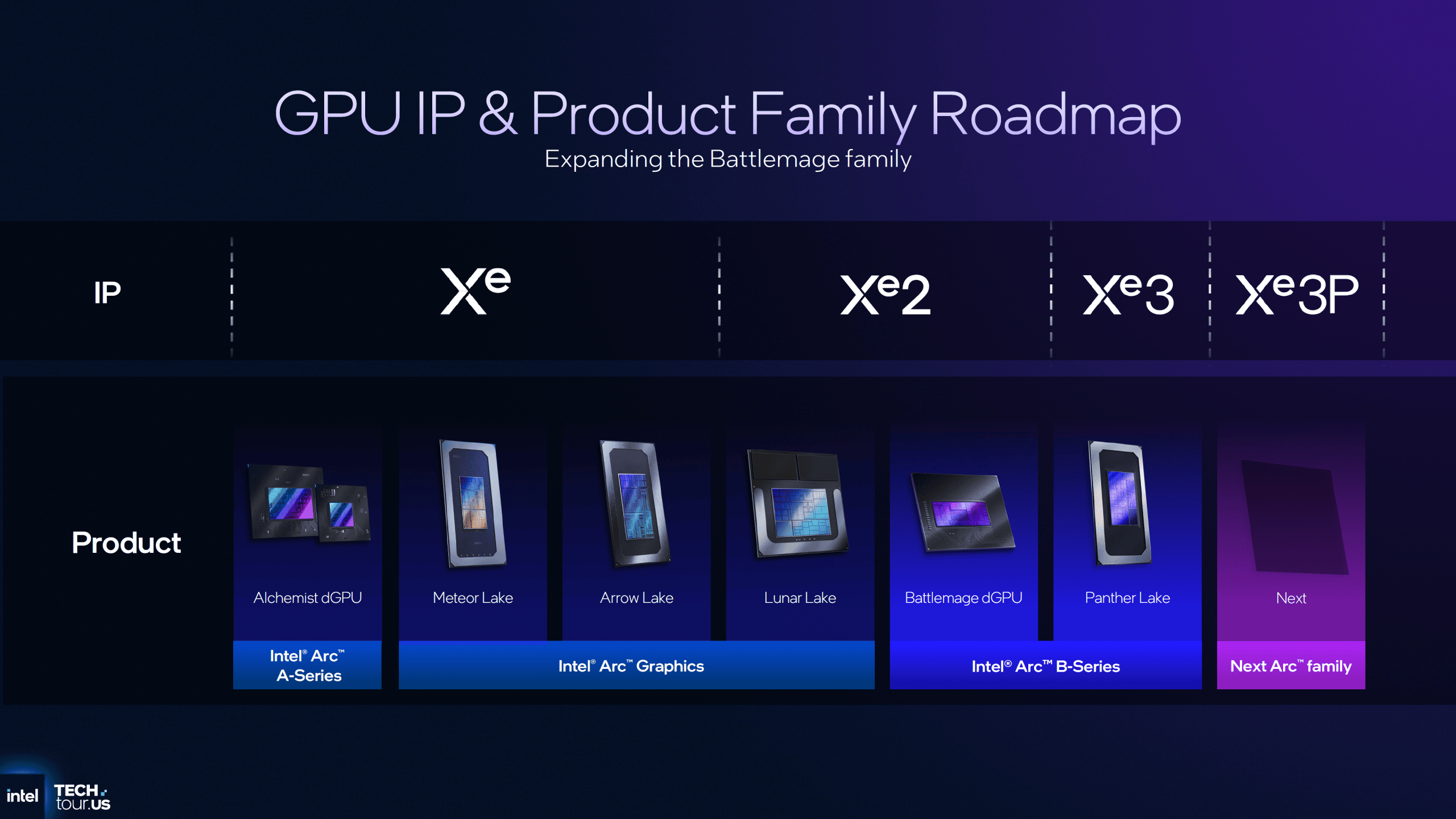
Intel confirms Xe3P and annual GPU roadmap for 2026

Folks at Wccftech have spotted Intel’s plans to launch Xe3P later this year. If you’re into high-performance computing, you’ll know GPUs aren’t just about raw power anymore. AI workloads, real-time rendering, and large-scale data center operations demand predictable performance. Xe3P is set to hit both desktops and AI inference platforms first, starting with Crescent Island, which reportedly uses LPDDR memory to balance cost with performance.

https://twitter.com/intel/status/2022358036040257762

Desktops will get Xe3P through the Nova Lake “Core Ultra Series 4” chips, though in a slightly reduced form. Laptops, on the other hand, may unlock the full potential of this architecture, replacing the current Panther Lake lineup.

Analysts say Xe3P builds on the current Xe3 family, which already beats previous Xe3 chips and even AMD’s RDNA 3.5 for mainstream platforms. And yes, it’s expected to hold Intel’s lead as AMD gears up RDNA 5.

Intel Xe Next in 2027

Intel’s roadmap doesn’t stop there. Xe Next, formerly Xe4, is slated for 2027, hinting at both AI inference-focused platforms like Jaguar Shores and next-gen client devices. For AI workloads, LPDDR memory will be used, while high-end Shores units could adopt HBM. On the client side, Intel plans to refresh its Arc lineup, moving from Arc B-Series to a new Arc C-Series (Celestial), covering integrated and discrete graphics.

While rumors suggested Intel might slow down GPU development, Xe3P and Xe Next show a company committed to annual updates. Predictable cadences mean developers and AI researchers can plan for hardware evolution without surprises. Partnerships with companies like NVIDIA complement Intel’s strategy, but do not replace it.

Sony May Delay PS6 Release to 2028 or 2029; Nintendo Switch 2 Could Face Price Hike This Year

Sony appears to be rethinking the timeline for its next-generation console as the global chip shortage shows no signs of slowing. With AI-driven demand pushing up prices for RAM, SSDs, and other critical components, even major console makers are feeling the pressure. Reports suggest the PlayStation 6 could see its debut pushed to 2028, or possibly 2029, well beyond earlier expectations.

PlayStation 6 delay looms amid chip shortages

According to Bloomberg, sources familiar with Sony’s plans said Sony Group Corp. is “considering pushing back the debut of its next PlayStation console to 2028 or even 2029” (via Wccftech). The decision has reportedly been taken as component costs have surged in recent months due to AI-driven demand for high-performance chips. This has resulted in making it difficult for manufacturers to secure parts at reasonable prices.

This wouldn’t be the first time the PS6 has been rumored to slip past the anticipated 2027 window. However, multiple recent reports suggest the delay can be a real possibility rather than a hypothetical scenario. Analysts say Sony may prefer a later launch over rushing production, which could lead to higher console prices or limited availability at launch.

Chip crisis hits Nintendo and Xbox as well

Sony isn’t the only company affected, as Bloomberg sources also indicate that Nintendo is considering raising the price of the Nintendo Switch 2 in 2026 due to the same supply pressures. Nintendo President Shuntaro Furukawa had previously suggested prices would remain stable unless unexpected external factors arose, but the current market volatility appears to qualify.

Meanwhile, the next-generation Microsoft Xbox is tentatively set for a 2027 launch, though some analysts warn that higher chip costs for the Magnus APU could make affordability a serious concern if the system hits store shelves too early.

As the chip shortage persists and AI demand continues to strain global supply chains, the rollout of next-gen consoles could be slower and more expensive than gamers had hoped.

NPR Host David Greene Sues Google Over Alleged Voice Resemblance in NotebookLM

Google’s NotebookLM has quickly become one of the most talked-about AI productivity tools on the market. Designed to turn documents into summaries, study guides, and even full podcast-style audio conversations, the feature that arguably stands out most is its AI-generated voice narration. However, that same voice narration may have just put Google into some legal trouble.

David Greene sues Google over NotebookLM’s voice

According to a report by The Washington Post, longtime NPR host David Greene is suing Google, claiming that the male AI podcast voice in NotebookLM closely mirrors his own (via TechCrunch). Greene, who previously hosted NPR’s “Morning Edition” and now leads “Left, Right, & Center” on KCRW, says friends, family, and colleagues began pointing out the resemblance shortly after the tool became famous.

He reportedly became convinced that the AI voice was copying his cadence, tone, and even subtle filler words like “uh.” “My voice is, like, the most important part of who I am,” Greene told the publication, highlighting the personal and professional value of vocal identity for broadcasters.

Google denies allegations

Google, however, has denied the allegation. A company spokesperson told The Washington Post that the NotebookLM voice is based on a paid professional actor and is not connected to Greene in any way. This isn’t the first time AI-generated voices have sparked controversy. Last year, OpenAI removed a ChatGPT voice after actress Scarlett Johansson raised concerns that it sounded too similar to her.

As AI voice tools grow more realistic, disputes like this may become more common, raising fresh questions about where inspiration ends and imitation begins.

PS6 Tipped to Skip Full RDNA 5 as Sony Explores Hybrid GPU Strategy to Keep Cost Down

Sony hasn’t officially acknowledged the PlayStation 6 (PS6) just yet. However, rumors around the upcoming console have already started brewing. If previous reports are accurate, we might not see the PS6 before 2027. However, in an extreme case, a 2030 launch is also possible. That said, nothing is confirmed as of now.

Speaking of rumors, earlier this month, popular tipster KeplerL2 previously hinted that the PS6 could feature up to 30GB of GDDR7 memory, a big jump from the 16GB GDDR6 found in the PlayStation 5. The rumored configuration reportedly uses a 160-bit memory bus capable of delivering up to 640GB/s of bandwidth, with 10 memory modules rated at 3GB each.

Fresh PS6 rumor suggest Sony might skip full RDNA 5 features

If accurate, that would give developers considerably more headroom for advanced rendering, larger open worlds, and AI-powered systems. However, not all of the speculation points to a straightforward upgrade. Recently, KeplerL2 also claimed that the PS6 won’t rely entirely on AMD’s upcoming RDNA 5 GPU architecture (via Notebookcheck). Much like the PlayStation 5, which blends RDNA 1 elements with ray-tracing enhancements, the next console is said to feature a hybrid GPU design rather than a full RDNA 5 implementation.

Elsewhere, we have also been hearing about rumors that the PS6 could pack up to 24GB of LPDDR5X memory, be dockable, and run PS5 titles, though it’s not expected to match the power of Sony’s main console.